
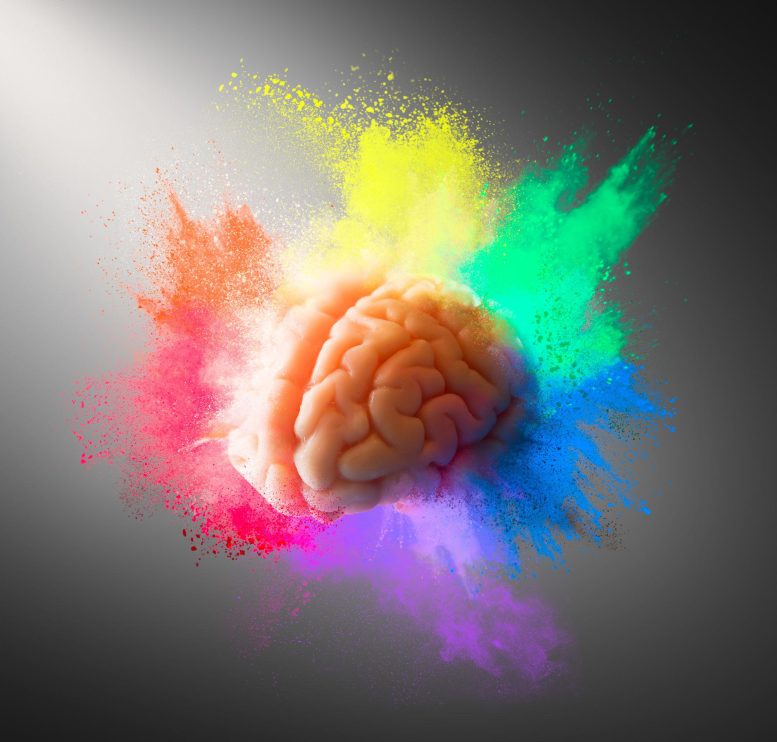
A recent study from the University of Arizona reveals that individuals with creative minds can find screen-free leisure time both productive and enjoyable.
A recent study from the University of Arizona, published in the Creativity Research Journal, indicates that individuals with a creative mindset tend to utilize their free time more effectively by engaging in mental exploration, allowing one thought to naturally progress to another.
The research discovered that those with higher creativity levels experienced less boredom while spending time alone in a room. Moreover, during the extended periods of unstructured time brought about by the COVID-19 pandemic, creative individuals reported feeling less bored and more mentally engaged.
“I am particularly interested in creativity because we wanted to know what’s going on in the mind of creative individuals, especially in situations where nothing constrains their thoughts,” said lead study author Quentin Raffaeli, a graduate student in the UArizona Department of Psychology.
In psychology and neuroscience, most studies on human thoughts either prompt participants to think in a certain way or ask them to report on thoughts they experienced, but less is known about how thoughts naturally arise and unfold over time in unprompted contexts, said Jessica Andrews-Hanna, an associate professor in the Department of Psychology and senior author of the paper.
“This is where our study comes in,” Andrews-Hanna said.
The Power of Solitude in Fostering Creativity
History is filled with anecdotes of famous scientists, artists, and philosophers who enjoyed being alone with their thoughts, and those people often generated some of their best ideas during idle time, Andrews-Hanna said.
“In today’s busy and digitally connected society, time to be alone with one’s thoughts without distraction may be becoming a rare commodity,” she added.
The researchers divided the study into two parts. For the first experiment, the researchers asked each participant to sit alone in a room for 10 minutes without any access to digital devices. In the absence of any particular prompt, the participants were asked to voice their thoughts aloud in real-time. The recorded files from 81 participants were then transcribed and analyzed.
The researchers assessed the participants’ creativity through a “divergent thinking test,” a lab-based verbal test that measures a person’s ability to think outside of the box. Participants who performed well in the divergent thinking test had thoughts that flowed freely and were associated with one another, often indicated by phrases such as “this reminds me of” or “speaking of which.”
How Creative Individuals Experience Time Alone
“While many participants had a tendency to jump between seemingly unrelated thoughts, creative individuals showed signs of thinking more associatively,” Raffaeli said.
The first experiment also found that creative people were more engaged in their thoughts when they were left alone without distractions, such as cell phones and the internet.
“Creative people rated themselves as being less bored, even over those 10 minutes. They also spoke more words overall, which indicated that their thoughts were more likely to move freely,” Andrews-Hanna said.
Creativity and Mental Engagement During the COVID-19 Pandemic
To complement their initial findings, the researchers extended their study in the context of a much larger span of time – the COVID-19 pandemic –when many people were alone with their thoughts more often.
For the second experiment, over 2,600 adults answered questions through a smartphone app called Mind Window, developed by Andrews-Hanna and her graduate student Eric Andrews. Participants who self-identified as being creative reported being less bored during the pandemic.
“As we become more overworked, overscheduled, and addicted to our digital devices, I think we need to do a better job in our homes, our workplaces, and our schools to cultivate time to simply relax with our thoughts,” Andrews-Hanna said.
The researchers are continuing this line of work using their Mind Window app. They encourage people to download and use the app to help scientists understand how people across the world think in their everyday lives.
“Understanding why different people think the way they do may lead to promising interventions to improve health and well-being,” Andrews-Hanna said.
Reference: “Creative Minds at Rest: Creative Individuals are More Associative and Engaged with Their Idle Thoughts” by Quentin Raffaelli, Rudy Malusa, Nadia-Anais de Stefano, Eric Andrews, Matthew D. Grilli, Caitlin Mills, Darya L. Zabelina and Jessica R. Andrews-Hanna, 23 June 2023, Creativity Research Journal.
DOI: 10.1080/10400419.2023.2227477
The study was funded by the National Institutes of Aging and the Arizona Alzheimer’s Consortium.
Never miss a breakthrough: Join the SciTechDaily newsletter.
Follow us on Google and Google News.