
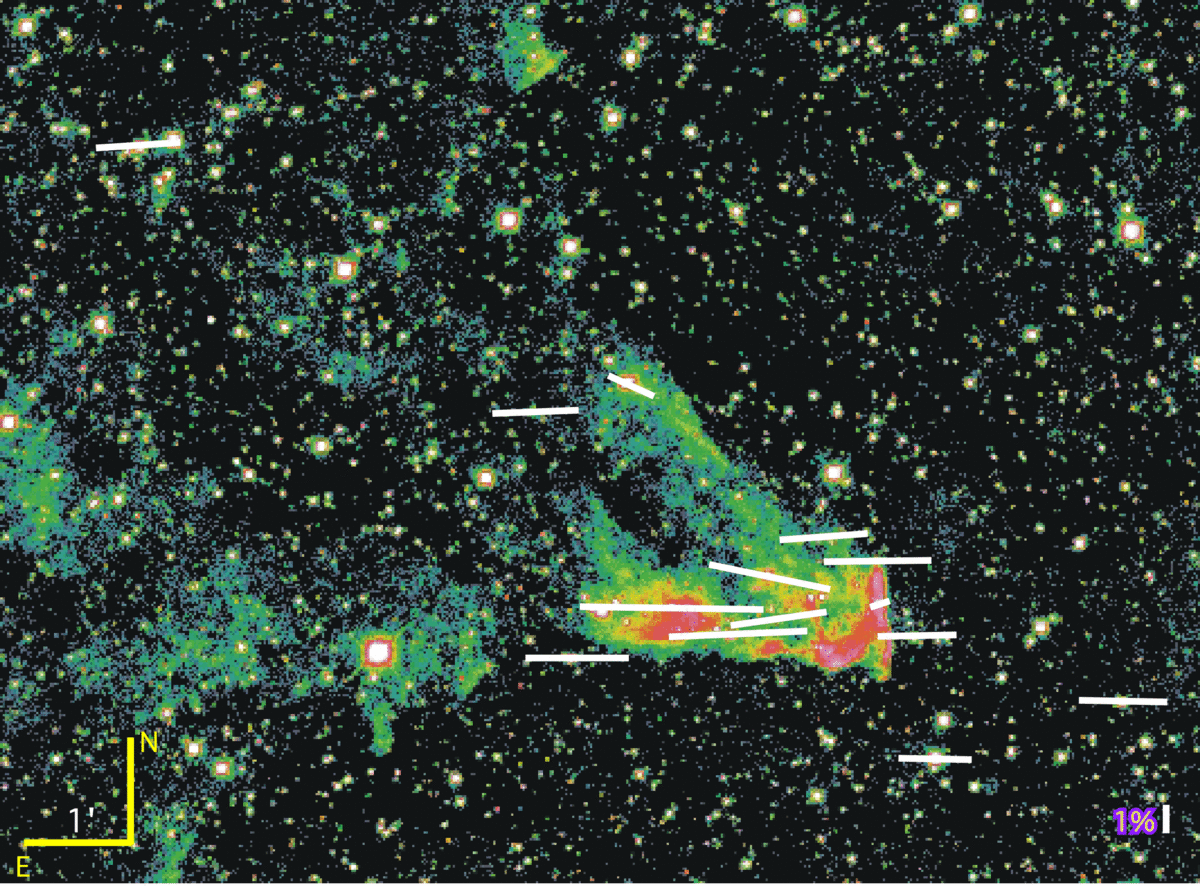
In a newly published study, astronomers report key observations that confirm a theory on how dust grains in interstellar space spin and organize themselves in the presence of magnetic fields to precisely align in key astrophysical environments.
For astrophysicists, the interplay of hydrogen — the most common molecule in the universe — and the vast clouds of dust that fill the voids of interstellar space has been an intractable puzzle of stellar evolution.
The dust, astronomers believe, is a key phase in the life cycle of stars, which are formed in dusty nurseries throughout the cosmos. But how the dust interacts with hydrogen and is oriented by the magnetic fields in deep space has proved a six-decade-long theoretical challenge.
Now, an international team of astronomers reports key observations that confirm a theory devised by University of Wisconsin-Madison astrophysicist Alexandre Lazarian and Wisconsin graduate student Thiem Hoang. The theory describes how dust grains in interstellar space, like soldiers in lock-drill formation, spin and organize themselves in the presence of magnetic fields to precisely align in key astrophysical environments.
The effort promises to untangle a theoretical logjam about key elements of the interstellar medium and underpin novel observational tactics to probe magnetic fields in space.
The new observations, conducted by a team led by B-G Andersson of the Universities Space Research Association (USRA), and their theoretical implications are reported in the October 1, 2013 edition of the Astrophysical Journal. The observations were conducted using a variety of techniques — optical and near-infrared polarimetry, high-accuracy optical spectroscopy and photometry, and sensitive imaging in the near-infrared — at observatories in Spain, Hawaii, Arizona, and New Mexico.
“We need to understand grain alignment if we want to make use of polarimetry as a means of investigating interstellar magnetic fields,” says Lazarian, who was encouraged to attack the problem by the renowned astrophysicist Lyman Spitzer. “Spitzer himself worked on the problem extensively.”
Scientists have long known that starlight becomes polarized as it shines through clouds of neatly aligned, rapidly spinning grains of interstellar dust. And the parsing of polarized light is a key observational technique. But how the grains of dust interact with hydrogen, become aligned so that starlight shining through becomes polarized, and are set spinning has been a mystery.
“While interstellar polarization has been known since 1949, the physical mechanisms behind grain alignment have been poorly understood until recently,” explains Andersson. “These observations form part of a coordinated effort to — after more than 60 years — place interstellar grain alignment on a solid theoretical and observational footing.”
The observations made by Andersson and his colleagues support an analytical theory posed by Lazarian and Hoang known as Radiative Alignment Torque, which describes how irregular grains can be aligned by their interaction with magnetic fields and stellar radiation. Under the theory, grains are spun, propeller-like, by photons. Their alignment is modified by magnetic fields, which orients them with respect to the field, telling an observer its direction. Impurities and defects on the dust grains produce catalytic sites for the formation of hydrogen molecules, which are subsequently ejected, creating miniature “rocket engines,” also called “Purcell thrusters” after Nobel laureate Edwin Purcell, who studied grain alignment.
The theory devised by Lazarian and Hoang predicts how the molecular hydrogen thrust changes grain alignment, and was put to the test by Andersson’s team of observers.
Confirming the theory, Lazarian notes, not only helps explain how interstellar dust grains align, but promises a new ability for astronomers to use polarized visible and near-infrared light to reliably probe the strength and structure of magnetic fields in interstellar space, a notoriously difficult phenomenon to measure quantitatively.
Interstellar magnetic fields are ubiquitous in spiral galaxies like our Milky Way and are believed to be essential regulators of star formation and the evolution of proto-planetary disks. They also control the regulation and propagation of cosmic rays.
The murky piece of the astrophysical puzzle, says Lazarian, was how the irregular grains of interstellar dust were set in spinning motion. The observations conducted by Andersson demonstrate that intense molecular hydrogen formation on the surface of the interstellar dust grains is an important contributor to the dust grains spinning.
Hydrogen does not exist in the element’s gas phase in space since the two atoms of the molecule cannot rid themselves of the formation reaction energy without a third body. The two hydrogen atoms therefore use the surfaces of dust grains as a substrate, and the force of the reaction energy is enough to set the dust grains in motion.
The new work, which was supported by the National Science Foundation, is especially timely, Lazarian says, as two new observatories — the ground-based ALMA, the Atacama Large Millimeter Array, and the space-based Planck Telescope — are poised to build on the new results.
Reference: “Evidence for H2 Formation Driven Dust Grain Alignment in IC 63” by B-G Andersson, V. Piirola, J. De Buizer, D. P. Clemens, A. Uomoto, M. Charcos-Llorens, T. R. Geballe, A. Lazarian, T. Hoang and T. Vornanen, 6 September 2013, The Astrophysical Journal.
DOI: 10.1088/0004-637X/775/2/84
Never miss a breakthrough: Join the SciTechDaily newsletter.
Follow us on Google and Google News.
1 Comment
Stellar magnetism is a known phenomena. Spherical bodies like Earth, planets
Stars etc are magnetic in nature due to the core plasma they have. Magnetic field should be felt in the inter-stellar space also. Next to Hydrogen, the most stable element formed in the space is Iron, the evidence of which can be had from the mateorites. Iron dust in the space should align themselves in the stellar magnetic field to form asteroids and mateors first and then precipitate on planets whose inner cores already have the magnetic elements like Iron and Nickel.Thank You.