

Decoding the Optical Response of Nonlinear Scattering Media: A Leap Toward Highly Scalable Physical Operators
Is it possible to see through a scattering medium such as ground glass? Traditionally, this would be considered impossible. When light passes through an opaque substance, the information carried within the light becomes “jumbled up”, almost as if undergoes complex encryption.
Recently, a remarkable scientific breakthrough by Professor Choi Wonshik’s team from the IBS Center for Molecular Spectroscopy and Dynamics (IBS CMSD) has unveiled a method to leverage this phenomenon in the fields of optical computing and machine learning.
Since 2010, several previous studies have attempted to harness information lost due to scattering media, such as biological tissues, using mathematics. This has been typically done by employing optical operators such as linear scattering matrices, which can be used to determine the input-output relationships of photons as they undergo scattering.
This topic has been of primary research interest for Professor Choi’s team from the IBS CMSD, which published many works that combine both hardware and software-based adaptive optics for tissue imaging. Some of their work was demonstrated in new types of microscopes that can see through scattering medium with high opacity, such as mouse skulls, as well as perform deep 3D imaging of tissues.
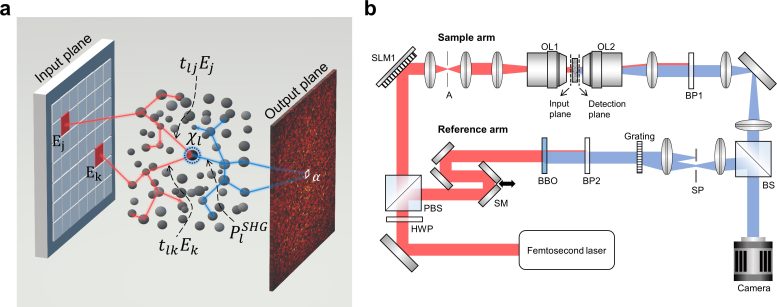
However, things become much more complex when nonlinearity enters the equation. If a scattering medium generates nonlinear signals, it can no longer be represented simply by a linear matrix, as the principle of superposition is violated. Moreover, measuring the nonlinear input-output characteristics becomes a daunting challenge, setting a demanding stage for research.
Unraveling the Mystery of Nonlinear Scattering Media
This time, Professor Choi’s team has achieved yet another scientific breakthrough. They became the first to discover that the optical input-output response of a nonlinear scattering medium can be defined by a third-order tensor, as opposed to a linear matrix.
Third-order tensor is a mathematical object used to represent relationships between three sets of data. In simple terms, it is an array of numbers arranged in a three-dimensional structure. Tensors are generalizations of scalars (0th-order tensors), vectors (1st-order tensors), and matrices (2nd-order tensors) and are commonly used in various fields of mathematics, physics, and engineering to describe physical quantities and their relationships.
To demonstrate this, the team utilized a medium comprised of barium titanate nanoparticles, which generate nonlinear second harmonic generation (SHG) signals due to the inherent noncentrosymmetric properties of barium titanate. These SHG signals emerge as a square of the input electric field through the second harmonic process, causing cross-terms when multiple input channels are activated simultaneously, disrupting the linear superposition principle. The researchers devised and experimentally validated a novel theoretical framework involving these cross-terms in a third-order tensor.
To illustrate this, the researchers measured cross-terms by isolating the difference between the output electric fields produced when two input channels were activated simultaneously, and when each channel was activated separately. This necessitated an additional 1,176 measurements set by the possible combinations of two independent input channels, even with just 49 input channels.
“The effort required to detect cross-terms from weak nonlinear signals was significant,” noted Dr. Moon Jungho, the study’s lead author.
Real-World Applications Unleashed
The tensor derived from the nonlinear scattering medium has a higher rank than matrices of linear scattering media, hinting at its potential as a scalable physical operator. The team demonstrated this through the real-world implementation of nonlinear optical encryption and all-optical logic gates.
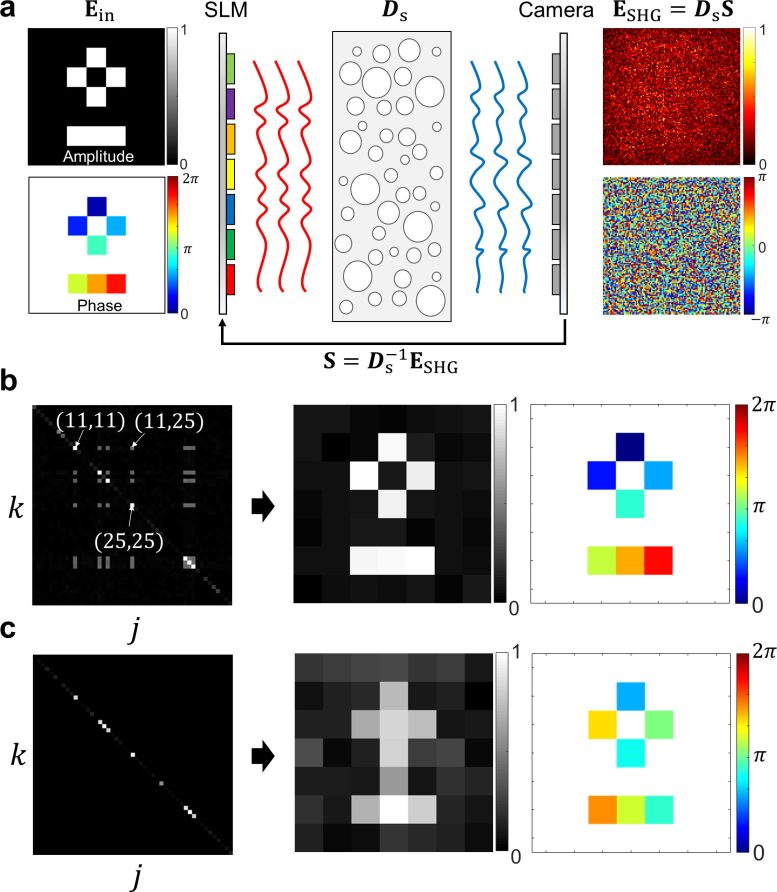
First, the team successfully demonstrated that nonlinear scattering media can be used for the optical encryption process. When specific image information is inputted into the media, the output second harmonic wave signals are displayed as random patterns, akin to a series of encryption processes.
Conversely, by performing an inverse operation of the third-order tensor representation of the second harmonic wave, the original input information can be retrieved through a decryption process. Utilizing the inverse operation of the tensor input-output response, they decoded original signals from randomly encoded SHG signals, which offers enhanced security over standard optical encryption that uses linear scattering media.
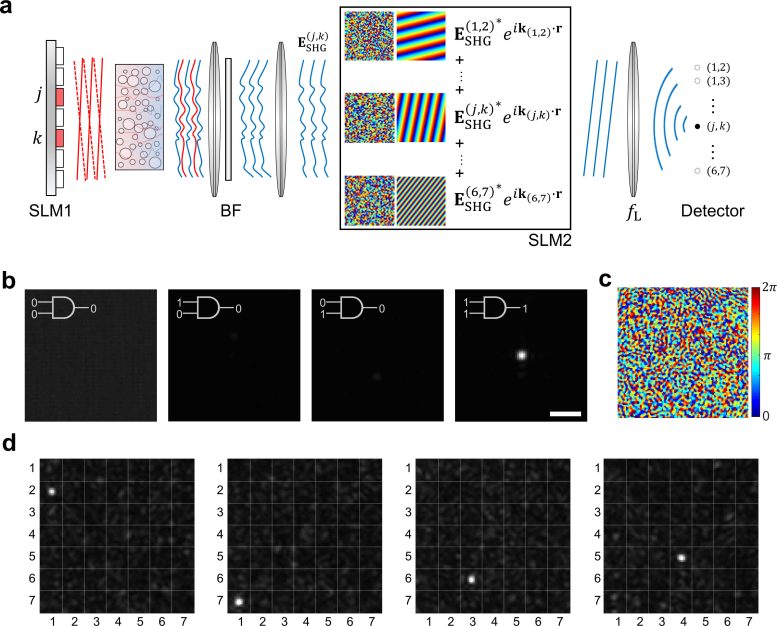
Furthermore, the integration of digital phase conjugation allowed the researchers to showcase all-optical AND logic gates that activate only when two specific input channels are simultaneously activated. This approach offers potential advantages over silicon-based logic, including reduced energy consumption and light-speed parallel processing capabilities.
This research is expected to open up new frontiers in the realms of optical computing and machine learning. “In the burgeoning field of all-optical machine learning, nonlinear optical layers are key in enhancing model performance. We are currently investigating how our research could be integrated into this field,” stated Professor Choi.
Reference: “Measuring the scattering tensor of a disordered nonlinear medium” by Jungho Moon, Ye-Chan Cho, Sungsam Kang, Mooseok Jang and Wonshik Choi, 31 July 2023, Nature Physics.
DOI: 10.1038/s41567-023-02163-8
The study was funded by the Institute for Basic Science.
Never miss a breakthrough: Join the SciTechDaily newsletter.
Follow us on Google and Google News.