
Close Menu
    Facebook X (Twitter) Instagram
    SciTechDaily
    • Biology
    • Chemistry
    • Earth
    • Health
    • Physics
    • Science
    • Space
    • Technology
    Facebook X (Twitter) Pinterest YouTube RSS
    SciTechDaily
    Home»Physics»Physicists Amplify Light Using Sound on a Silicon Chip
    Physics

    Physicists Amplify Light Using Sound on a Silicon Chip

    By Jim Shelton, Yale UniversityJune 13, 20161 Comment3 Mins Read
    Facebook Twitter Pinterest Telegram LinkedIn WhatsApp Email Reddit
    Share
    Facebook Twitter LinkedIn Pinterest Telegram Email Reddit
    Scientists Amplify Light Using Sound on a Silicon Chip
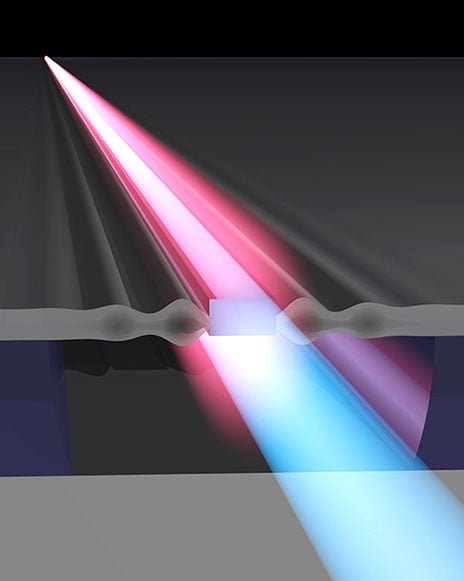
    Physicists have achieved a breakthrough by harnessing the power of sound to amplify the intensity of light waves on a silicon microchip.

    A team of physicists has discovered a way to greatly boost the intensity of light waves on a silicon microchip using the power of sound.

    In a study to be published in the journal Nature Photonics, a team led by Peter Rakich describes a new waveguide system that harnesses the ability to precisely control the interaction of light and sound waves. This work solves a long-standing problem of how to utilize this interaction in a robust manner on a silicon chip as the basis for powerful new signal-processing technologies.

    The prevalence of silicon chips in today’s technology makes the new system particularly advantageous, the researchers note. “Silicon is the basis for practically all microchip technologies,” said Rakich, who is an assistant professor of applied physics and physics at Yale. “The ability to combine both light and sound in silicon permits us to control and process information in new ways that weren’t otherwise possible.”

    Rakich said combining the two capabilities “is like giving a UPS driver an amphibious vehicle — you can find a much more efficient route for delivery when traveling by land or water.”

    These opportunities have motivated numerous groups around the world to explore such hybrid technologies on a silicon chip. However, progress was stifled because those devices weren’t efficient enough for practical applications. The Yale group lifted this roadblock using new device designs that prevent light and sound from escaping the circuits.

    “Figuring out how to shape this interaction without losing amplification was the real challenge,” said Eric Kittlaus, a graduate student in Rakich’s lab and the study’s first author. “With precise control over the light-sound interaction, we will be able to create devices with immediate practical uses, including new types of lasers.”

    The researchers said there are commercial applications for the technology in a number of areas, including fiber-optic communications and signal processing. The system is part of a larger body of research the Rakich lab has conducted for the past five years, focused on designing new microchip technologies for light.

    Heedeuk Shin, a former member of the Rakich lab who is now a professor at the Pohang University of Science and Technology in Korea, is the study’s other co-author. “We’re glad to help advance these new technologies, and are very excited to see what the future holds,” Shin said.

    The work was supported by the MesoDynamic Architectures program at the U.S. Department of Defense’s Defense Advanced Research Projects Agency (DARPA).

    Reference: “Large Brillouin Amplification in Silicon” by Eric A. Kittlaus, Heedeuk Shin and Peter T. Rakich, 13 June 2016, Nature Photonics.
    DOI: 10.1038/nphoton.2016.112
    arXiv:1510.08495

    Never miss a breakthrough: Join the SciTechDaily newsletter.
    Follow us on Google and Google News.

    Photonics Yale University
    Share. Facebook Twitter Pinterest LinkedIn Email Reddit

    Related Articles

    Physicists Use Laser Light to Cool Traveling Sound Waves in Silicon Chips

    Scientists Demonstrate New Method to Control the Behavior of Light

    New Type of Silicon Laser Uses Sound Waves to Amplify Light

    Yale Engineers Advance Quantum Technology With Photon Control

    Chip-Scale Device Enables Yale Engineers to ‘See Without Looking’

    Metamaterials Amplify the Photonic Spin Hall Effect

    Study Shows Graphene is Highly Efficient in Converting Light to Electricity

    Researchers Use Powerful X-Rays To “Supercharge” Atoms

    Yale Physicists Take Significant Step in the Development of Quantum Computing

    1 Comment

    1. Gregory on August 5, 2016 6:40 pm

      Awesome let the water flow!

      Reply
    Leave A Reply Cancel Reply

    • Facebook
    • Twitter
    • Pinterest
    • YouTube

    Don't Miss a Discovery

    Subscribe for the Latest in Science & Tech!

    Trending News

    Scientists Recreate a Nuclear Fireball and Uncover Fallout’s Hidden Chemistry

    These Tiny Gut Particles Could Be Accelerating Aging Throughout the Body

    Doctors Changed One Thing and Weight Gain Stopped

    Magnetic Fields May Solve a Longstanding Binary Star Mystery

    The Probiotic Breakthrough for Natural Anxiety Relief and Better Mental Health

    Animal vs. Plant Protein: Scientists Found a Surprising Nutritional Difference

    According to Scientists, This Simple Dietary Change Is Linked to Lower Depression Scores

    Researchers Discover a Hidden Vitamin D Problem That Persists Year-Round

    Follow SciTechDaily
    • Facebook
    • Twitter
    • YouTube
    • Pinterest
    • Newsletter
    • RSS
    SciTech News
    • Biology News
    • Chemistry News
    • Earth News
    • Health News
    • Physics News
    • Science News
    • Space News
    • Technology News
    Recent Posts
    • Mini Brain Organoids Expose Hidden Biological Differences in Alzheimer’s Disease
    • Scientists Recommend Doing This To Reduce Anxiety During Pregnancy
    • Scientists Reveal What Happened When 12 People Were Trapped Together in Antarctica for 10 Months
    • Buried for 1.7 Billion Years: These Ancient Fossils May Rewrite the Story of Complex Life
    • NASA Spots Giant Ocean Swell Signaling a Potential El Niño Comeback
    Copyright © 1998 - 2026 SciTechDaily. All Rights Reserved.
    • Science News
    • About
    • Contact
    • Editorial Board
    • Privacy Policy
    • Terms of Use

    Type above and press Enter to search. Press Esc to cancel.