
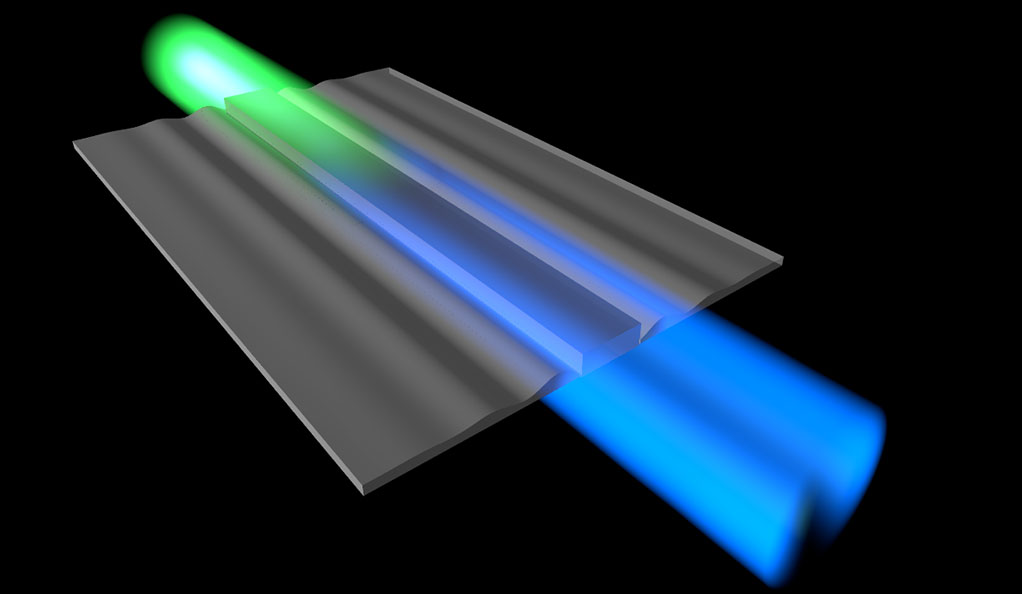
Yale scientists have discovered that laser light can be used to cool traveling sound waves in a silicon chip. Their findings appear in the November 27 online edition of the journal Physical Review X.
In the last several decades, the ability to cool clouds of atoms using laser light has revolutionized atomic physics, leading to the discovery of new states of matter and better atomic clocks. Laser cooling relies on the fact that photons, or light particles, carry momentum and can exert a force on other objects.
These techniques have recently been adapted to slow down, or cool, mechanical oscillators comprised of billions of atoms. This type of cooling has become an enabling technique for exploring the quantum properties of mechanical objects and reducing forms of noise that would otherwise corrupt precision measurement.
Yale researchers have extended these phenomena by showing how light can be used to cool sound waves traveling within solid materials. To do this, the researchers developed a special type of nano-scale silicon structure that allows propagating light and sound waves to interact.
“By tailoring the optical and acoustic properties of these waveguides, we’ve been able to enhance and shape the interaction between light and sound,” said Peter Rakich, an associate professor of applied physics at Yale who led the research. “This is the key that allows us to reduce the energy carried by thermally excited sound waves.”
When a photon interacts with sound waves propagating in a solid, it scatters to different colors of light. When the photon becomes red-shifted, it loses a portion of its energy, imparting it to the sound wave. Simultaneously, the light absorbs the acoustic energy and carries it away as a blue-shifted photon. This second process slows the motion of the sound wave, bringing it to a lower effective temperature.
Normally these two opposing processes would counteract and balance out. However, Yale researchers designed a waveguide in which a certain group of sound waves only experience the cooling process. “We call this symmetry breaking, and it’s the essential ingredient for the cooling process to dominate,” said Eric Kittlaus, a Yale Ph.D. student and co-author of the study.
First author Nils Otterstrom, a Yale Ph.D. student, noted that the researchers were surprised by the strength of the cooling effect. He said it led the team to develop a rigorous theoretical framework for understanding the phenomena, as well as coming up with systematic experimental studies.
“We now have a knob that allows us to control processes that are at the heart of emerging chip-scale technology, including new types of lasers, gyroscopes, and signal processing systems,” Otterstrom said.
Added Rakich, “We are really excited about where this work may lead. We now have the ability to tame and control noise in a large range of systems that are crucial to communication, information processing, and measurement in a way that we never had before.”
Reference: “Optomechanical Cooling in a Continuous System” by Nils T. Otterstrom, Ryan O. Behunin, Eric A. Kittlaus and Peter T. Rakich, 27 November 2018, Physical Review X.
DOI: 10.1103/PhysRevX.8.041034
Former Yale researcher Ryan Behunin, who is now at Northern Arizona University, is a co-author of the study.
Never miss a breakthrough: Join the SciTechDaily newsletter.
Follow us on Google and Google News.