
Close Menu
    Facebook X (Twitter) Instagram
    SciTechDaily
    • Biology
    • Chemistry
    • Earth
    • Health
    • Physics
    • Science
    • Space
    • Technology
    Facebook X (Twitter) Pinterest YouTube RSS
    SciTechDaily
    Home»Space»Scientists Discover Two Gravitationally Lensed Quasars
    Space

    Scientists Discover Two Gravitationally Lensed Quasars

    By TYLER JUMP, HARVARD-SMITHSONIAN CENTER FOR ASTROPHYSICSNovember 28, 2018No Comments3 Mins Read
    Facebook Twitter Pinterest Telegram LinkedIn WhatsApp Email Reddit
    Share
    Facebook Twitter LinkedIn Pinterest Telegram Email Reddit
    Gravitationally Lensed Quasars
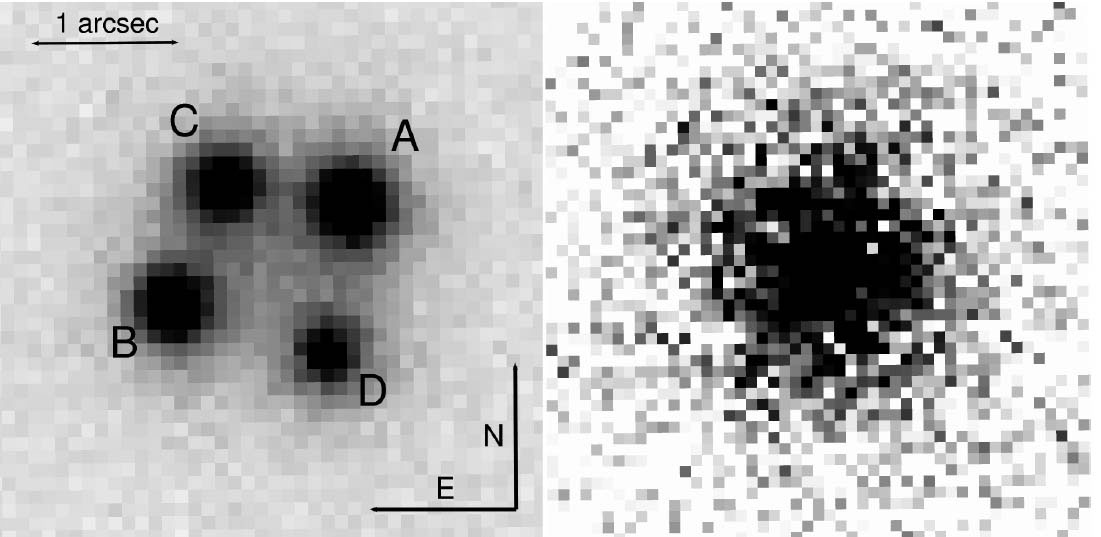
    (left) A near-infrared image of a quasar whose light has been traveling for about 10 billion years and which has been distorted by an intervening galaxy into a reimaged (gravitationally lensed) set of four images of the same quasar. The right frame shows the faint intervening galaxy after subtraction of the four quasar images.

    The path of light is bent by mass, an effect predicted by Einstein’s theory of gravity, and when a massive galaxy or cluster lies along our line of sight to a more distant galaxy its matter will act as a lens to image the light from that object. So-called strong gravitational lensing creates highly distorted, magnified, and often multiple images of a single source. (Strong lensing is distinct from weak lensing which results in moderately deformed shapes of background galaxies.)

    Quasars are galaxies with massive black holes at their cores around which vast amounts of energy are being radiated, more than from the rest of the entire host galaxy. Their luminosities allow quasars to be seen at cosmological distances and they are therefore likely candidates for strong lensing, with a few hundred gravitationally lensed quasars known so far. They have provided valuable information not only about quasars and lensing but also on cosmology since the distorted light paths of the distant objects have traveled across cosmological distances.

    CfA astronomer David James was a member of a large international team systematically searching for new gravitationally lensed quasars. They used the WISE infrared all-sky survey to search for candidates whose infrared colors suggested they were galaxies with active nuclei (like quasars). They processed images of these candidates with a sophisticated algorithm looking for evidence of their being multiple components, such as would be expected from a lensed system, and then followed up this subset with spectroscopic and ground-based imaging observations using higher spatial resolution than WISE. Of the original set of fifty-four candidates, they found two whose spectra confirmed that they were gravitationally lensed quasars, one with four sub-images and one with two, each of whose light has been traveling towards us for about ten billion years. The images in these two cases also showed traces of the lensing galaxy, an important verification of the lensing effect, although the galaxies were too faint to obtain measurements of their distances. The scientists also identified another seven objects that are likely to be doubled-quasars, but further research is needed to confirm those results.

    Reference: “The STRong lensing Insights into the Dark Energy Survey (STRIDES) 2016 Follow-up Campaign – II. New quasar lenses from double component fitting”  by T Anguita, P L Schechter, N Kuropatkin, N D Morgan, F Ostrovski, L E Abramson, A Agnello, Y Apostolovski, C D Fassnacht, J W Hsueh, V Motta, K Rojas, C E Rusu, T Treu, P Williams, M Auger, E Buckley-Geer, H Lin, R McMahon, T M C Abbott, S Allam, J Annis, R A Bernstein, E Bertin, D Brooks, D L Burke, A Carnero Rosell, M Carrasco-Kind, J Carretero, C E Cunha, C B D’Andrea, J De Vicente, D L DePoy, S Desai, H T Diehl, P Doel, B Flaugher, J García-Bellido, D W Gerdes, D Gruen, R A Gruendl, J Gschwend, W G Hartley, D L Hollowood, K Honscheid, D J James, K Kuehn, M Lima, M A G Maia, R Miquel, A A Plazas, E Sanchez, V Scarpine, M Smith, M Soares-Santos, F Sobreira, E Suchyta, G Tarle and A R Walker, 9 August 2018, MNRAS.
    DOI: 10.1093/mnras/sty2172

    Never miss a breakthrough: Join the SciTechDaily newsletter.
    Follow us on Google and Google News.

    Astronomy Astrophysics Cosmology Popular
    Share. Facebook Twitter Pinterest LinkedIn Email Reddit

    Related Articles

    “Cannibal Stars” and Black Holes May Have Formed in the Universe’s First Second

    What If Einstein Was Only Half Right? NASA’s New Test for Dark Energy

    New Theory Suggests We’ve Been Looking for Dark Matter All Wrong

    Dark Matter and Dark Energy Don’t Exist, New Study Claims

    The Hunt for Dark Matter Has a New, Surprising Target

    Scientists Just Found a Way to Simulate the Universe on a Laptop

    New Measurements Show We May Live in a Giant “Cosmic Void”

    Webb’s Mysterious “Little Red Dots” May Be the Cradle of the First Black Holes

    Webb Telescope Spots Oldest Black Hole, Shattering Cosmic Records

    Leave A Reply Cancel Reply

    • Facebook
    • Twitter
    • Pinterest
    • YouTube

    Don't Miss a Discovery

    Subscribe for the Latest in Science & Tech!

    Trending News

    Scientists Discover Stem Cells That Could Regrow Teeth and Bone

    Early Cannabis Use May Stall Key Brain Skills in Teens

    Popular Vitamin D Supplement Has “Previously Unknown” Negative Effect, Study Finds

    Study Reveals Malaria’s Hidden Role in Human Evolution

    The Hidden Risk of Taking Breaks From Weight-Loss Drugs Like Ozempic

    Scientists Warn That This Common Pet Fish Can Wreck Entire Ecosystems

    Scientists Make Breakthrough in Turning Plastic Trash Into Clean Fuel Using Sunlight

    This Popular Supplement May Interfere With Cancer Treatment, Scientists Warn

    Follow SciTechDaily
    • Facebook
    • Twitter
    • YouTube
    • Pinterest
    • Newsletter
    • RSS
    SciTech News
    • Biology News
    • Chemistry News
    • Earth News
    • Health News
    • Physics News
    • Science News
    • Space News
    • Technology News
    Recent Posts
    • Beyond Inflammation: Scientists Uncover New Cause of Persistent Rheumatoid Arthritis
    • Cancer-Like Mutations Found in the Brain May Be Driving Alzheimer’s Disease
    • A Simple Molecule Could Unlock Safer, Easier Weight Loss
    • Stretching Diamonds Unlocks Powerful New Quantum Sensing Abilities
    • This Robot Could Explore Mars 3x Faster Than Today’s Rovers
    Copyright © 1998 - 2026 SciTechDaily. All Rights Reserved.
    • Science News
    • About
    • Contact
    • Editorial Board
    • Privacy Policy
    • Terms of Use

    Type above and press Enter to search. Press Esc to cancel.