
Close Menu
    Facebook X (Twitter) Instagram
    SciTechDaily
    • Biology
    • Chemistry
    • Earth
    • Health
    • Physics
    • Science
    • Space
    • Technology
    Facebook X (Twitter) Pinterest YouTube RSS
    SciTechDaily
    Home»Health»Researchers Use ‘Trojan Horse’ to Kill Deadly Antibiotic-Resistant Bacteria
    Health

    Researchers Use ‘Trojan Horse’ to Kill Deadly Antibiotic-Resistant Bacteria

    By Nagoya UniversitySeptember 20, 20191 Comment3 Mins Read
    Facebook Twitter Pinterest Telegram LinkedIn WhatsApp Email Reddit
    Share
    Facebook Twitter LinkedIn Pinterest Telegram Email Reddit
    Fighting Antibiotic-Resistant Bacteria
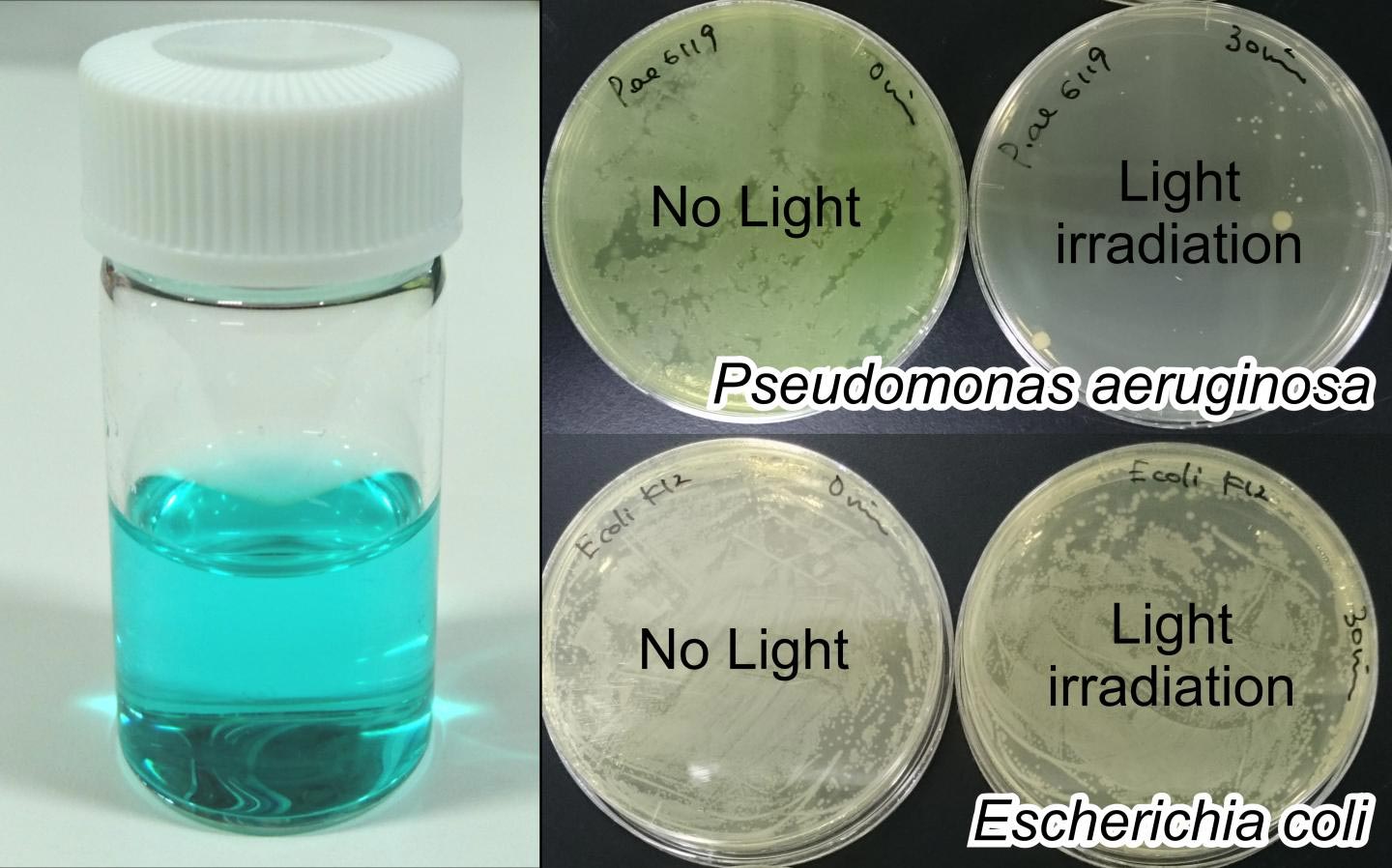
    Nagoya University researchers and colleagues in Japan have demonstrated a new strategy in fighting antibiotics resistance: the use of artificial haem proteins as a Trojan horse to selectively deliver antimicrobials to target bacteria, enabling their specific and effective sterilization. The technique killed 99.9% of Pseudomonas aeruginosa, a potentially deadly, antibiotic-resistant bacterium present in hospitals. This image shows a solution of the extracellular heme acquisition system protein A (HasA) with gallium phthalocyanine (Left) and the results of sterilization of Pseudomonas aeruginosa and Escherichia coli treated with HasA-bound gallium phthalocyanine by irradiation with near-infrared light (Right). Credit: Osami Shoji

    New strategy developed to kill pathogens resistant to antibiotics.

    A potentially deadly, antibiotic-resistant bacterium present in hospitals, can be killed by hijacking its haem-acquisition system to selectively deliver antimicrobials; the strategy should also work for other dangerous bacteria. The new strategy, developed by Nagoya University researchers and colleagues in Japan, was published in the journal ACS Chemical Biology.

    Pseudomonas aeruginosa is a dangerous bacterium that causes infections in hospital settings and in people with weakened immune systems. It can cause blood infections and pneumonia, while severe infections can be deadly. Highly resistant to antibiotic treatment, P. aeruginosa is one of the most critical pathogens urgently requiring alternative treatment strategies, according to the World Health Organization.

    This bacterium is one of many that have evolved a system that allows them to acquire difficult-to-access iron from the human body. Iron is essential for bacterial growth and survival, but in humans, most of it is held up within the ‘haem’ complex of haemoglobin. To get hold of it, P. aeruginosa and other bacteria secrete a protein, called HasA, which latches onto haem in the blood. This complex is recognized by a membrane receptor on the bacterium called HasR, permitting haem entry into the bacterial cell, while HasA is recycled to pick up more haem.

    Bioinorganic chemist Osami Shoji of Nagoya University and collaborators have found a way to hijack this ‘haem acquisition system’ for drug delivery. They developed a powder formed of HasA and the pigment gallium phthalocyanine (GaPc), which, when applied to a culture of P. aeruginosa, was consumed by the bacteria.

    “When the pigment is exposed to near-infrared light, harmful reactive oxygen species are generated inside the bacterial cells,” explains Shoji. When tested, over 99.99% of the bacteria were killed following treatment with one micromolar of  HasA with GaPc and ten minutes of irradiation.

    The strategy also worked on other bacteria with the HasR receptor on their membranes, but not on ones without it.

    The haem acquisition system is so essential to these bacteria’s survival that it is not expected to change, making it unlikely the bacteria will develop resistance to this drug strategy, the researchers believe.

    “Our findings support the use of artificial haem proteins as a Trojan horse to selectively deliver antimicrobials to target bacteria, enabling their specific and effective sterilization, irrespective of antibiotic resistance,” the team reports in their study.

    The researchers next aim to test their strategy for treating infections, and are working on modifying their approach for sterilizing other pathogens that possess a similar haem acquisition system.

    ###

    Reference: “Hijacking the Heme Acquisition System of Pseudomonas aeruginosa for the Delivery of Phthalocyanine as an Antimicrobial” by Yuma Shisaka, Yusuke Iwai, Shiho Yamada, Hiromu Uehara, Takehiko Tosha, Hiroshi Sugimoto, Yoshitsugu Shiro, Joshua K. Stanfield, Kazuya Ogawa, Yoshihito Watanabe and Osami Shoji, 9 July 2019, ACS Chemical Biology.
    DOI: 10.1021/acschembio.9b00373

    Never miss a breakthrough: Join the SciTechDaily newsletter.
    Follow us on Google and Google News.

    Antibiotics Bacteria Drugs Nagoya University
    Share. Facebook Twitter Pinterest LinkedIn Email Reddit

    Related Articles

    Failure Against “Nightmare Bacteria” a Chilling Commentary on Future of Antibiotics – “Much of Modern Medicine May Become Infeasible”

    Engineers Program Viruses as a New Weapon to Combat Infection

    Warning: Antibiotic-Resistant Bacteria Spread by Washing Machines

    New Strategy Makes Bacteria More Vulnerable to Antibiotics

    New Research Shows Antibiotics Work Differently Than Thought

    MIT Scientists Develop New Method to Deliver Beneficial Bacteria to the GI Tract

    Biologists Reverse Bacterial Resistance to Antibiotics

    Engineered Liposomes: A Possible Alternative to Antibiotics

    UCSD Biologists Develop New Method for Identifying Antibiotics

    1 Comment

    1. Dr Anil Nayyar on September 20, 2019 7:41 pm

      Highly informative articles & very useful site.Short of words for appriciation.

      Reply
    Leave A Reply Cancel Reply

    • Facebook
    • Twitter
    • Pinterest
    • YouTube

    Don't Miss a Discovery

    Subscribe for the Latest in Science & Tech!

    Trending News

    Millions Take These IBS Drugs, But a New Study Finds Serious Risks

    Scientists Unlock Hidden Secrets of 2,300-Year-Old Mummies Using Cutting-Edge CT Scanner

    Bread Might Be Making You Gain Weight Even Without Eating More Calories

    Scientists Discover Massive Magma Reservoir Beneath Tuscany

    Europe’s Most Active Volcano Just Got Stranger – Here’s Why Scientists Are Rethinking It

    Alzheimer’s Symptoms May Start Outside the Brain, Study Finds

    Millions Take This Popular Supplement – Scientists Discover a Concerning Link to Heart Failure

    The Universe Is Expanding Too Fast and Scientists Can’t Explain Why

    Follow SciTechDaily
    • Facebook
    • Twitter
    • YouTube
    • Pinterest
    • Newsletter
    • RSS
    SciTech News
    • Biology News
    • Chemistry News
    • Earth News
    • Health News
    • Physics News
    • Science News
    • Space News
    • Technology News
    Recent Posts
    • Doctors Surprised by the Power of a Simple Drug Against Colon Cancer
    • Why Popular Diabetes Drugs Like Ozempic Don’t Work for Everyone: The “Genetic Glitch”
    • Scientists Create Improved Insulin Cells That Reverse Diabetes in Mice
    • Scientists Stunned After Finding Plant Thought Extinct for 60 Years
    • A Common Diabetes Drug May Hold the Key to Stopping HIV From Coming Back
    Copyright © 1998 - 2026 SciTechDaily. All Rights Reserved.
    • Science News
    • About
    • Contact
    • Editorial Board
    • Privacy Policy
    • Terms of Use

    Type above and press Enter to search. Press Esc to cancel.