
Close Menu
    Facebook X (Twitter) Instagram
    SciTechDaily
    • Biology
    • Chemistry
    • Earth
    • Health
    • Physics
    • Science
    • Space
    • Technology
    Facebook X (Twitter) Pinterest YouTube RSS
    SciTechDaily
    Home»Technology»Reversing Baldness by Wearing a Hat – New Low-Cost Hair Growth Technology
    Technology

    Reversing Baldness by Wearing a Hat – New Low-Cost Hair Growth Technology

    By Sam Million-Weaver, University of Wisconsin-MadisonSeptember 19, 20192 Comments3 Mins Read
    Facebook Twitter Pinterest Telegram LinkedIn WhatsApp Email Reddit
    Share
    Facebook Twitter LinkedIn Pinterest Telegram Email Reddit
    Hair Regrowing Device
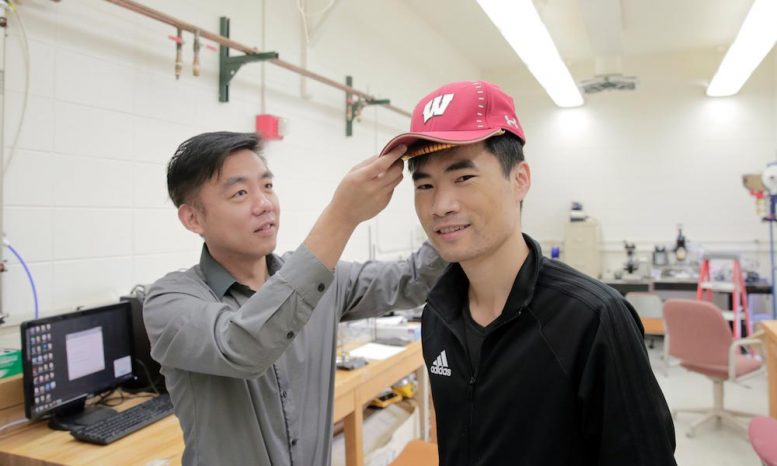
    UW-Madison Materials Science and Engineering Professor Xudong Wang (left) and colleagues developed a device — unobtrusive enough to fit under a cap — that harnesses energy from the wearer and delivers gentle electric pulses to stimulate dormant hair follicles and regrow hair. Credit: UW-Madison photo by Sam Million-Weaver.

    Few things on earth strike fear into the hearts of men more profoundly than hair loss. But reversing baldness could someday be as easy as wearing a hat, thanks to a noninvasive, low-cost hair-growth-stimulating technology developed by engineers at the University of Wisconsin–Madison.

    “I think this will be a very practical solution to hair regeneration,” says Xudong Wang, a professor of materials science and engineering at UW–Madison.

    Wang and colleagues published a description of the technology in the journal ACS Nano.

    Based on devices that gather energy from a body’s day-to-day motion, the hair-growth technology stimulates the skin with gentle, low-frequency electric pulses, which coax dormant follicles to reactivate hair production.

    The devices don’t cause hair follicles to sprout anew in smooth skin. Instead, they reactivate hair-producing structures that have gone dormant. That means they could be used as an intervention for people in the early stages of pattern baldness, but they wouldn’t bestow cascading tresses to someone who has been as bald as a billiard ball for several years.

    Because the devices are powered by the movement of the wearer, they don’t require a bulky battery pack or complicated electronics. In fact, they’re so low-profile that they could be discreetly worn underneath the crown of an everyday baseball cap.

    Electric Hair Regrow Device
    The device, right, is shown along with a baseball cap used to cover it. Credit: UW-Madison photo by Alex Holloway.

    Wang is a world expert in the design and creation of energy-harvesting devices. He has pioneered electric bandages that stimulate wound-healing and a weight-loss implant that uses gentle electricity to trick the stomach into feeling full.

    The hair-growth technology is based on a similar premise: Small devices called nanogenerators passively gather energy from day-to-day movements and then transmit low-frequency pulses of electricity to the skin. That gentle electric stimulation causes dormant follicles to “wake up.”

    “Electric stimulations can help many different body functions,” says Wang. “But before our work, there was no really good solution for low-profile devices that provide gentle but effective stimulations.”

    Because the electric pulses are incredibly gentle and won’t penetrate any deeper than the very outermost layers of the scalp, the devices don’t seem to cause any unpleasant side effects. That’s a marked advantage over other baldness treatments, like the medicine Propecia, which carries risks of sexual dysfunction, depression, and anxiety.

    What’s more, in side-by-side tests on hairless mice, the devices stimulated hair growth just as effectively as two different compounds found in baldness medicines.

    “It’s a self-activated system, very simple and easy to use,” says Wang. “The energy is very low so it will cause minimal side effects.”

    The researchers have patented the concept with the Wisconsin Alumni Research Foundation, and they hope to move forward with human testing soon.

    Reference: “Self-Activated Electrical Stimulation for Effective Hair Regeneration via a Wearable Omnidirectional Pulse Generator” by Guang Yao, Dawei Jiang, Jun Li, Lei Kang, Sihong Chen, Yin Long, Yizhan Wang, Peng Huang, Yuan Lin, Weibo Cai and Xudong Wang, 10 September 2019, ACS Nano.
    DOI: 10.1021/acsnano.9b03912

    Never miss a breakthrough: Join the SciTechDaily newsletter.
    Follow us on Google and Google News.

    Biomedical Hair University of Wisconsin-Madison
    Share. Facebook Twitter Pinterest LinkedIn Email Reddit

    Related Articles

    Hair Regeneration: AI Helps Design Baldness Treatment That Works Better Than Testosterone or Minoxidil

    “Erasure” – New Discovery Could Be the Key to Practical Quantum Computing

    Do the Twist: Making 2D Quantum Materials Using Curved Surfaces

    Printed Electronics Enables Electrified Tattoos and Personalized Biosensors

    Spray Painting Fiber Bandages Onto Wounds With Biomedical Electrospinning Device

    New Adhesive Binds Wet Surfaces in Seconds – Could Replace Surgical Sutures

    Not Spiderwebs – These Electrospun Fibers Weave New Medical Innovations

    New Graphene Sensors Could Provide Unprecedented Insights into Brain Structure

    Cheap, Oxide-Based Materials Boost Promise of Hydrogen Fuel

    2 Comments

    1. Laura Hoffman on September 21, 2019 12:47 pm

      So How Much Does This Hair Stuff Cost?

      Reply
    2. Sabrina on September 21, 2019 8:23 pm

      How would one get on the list to be a part of the human testing part?

      Reply
    Leave A Reply Cancel Reply

    • Facebook
    • Twitter
    • Pinterest
    • YouTube

    Don't Miss a Discovery

    Subscribe for the Latest in Science & Tech!

    Trending News

    Monster Storms on Jupiter Unleash Lightning Beyond Anything on Earth

    Scientists Create “Liquid Gears” That Spin Without Touching

    The Simple Habit That Could Help Prevent Cancer

    Millions Take These IBS Drugs, But a New Study Finds Serious Risks

    Scientists Unlock Hidden Secrets of 2,300-Year-Old Mummies Using Cutting-Edge CT Scanner

    Bread Might Be Making You Gain Weight Even Without Eating More Calories

    Scientists Discover Massive Magma Reservoir Beneath Tuscany

    Europe’s Most Active Volcano Just Got Stranger – Here’s Why Scientists Are Rethinking It

    Follow SciTechDaily
    • Facebook
    • Twitter
    • YouTube
    • Pinterest
    • Newsletter
    • RSS
    SciTech News
    • Biology News
    • Chemistry News
    • Earth News
    • Health News
    • Physics News
    • Science News
    • Space News
    • Technology News
    Recent Posts
    • Simple Blood Test May Predict Alzheimer’s Years Before Brain Scans Show Signs
    • Scientists Say Adding This Unusual Seafood to Your Diet Could Reverse Signs of Aging
    • U.S. Waste Holds $5.7 Billion Worth of Crop Nutrients
    • Scientists Say a Hidden Structure May Exist Inside Earth’s Core
    • Doctors Surprised by the Power of a Simple Drug Against Colon Cancer
    Copyright © 1998 - 2026 SciTechDaily. All Rights Reserved.
    • Science News
    • About
    • Contact
    • Editorial Board
    • Privacy Policy
    • Terms of Use

    Type above and press Enter to search. Press Esc to cancel.