
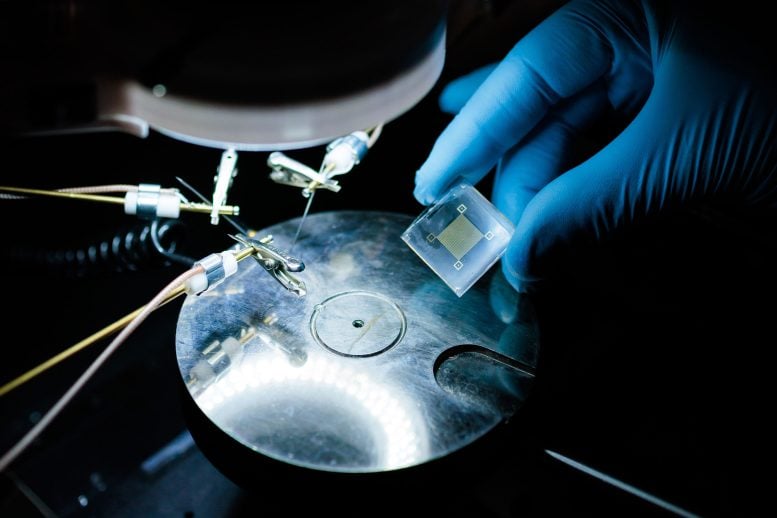
Researchers developed a flexible AI computing patch that analyzes health data directly on the body, enabling near-instant medical insights and highly accurate heart monitoring.
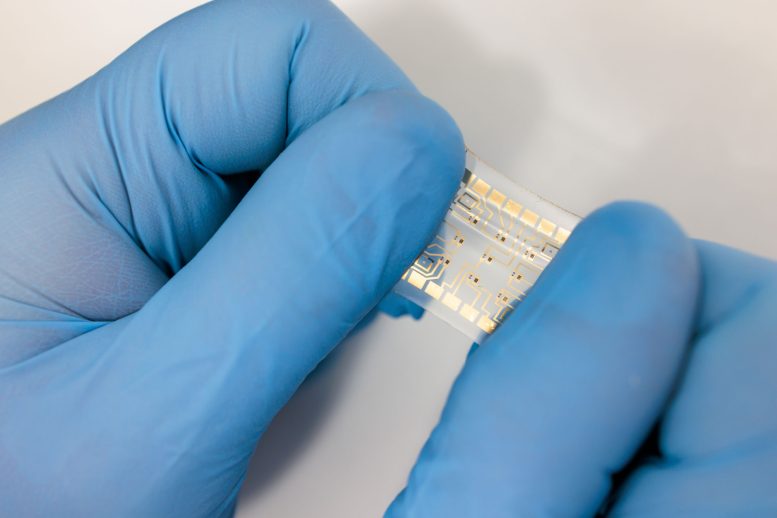
Researchers at the University of Chicago Pritzker School of Molecular Engineering (UChicago PME) have created a skin-like computing patch that can process health data using artificial intelligence directly on the body. Unlike conventional wearable devices, the patch performs AI calculations in milliseconds without needing to send information over a wireless connection.
Most smartwatches can monitor metrics such as heart rate and movement, but the actual data analysis takes place on external servers. That delay can be problematic in situations where every millisecond matters, such as detecting ventricular fibrillation, a life-threatening heart rhythm disorder.
Developed and tested with researchers at Argonne National Laboratory, the new device was made possible by manufacturing techniques that allow organic electrochemical transistors to be printed onto flexible materials.
“The future that we’re trying to realize is to make wearable and implantable devices smarter,” said Sihong Wang, an associate professor of molecular engineering at UChicago PME and co-senior author of the new study, published in Nature Electronics. “It’s helping people have a personal, instantaneous doctor integrated into their devices.”
Stretchable Neuromorphic Computing for Human Tissues
Wang’s laboratory has spent years developing electronic components that can stretch and flex like human skin, with the goal of creating intelligent devices that can attach directly to biological tissues. Previous achievements included stretchable transistor arrays and a stretchable OLED display.
For this project, the researchers aimed to build a stretchable neuromorphic computing circuit, a large network of transistors capable of analyzing health information. Earlier studies had shown that the idea could work with a limited number of transistors, but scaling it to a practical system remained a challenge.
Organic Electrochemical Transistors Mimic Brain Synapses
The team chose organic electrochemical transistors, which operate differently from the transistors found in conventional computer chips. These devices process information through both electrical currents and the movement of ions within a gel-like electrolyte layer. Because the electrolyte can retain information over time, each transistor effectively has its own memory, similar to the way brain synapses strengthen or weaken to store learned patterns.
Building these devices was not straightforward. The flexible substrate is sensitive to heat and solvents, making standard chip manufacturing methods unsuitable. The gel electrolyte also tends to flow like a liquid, allowing neighboring devices to merge and potentially create short circuits.
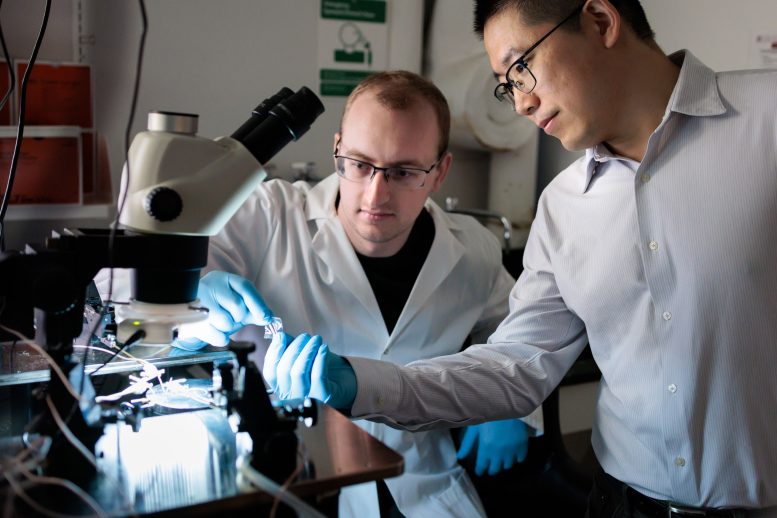
“What we had to ask was whether we could use or change the properties of these polymers to make them compatible with photolithography—the main patterning method used in the microelectronics industry,” Wang said.
Breakthrough Manufacturing Method Scales Flexible Electronics
To overcome these obstacles, the researchers developed a polymer gel that hardens into precise structures when exposed to ultraviolet light. The technique allows the fabrication of up to 10,000 organic electrochemical transistors per square centimeter (about 64,500 per square inch).
“As computer scientists, we’re used to thinking of a neural network weight as just a number,” said Zixuan Zhao, a graduate student at UChicago CS and co-first author of the study. “In hardware, it’s a material—with variability, history, and physical limits. The challenge was to hold those constraints in mind and still compute with enough precision to matter.”
Real-Time Heart Rhythm Mapping in Milliseconds
To evaluate the technology, the team used a stretchable transistor array to run a pretrained algorithm designed to support the treatment of ventricular fibrillation. This dangerous condition causes chaotic electrical activity in the heart and can be fatal. Current treatment often relies on delivering a powerful shock to the entire heart, but researchers have proposed a more targeted approach that tracks abnormal electrical waves and applies small corrective pulses before the waves spread.
The challenge is speed. These electrical wavefronts move through the heart so rapidly that the analysis must be completed within milliseconds, making remote processing impractical.
“This is a situation where it’s not feasible to have remote computing. It just takes too long,” said Wang. “But if you have a computing device that can do the analysis within the body, it could be possible.”
High-Accuracy Health Risk Prediction on the Body
Using cardiac mapping data from a donated human heart, the researchers demonstrated that the stretchable array could identify wavefront locations with 99.6% accuracy, even when stretched to more than one and a half times its original length.
In another test, a neural network encoded within the array analyzed vital signs and personal health information, including cholesterol levels, blood sugar, maximum heart rate, and ECG measurements, to estimate heart attack risk. The system achieved an accuracy rate of 83.5%.
Wang believes the computing array could become part of a fully integrated health monitoring platform. His team is now working to combine the technology with stretchable wireless communication systems and more advanced sensors, creating devices that can collect, analyze, and respond to health data in real time.
“Instead of sending data away to a remote server, we can begin making sense of it right where life is happening,” said Fangfang Xia, a computer scientist at Argonne National Laboratory and co-senior author of the study.
Reference: “A large-scale stretchable neuromorphic circuit for on-body edge computing” by Songsong Li, Zixuan Zhao, Max Weires, Shiyu Hu, Yang Li, Lingfeng Tang, Shilei Dai, Yahao Dai, Youdi Liu, Nan Li, Wei Liu, Naisong Shan, Junyi Yin, Xiaoao Shi, Sean Sutyak, Cheng Zhang, Jie Xu, Junhong Chen, Yuepeng Zhang, Igor R. Efimov, Fangfang Xia and Sihong Wang, 20 May 2026, Nature Electronics.
DOI: 10.1038/s41928-026-01639-8
This work and the researchers involved were supported by the US Office of Naval Research (N00014-21-1- 2266, N00014-21-1-2581), the University of Chicago Joint Task Force Initiative, the National Institutes of Health (1DP2EB034563, R01-HL141470, R01 HL165002), Argonne National Laboratory, the U.S. Department of Energy (DE-AC02-06CH11357, DE‐SC0014664), the Leducq Foundation, and the CZ Biohub.
Never miss a breakthrough: Join the SciTechDaily newsletter.
Follow us on Google and Google News.