
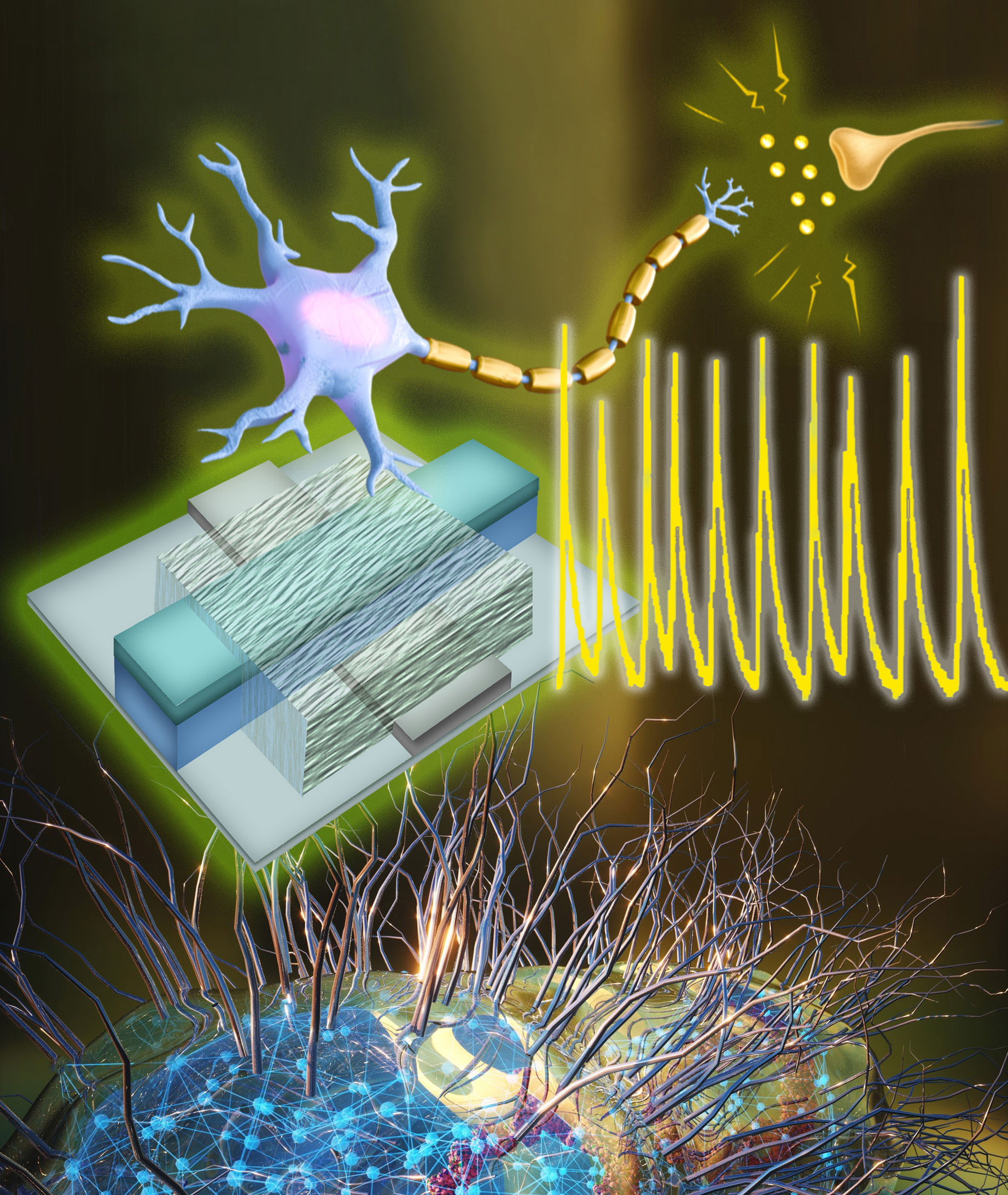
Built from low-powered protein nanowires made by bacteria, these neurons could enable vastly more efficient, bio-inspired computers.
Engineers at the University of Massachusetts Amherst have developed an artificial neuron that behaves strikingly like its natural counterpart. The breakthrough builds on earlier research in which the team created protein nanowires from electricity-producing bacteria. Their new discovery suggests the possibility of designing computers that are far more energy-efficient and capable of directly interacting with living cells.
“Our brain processes an enormous amount of data,” says Shuai Fu, a graduate student in electrical and computer engineering at UMass Amherst and lead author of the study published in Nature Communications. “But its power usage is very, very low, especially compared to the amount of electricity it takes to run a Large Language Model, like ChatGPT.”
In terms of efficiency, the human body leaves current technology far behind. The brain contains billions of neurons, specialized cells responsible for sending and receiving electrical signals throughout the body. Despite this complexity, it requires only about 20 watts of power to perform tasks such as writing a story. By contrast, a large language model may draw well over a megawatt of electricity to accomplish the same activity.
The Efficiency Challenge
While electrical and computer engineers have long been interested in using artificial neurons as the circuitry for more efficient computers, the problem has always been how to keep their voltage low enough. “Previous versions of artificial neurons used 10 times more voltage—and 100 times more power—than the one we have created,” says Jun Yao, associate professor of electrical and computer engineering at UMass Amherst and the paper’s senior author. That means that previous attempts at creating artificial neurons weren’t all that efficient, nor could they plug directly into living neurons, which would be frightened by the increased amplitude.
“Ours register only 0.1 volts, which is about the same as the neurons in our bodies,” says Yao.
There are a wide range of applications for Fu and Yao’s new neuron, from redesigning computers along bio-inspired, and far more efficient principles, to electronic devices that could speak to our bodies directly.
“We currently have all kinds of wearable electronic sensing systems,” says Yao, “but they are comparatively clunky and inefficient. Every time they sense a signal from our body, they have to electrically amplify it so that a computer can analyze it. That intermediate step of amplification increases both power consumption and the circuit’s complexity, but sensors built with our low-voltage neurons could do without any amplification at all.”
The secret ingredient in the team’s new low-powered neuron is a protein nanowire synthesized from the remarkable bacteria Geobacter sulfurreducens, which also has the superpower of producing electricity. Yao, along with various colleagues, have used the bacteria’s protein nanowires to design a whole host of extraordinary efficient devices: a biofilm, powered by sweat, that can power personal electronics; an “electronic nose” that can sniff out disease; and a device, which can be built of nearly anything, that can harvest electricity from thin air itself.
Reference: “Constructing artificial neurons with functional parameters comprehensively matching biological values” by Shuai Fu, Hongyan Gao, Siqi Wang, Xiaoyu Wang, Trevor Woodard, Zhien Wang, Jing Kong, Derek R. Lovley and Jun Yao, 29 September 2025, Nature Communications.
DOI: 10.1038/s41467-025-63640-7
This research was supported by the Army Research Office, the U.S. National Science Foundation, the National Institutes of Health and the Alfred P. Sloan Foundation.
Never miss a breakthrough: Join the SciTechDaily newsletter.
Follow us on Google and Google News.
1 Comment
Impressive but no discussion of fault tolerance or scaling that I could find…some of the efficient devices mentioned are proposals/inventions.