
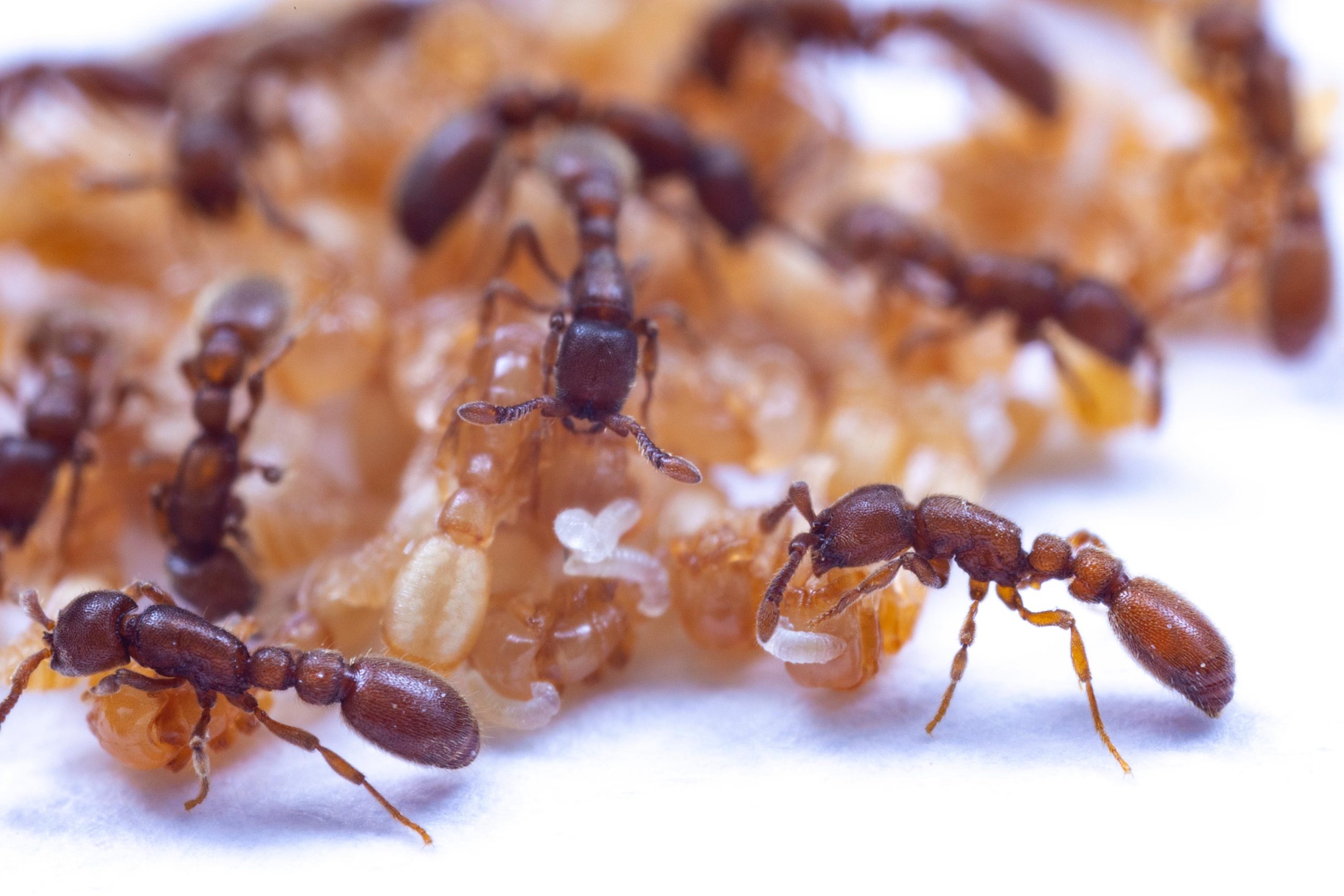
Ants rely on an extraordinary sense of smell to build and organize their societies. Each of their neurons can detect only one specific scent, a rule that keeps their chemical messages clear.
Scientists studying the clonal raider ant have now discovered how this works: each neuron activates one odor gene while silencing all the others. The finding reveals a hidden genetic process that helps ants communicate, survive, and evolve their complex social systems.
Ant Societies Built on Scent
Ant societies rely on scent to function. Pheromones help them find food, alert each other to danger, and coordinate the daily life of their colonies. This chemical language depends on a simple biological rule: one receptor per neuron. Inside an ant’s genome are hundreds of odorant receptor genes, each responsible for detecting specific smells. If a single neuron were to activate more than one receptor, the signals reaching the brain would overlap and blur, destroying the ant’s precise sense of smell.
Researchers studying the clonal raider ant have now uncovered how each neuron chooses just one receptor from hundreds of options. Their work, published in Current Biology, resolves a long-standing question about how ants preserve clarity in their chemical communication system.
“We’re describing a new form of gene regulation,” says Daniel Kronauer, head of the Laboratory of Social Evolution and Behavior at Rockefeller. “Our results demonstrate the importance of studying less conventional model species. We were able to discover new, fundamental molecular phenomena in clonal raider ants that we could not have seen in fruit flies.”
The Dogma of Smell
A key rule in the science of smell is that every sensory neuron must have its own molecular identity. “It’s a kind of dogma in the field of sensory neuroscience,” says Giacomo Glotzer, a graduate student in the Kronauer lab. “Each sensory neuron typically expresses one receptor—and that gives it its identity.”
Different organisms achieve this one-to-one pairing in distinct ways. In fruit flies, molecular switches precisely turn individual genes on or off so that only one receptor is expressed per neuron. Mammals use a more unpredictable system, in which neurons randomly reorganize their chromatin until just one receptor gene remains active.
Until now, it was unclear whether ants followed a method similar to flies or mammals, or something entirely their own. Unlike fruit flies, which have about 60 receptor genes, ants possess several hundred—numbers closer to those of mammals. Many of these genes are grouped into clusters of nearly identical sequences, making it difficult to activate one without unintentionally triggering others. Such genetic crowding means the straightforward approach used by fruit flies would not work for ants, implying that these social insects have evolved a unique way to preserve their “one receptor, one neuron” balance.
Hunting for the Ant Strategy
Building on a foundational paper on the subject that the team had published in 2023, the lab set out to capture this elusive mechanism in action. After dissecting the antennal tissue of clonal raider ants, the team then used RNA sequencing, to determine which genes were turned on, and RNA fluorescence in situ hybridization, to localize those genes in the ant antenna. They then used numerous cutting-edge molecular and computational techniques to create a clear image of one chosen receptor surrounded by its quieted neighbors.
They found that, when an ant neuron switches on its chosen receptor gene, it doesn’t stop there. The RNA polymerase—the engine that copies the DNA into RNA—continues past that gene’s normal endpoint, spilling into the genes that sit downstream of the target. These “readthrough” transcripts remain trapped in the nucleus, likely because they lack the unique tag required for export. The authors speculate that these transcripts are non-functional, but that their production itself is what silences downstream genes. Meanwhile, the neuron also generates “antisense” RNAs in the other direction. The polymerase here acts as a roadblock to silence upstream genes that might otherwise have turned on.
The result is a protective genetic shield around the chosen receptor gene.
“When we took the mechanism apart and dissected it into its constituent parts, we found that this strategy serves to silence the local genomic environment, giving that cell its singular receptor identity,” says Parviz Daniel Hejazi Pastor, a biomedical fellow in the Kronauer lab. “Our findings center around transcriptional interference—that the neuron chooses one receptor by preventing the true transcription of other receptors both upstream and downstream.”
Beyond Clonal Raider Ants
The team went on to confirm that this same mechanism is at work in other social insects, including the Indian jumping ant and the honeybee. These findings raise the possibility that many insects, both social and non-social, use transcriptional interference to maintain a 1:1 ratio between receptors and neurons. “This mechanism may be even more broadly distributed than we thought, particularly among insect species with large repertoires of olfactory receptor genes” Kronauer says. “It’s even possible that fruit flies are the odd ones out.”
The implications extend far beyond insect olfaction. By showing that tight clusters of related genes can be governed by two-way safeguards—readthrough that quiets downstream neighbors and antisense transcription that blocks upstream ones—this work offers a blueprint for how genomes might keep large gene families in check. The results also point to a potential mechanism for explaining how ants quickly expand their sense of smell over relatively short evolutionary time. The findings described in this paper might allow newly duplicated receptor genes to be integrated into a sensory system without the need to coevolve additional regulatory mechanisms.
“Once you have the system in place like this, you can allow it to become more complex without disrupting anything,” Kronauer says. “We speculate that this kind of gene regulatory system contributes to allowing the ants to evolve new olfactory receptors so quickly.”
Reference: “Transcriptional interference gates monogenic odorant receptor expression in ants” by Giacomo L. Glotzer, P. Daniel H. Pastor and Daniel J.C. Kronauer, 19 September 2025, Current Biology.
DOI: 10.1016/j.cub.2025.09.026
Never miss a breakthrough: Join the SciTechDaily newsletter.
Follow us on Google and Google News.