
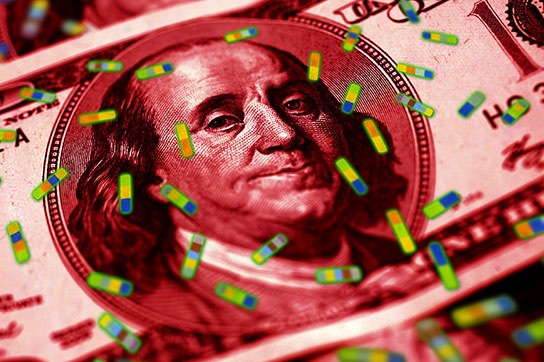
MIT chemical engineers invented smartphone-readable microparticles that can be used to verify goods and crack down on counterfeiting. By encoding these particles with different colored stripes, they can generate vast quantities of unique combinations that can be used to tag products.
Some 2 to 5 percent of all international trade involves counterfeit goods, according to a 2013 United Nations report. These illicit products — which include electronics, automotive and aircraft parts, pharmaceuticals, and food — can pose safety risks and cost governments and private companies hundreds of billions of dollars annually.
Many strategies have been developed to try to label legitimate products and prevent illegal trade — but these tags are often too easy to fake, are unreliable, or cost too much to implement, according to MIT researchers who have developed a new alternative.
Led by MIT chemical engineering professor Patrick Doyle and Lincoln Laboratory technical staff member Albert Swiston, the researchers have invented a new type of tiny, smartphone-readable particle that they believe could be deployed to help authenticate currency, electronic parts, and luxury goods, among other products. The particles, which are invisible to the naked eye, contain colored stripes of nanocrystals that glow brightly when lit up with near-infrared light.
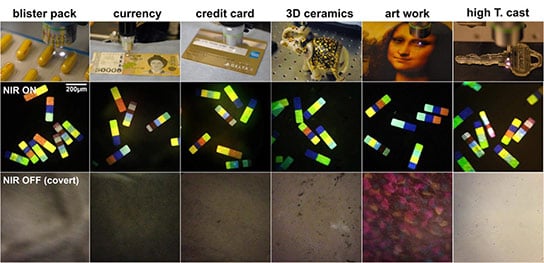
These particles can easily be manufactured and integrated into a variety of materials, and can withstand extreme temperatures, sun exposure, and heavy wear, says Doyle, the senior author of a paper describing the particles in the April 13 issue of Nature Materials. They could also be equipped with sensors that can “record” their environments — noting, for example, if a refrigerated vaccine has ever been exposed to temperatures too high or low.
The paper’s lead authors are MIT postdoc Jiseok Lee and graduate student Paul Bisso. MIT graduate students Rathi Srinivas and Jae Jung Kim also contributed to the research.
A massive encoding capacity
The new particles are about 200 microns long and include several stripes of different colored nanocrystals, known as “rare earth upconverting nanocrystals.” These crystals are doped with elements such as ytterbium, gadolinium, erbium, and thulium, which emit visible colors when exposed to near-infrared light. By altering the ratios of these elements, the researchers can tune the crystals to emit any color in the visible spectrum.
To manufacture the particles, the researchers used stop-flow lithography, a technique developed previously by Doyle. This approach allows shapes to be imprinted onto parallel flowing streams of liquid monomers — chemical building blocks that can form longer chains called polymers. Wherever pulses of ultraviolet light strike the streams, a reaction is set off that forms a solid polymeric particle.
In this case, each polymer stream contains nanocrystals that emit different colors, allowing the researchers to form striped particles. So far, the researchers have created nanocrystals in nine different colors, but it should be possible to create many more, Doyle says.
Using this procedure, the researchers can generate vast quantities of unique tags. With particles that contain six stripes, there are 1 million different possible color combinations; this capacity can be exponentially enhanced by tagging products with more than one particle. For example, if the researchers created a set of 1,000 unique particles and then tagged products with any 10 of those particles, there would be 1030 possible combinations — far more than enough to tag every grain of sand on Earth.
“It’s really a massive encoding capacity,” says Bisso, who started this project while on the technical staff at Lincoln Lab. “You can apply different combinations of 10 particles to products from now until long past our time and you’ll never get the same combination.”
“The use of these upconverting nanocrystals is quite clever and highly enabling,” says Jennifer Lewis, a professor of biologically inspired engineering at Harvard University who was not involved in the research. “There are several striking features of this work, namely the exponentially scaling encoding capacities and the ultralow decoding false-alarm rate.”
Versatile particles
The microparticles could be dispersed within electronic parts or drug packaging during the manufacturing process, incorporated directly into 3-D-printed objects, or printed onto currency, the researchers say. They could also be incorporated into ink that artists could use to authenticate their artwork.
The researchers demonstrated the versatility of their approach by using two polymers with radically different material properties — one hydrophobic and one hydrophilic —to make their particles. The color readouts were the same with each, suggesting that the process could easily be adapted to many types of products that companies might want to tag with these particles, Bisso says.
“The ability to tailor the tag’s material properties without impacting the coding strategy is really powerful,” he says. “What separates our system from other anti-counterfeiting technologies is this ability to rapidly and inexpensively tailor material properties to meet the needs of very different and challenging requirements, without impacting smartphone readout or requiring a complete redesign of the system.”
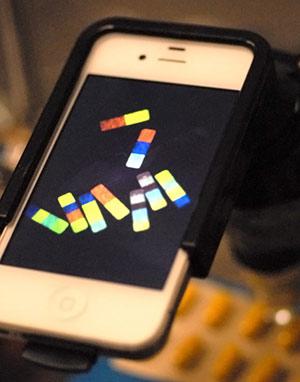
Another advantage to these particles is that they can be read without an expensive decoder like those required by most other anti-counterfeiting technologies. Using a smartphone camera equipped with a lens offering twentyfold magnification, anyone could image the particles after shining near-infrared light on them with a laser pointer. The researchers are also working on a smartphone app that would further process the images and reveal the exact composition of the particles.
The research was funded by the U.S. Air Force, the Office of the Assistant Secretary of Defense for Research and Engineering, the Singapore-MIT Alliance, the National Science Foundation, the U.S. Army Research Office, and the National Institutes of Health.
Illustration: Jose-Luis Olivares/MIT
Never miss a breakthrough: Join the SciTechDaily newsletter.
Follow us on Google and Google News.