
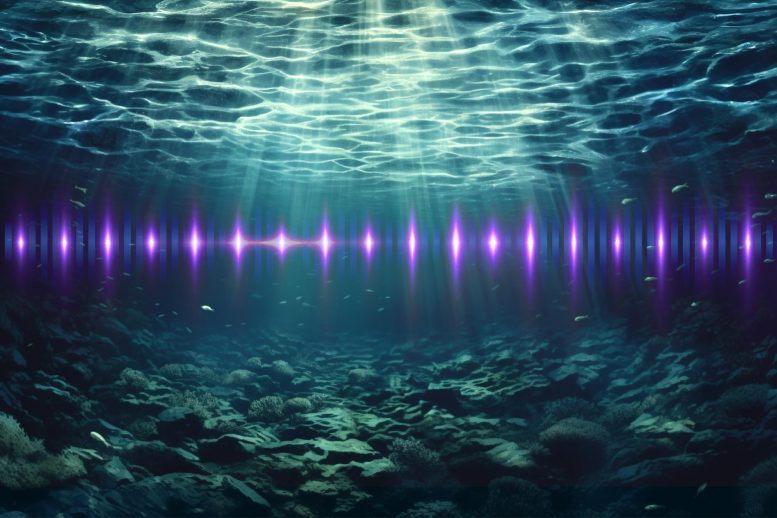
The system could be used for battery-free underwater communication across kilometer-scale distances, to aid monitoring of climate and coastal change.
MIT researchers have demonstrated the first system for ultra-low-power underwater networking and communication, which can transmit signals across kilometer-scale distances.
This technique, which the researchers began developing several years ago, uses about one millionth the power that existing underwater communication methods use. By expanding their battery-free system’s communication range, the researchers have made the technology more feasible for applications such as aquaculture, coastal hurricane prediction, and climate change modeling.
“What started as a very exciting intellectual idea a few years ago — underwater communication with a million times lower power — is now practical and realistic. There are still a few interesting technical challenges to address, but there is a clear path from where we are now to deployment,” says Fadel Adib, associate professor in the Department of Electrical Engineering and Computer Science and director of the Signal Kinetics group in the MIT Media Lab.
The Power of Underwater Backscatter
Underwater backscatter enables low-power communication by encoding data in sound waves that it reflects, or scatters, back toward a receiver. These innovations enable reflected signals to be more precisely directed at their source.
Due to this “retrodirectivity,” less signal scatters in the wrong directions, allowing for more efficient and longer-range communication.
When tested in a river and an ocean, the retrodirective device exhibited a communication range that was more than 15 times farther than previous devices. However, the experiments were limited by the length of the docks available to the researchers.
To better understand the limits of underwater backscatter, the team also developed an analytical model to predict the technology’s maximum range. The model, which they validated using experimental data, showed that their retrodirective system could communicate across kilometer-scale distances.
The researchers shared these findings in two papers which will be presented at this year’s ACM SIGCOMM and MobiCom conferences. Adib, senior author on both papers, is joined on the SIGCOMM paper by co-lead authors Aline Eid, a former postdoc who is now an assistant professor at the University of Michigan, and Jack Rademacher, a research assistant; as well as research assistants Waleed Akbar and Purui Wang, and postdoc Ahmed Allam. The MobiCom paper is also written by co-lead authors Akbar and Allam.
Communicating With Sound Waves
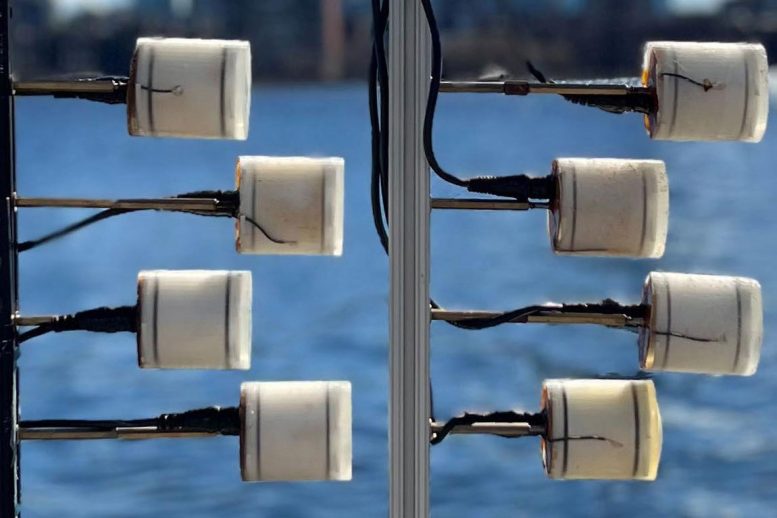
Underwater backscatter communication devices utilize an array of nodes made from “piezoelectric” materials to receive and reflect sound waves. These materials produce an electric signal when mechanical force is applied to them.
When sound waves strike the nodes, they vibrate and convert the mechanical energy to an electric charge. The nodes use that charge to scatter some of the acoustic energy back to the source, transmitting data that a receiver decodes based on the sequence of reflections.
But because the backscattered signal travels in all directions, only a small fraction reaches the source, reducing the signal strength and limiting the communication range.
To overcome this challenge, the researchers leveraged a 70-year-old radio device called a Van Atta array, in which symmetric pairs of antennas are connected in such a way that the array reflects energy back in the direction it came from.
However, connecting piezoelectric nodes to make a Van Atta array reduces their efficiency. The researchers avoided this problem by placing a transformer between pairs of connected nodes. The transformer, which transfers electric energy from one circuit to another, allows the nodes to reflect the maximum amount of energy back to the source.
“Both nodes are receiving and both nodes are reflecting, so it is a very interesting system. As you increase the number of elements in that system, you build an array that allows you to achieve much longer communication ranges,” Eid explains.
In addition, they used a technique called cross-polarity switching to encode binary data in the reflected signal. Each node has a positive and a negative terminal (like a car battery), so when the positive terminals of two nodes are connected and the negative terminals of two nodes are connected, that reflected signal is a “bit one.”
But if the researchers switch the polarity, and the negative and positive terminals are connected to each other instead, then the reflection is a “bit zero.”
“Just connecting the piezoelectric nodes together is not enough. By alternating the polarities between the two nodes, we are able to transmit data back to the remote receiver,” Rademacher explains.
When building the Van Atta array, the researchers found that if the connected nodes were too close, they would block each other’s signals. They devised a new design with staggered nodes that enables signals to reach the array from any direction. With this scalable design, the more nodes an array has, the greater its communication range.
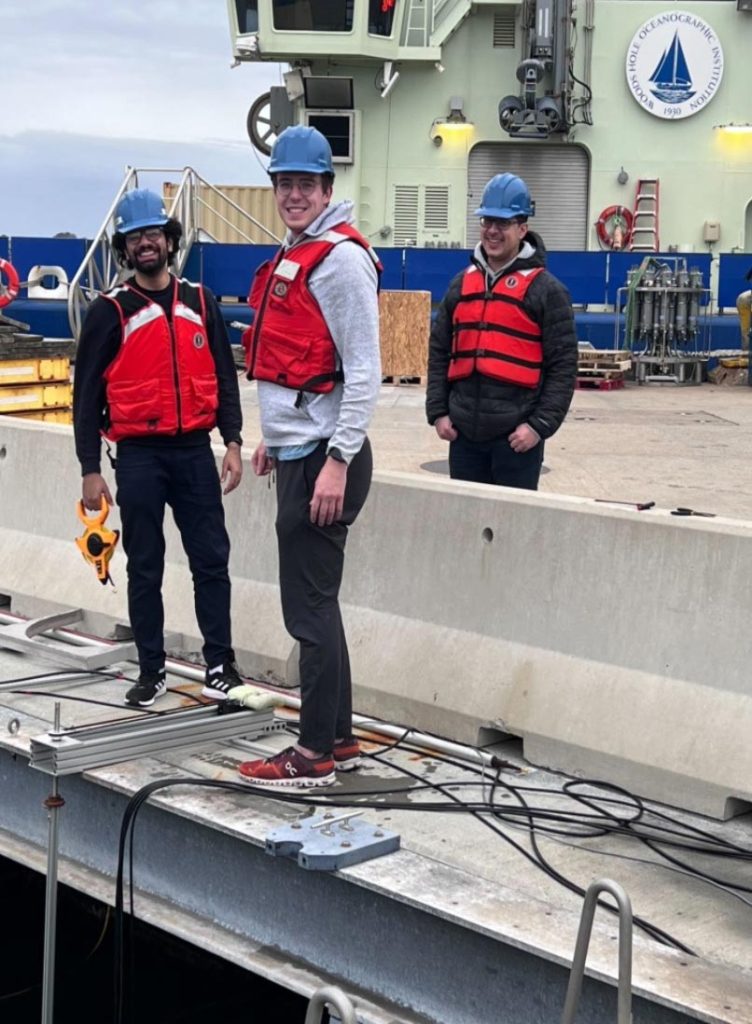
They tested the array in more than 1,500 experimental trials in the Charles River in Cambridge, Massachusetts, and in the Atlantic Ocean, off the coast of Falmouth, Massachusetts, in collaboration with the Woods Hole Oceanographic Institution. The device achieved communication ranges of 300 meters, more than 15 times longer than they previously demonstrated.
However, they had to cut the experiments short because they ran out of space on the dock.
Modeling the Maximum
That inspired the researchers to build an analytical model to determine the theoretical and practical communication limits of this new underwater backscatter technology.
Building off their group’s work on RFIDs, the team carefully crafted a model that captured the impact of system parameters, like the size of the piezoelectric nodes and the input power of the signal, on the underwater operation range of the device.
“It is not a traditional communication technology, so you need to understand how you can quantify the reflection. What are the roles of the different components in that process?” Akbar says.
For instance, the researchers needed to derive a function that captures the amount of signal reflected out of an underwater piezoelectric node with a specific size, which was among the biggest challenges of developing the model, he adds.
They used these insights to create a plug-and-play model into which a user could enter information like input power and piezoelectric node dimensions and receive an output that shows the expected range of the system.
They evaluated the model on data from their experimental trials and found that it could accurately predict the range of retrodirected acoustic signals with an average error of less than one decibel.
Using this model, they showed that an underwater backscatter array can potentially achieve kilometer-long communication ranges.
“We are creating a new ocean technology and propelling it into the realm of the things we have been doing for 6G cellular networks. For us, it is very rewarding because we are starting to see this now very close to reality,” Adib says.
The researchers plan to continue studying underwater backscatter Van Atta arrays, perhaps using boats so they could evaluate longer communication ranges. Along the way, they intend to release tools and datasets so other researchers can build on their work. At the same time, they are beginning to move toward commercialization of this technology.
“Limited range has been an open problem in underwater backscatter networks, preventing them from being used in real-world applications. This paper takes a significant step forward in the future of underwater communication, by enabling them to operate on minimum energy while achieving long range,” says Omid Abari, assistant professor of computer science at the University of California at Los Angeles, who was not involved with this work. “The paper is the first to bring Van Atta Reflector array technique into underwater backscatter settings and demonstrate its benefits in improving the communication range by orders of magnitude. This can take battery-free underwater communication one step closer to reality, enabling applications such as underwater climate change monitoring and coastal monitoring.”
References:
“Enabling Long-Range Underwater Backscatter via Van Atta Acoustic Networks” by Aline Eid, Jack Rademacher, Waleed Akbar, Purui Wang, Ahmed Allam and Fadel Adib, SIGCOMM.
PDF
“The Underwater Backscatter Channel: Theory, Link Budget, and Experimental Validation” by Waleed Akbar, Ahmed Allam and Fadel Adib, MobiCom.
PDF
This research was funded, in part, by the Office of Naval Research, the Sloan Research Fellowship, the National Science Foundation, the MIT Media Lab, and the Doherty Chair in Ocean Utilization.
Never miss a breakthrough: Join the SciTechDaily newsletter.
Follow us on Google and Google News.
1 Comment
Another improvement in submarine warefare. Like we need it.