
Anyone who wants to produce medication, plastics or fertilizer using conventional methods needs heat for chemical reactions – but not so with photochemistry, where light provides the energy. The process to achieve the desired product also often takes fewer intermediate steps.
Researchers from the University of Basel are now going one step further and are demonstrating how the energy efficiency of photochemical reactions can be increased tenfold. More sustainable and cost-effective applications are now tantalizingly close.
Industrial chemical reactions usually occur in several stages across various interim products. Photochemistry enables shortcuts, meaning fewer intermediate steps are required. Photochemistry also allows you to work with less hazardous substances than in conventional chemistry, as light produces a reaction in substances which do not react well under heat. However, to this point there have not been many industrial applications for photochemistry, partly because supplying energy with light is often inefficient or creates unwanted by-products.
The research group led by Professor Oliver Wenger at the University of Basel now describes a fundamental principle which has an unexpectedly strong impact on the energy efficiency of photochemistry and can increase the speed of photochemical reactions. Their results are published in Nature Chemistry.
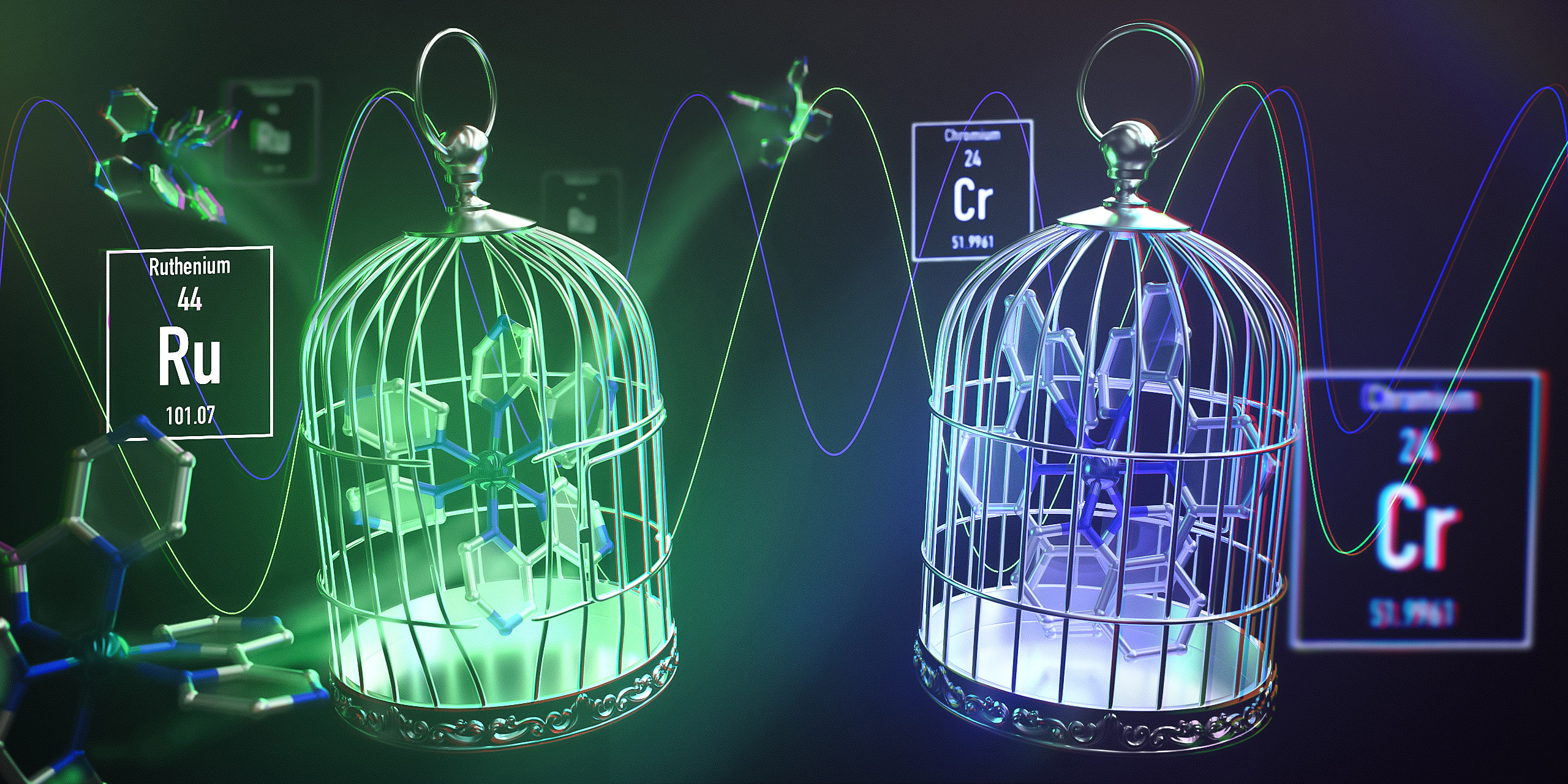
In the case of this kind of reaction, the starting molecules are in a liquid solution. If they receive energy in the form of light, they can exchange electrons with one another and form radicals. These extremely reactive molecules always occur in pairs and remain surrounded by solvent, which encloses the pairs of radicals like a kind of cage. In order for the radicals to be able to continue to react to the desired target products, they need to “break out” of this cage and find a reaction partner outside of it. The team surrounding Wenger and his postdoc Dr. Cui Wang identified this process of breaking out as a decisive step which limits the energy efficiency and the speed of photochemical reactions.
Radicals break free
As long as the radicals remain in pairs in the solvent cage, they can spontaneously react with one another back into the starting materials. This reverse reaction wastes energy because it only uses the light already absorbed to get back to the starting point. The Basel team was able to slow down this reverse reaction and therefore give the radicals more time to leave the cage. The longer the unwanted reverse reaction became, the more radicals were able to break out and the more energy efficient and faster the desired target products developed.
Wang, who now holds the position of assistant professor at Osnabrück University, used two particular dyes in her study, both of which absorb light and store its energy for a short period before using it to form pairs of radicals. However, one of the two dyes examined was able to store significantly more energy than the other and transfer it to the radicals. Due to the additional energy, the radicals were able to leave the solvent cage up to ten times more efficiently. Consequently, the target products are produced with up to ten times higher energy efficiency. “This direct link between the radicals breaking out of the solvent cage and the efficient formation of the target products is astonishingly clear,” stated Wang.
Dyes are key
The key finding is that certain dyes can release more radicals than others per the amount of light absorbed. “The choice of dye can be used to boost the energy efficiency of photochemical reactions,” emphasizes Wenger. In turn, he states that energy efficiency is also a decisive criterion for the industrial use of photochemistry.
Reference: “Cage escape governs photoredox reaction rates and quantum yields” by Cui Wang, Han Li, Tobias H. Bürgin and Oliver S. Wenger, 18 March 2024, Nature Chemistry.
DOI: 10.1038/s41557-024-01482-4
Never miss a breakthrough: Join the SciTechDaily newsletter.
Follow us on Google and Google News.