
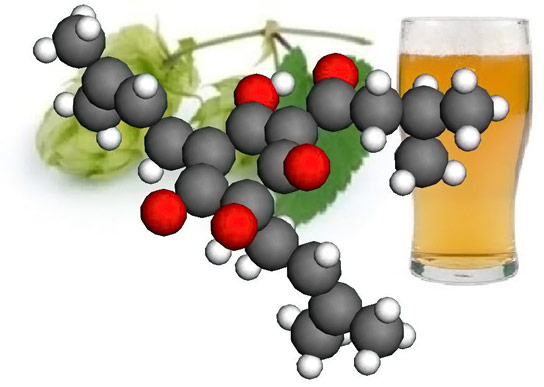
Using a process called X-ray crystallography, scientists at the University of Washington have determined the precise configuration of humulones, which may result in new pharmaceuticals to treat diabetes, some types of cancer, and other maladies.
Researchers employing a century-old observational technique have determined the precise configuration of humulones, substances derived from hops that give beer its distinctive flavor.
That might not sound like a big deal to the average brewmaster, but the findings overturn results reported in scientific literature in the last 40 years and could lead to new pharmaceuticals to treat diabetes, some types of cancer, and other maladies.
“Now that we have the right results, what happens to the bitter hops in the beer-brewing process makes a lot more sense,” said Werner Kaminsky, a University of Washington research associate professor of chemistry.
Kaminsky is the lead author of a paper describing the findings, published this month in the journal Angewandte Chemie International Edition.
There is documentation that beer and its bittering acids, in moderation, have beneficial effects on diabetes, some forms of cancer, inflammation and perhaps even weight loss.
Kaminsky used a process called X-ray crystallography to figure out the exact structure of those acids, humulone molecules and some of their derivatives, produced from hops in the brewing process. That structure is important to researchers looking for ways to incorporate those substances, and their health effects, into new pharmaceuticals.
Humulone molecules are rearranged during the brewing process to contain a ring with five carbon atoms instead of six. At the end of the process two side groups are formed that can be configured in four different ways – both groups can be above the ring or below, or they can be on opposite sides.
Which of the forms the molecule takes determines its “handedness,” Kaminsky said, and that is important for understanding how a particular humulone will react with another substance. If they are paired correctly, they will fit together like a nut and bolt.
If paired incorrectly, they might not fit together at all or it could be like placing a right hand into a left-handed glove. That could produce disastrous results in pharmaceuticals.
Kaminsky cited thalidomide, which has a number of safe uses but was famously used to treat morning sickness in pregnant women in the late 1950s and early 1960s before it was discovered to cause birth defects. Molecule “handedness” in one form of the drug was responsible for the birth defects, while the orientation of molecules in another form did not appear to have the negative effects.
To determine the configuration of humulones formed in the brewing process, coauthors Jan Urban, Clinton Dahlberg and Brian Carroll of KinDex Therapeutics, a Seattle pharmaceutical firm that funded the research, recovered acids from the brewing process and purified them.
They converted the humulones to salt crystals and sent them to Kaminsky, who used X-ray crystallography – a technique developed in the early 20th century – to determine the exact configuration of the molecules.
“Now that we know which hand belongs to which molecule, we can determine which molecule goes to which bitterness taste in beer,” Kaminsky said.
The authors point out that while “excessive beer consumption cannot be recommended to propagate good health, isolated humulones and their derivatives can be prescribed with documented health benefits.”
Some of the compounds have been shown to affect specific illnesses, Kaminsky said, while some with a slight difference in the arrangement of carbon atoms have been ineffective.
The new research sets the stage for finding which of those humulones might be useful in new compounds to be used as medical treatments.
Reference: “Absolute Configuration of Beer′s Bitter Compounds” by Dr. Jan Urban, Dipl.-Chem. Clinton J. Dahlberg, Dr. Brian J. Carroll, Prof. Werner Kaminsky, 13 December 2012, Angewandte Chemie International Edition.
DOI: 10.1002/anie.201208450
Never miss a breakthrough: Join the SciTechDaily newsletter.
Follow us on Google and Google News.