
Close Menu
    Facebook X (Twitter) Instagram
    SciTechDaily
    • Biology
    • Chemistry
    • Earth
    • Health
    • Physics
    • Science
    • Space
    • Technology
    Facebook X (Twitter) Pinterest YouTube RSS
    SciTechDaily
    Home»Chemistry»Chemists Discover a Simpler Way to Make Complex Medicines
    Chemistry

    Chemists Discover a Simpler Way to Make Complex Medicines

    By Laura Arenschield, Ohio State UniversityOctober 18, 2019No Comments4 Mins Read
    Facebook Twitter Pinterest Telegram LinkedIn WhatsApp Email Reddit
    Share
    Facebook Twitter LinkedIn Pinterest Telegram Email Reddit
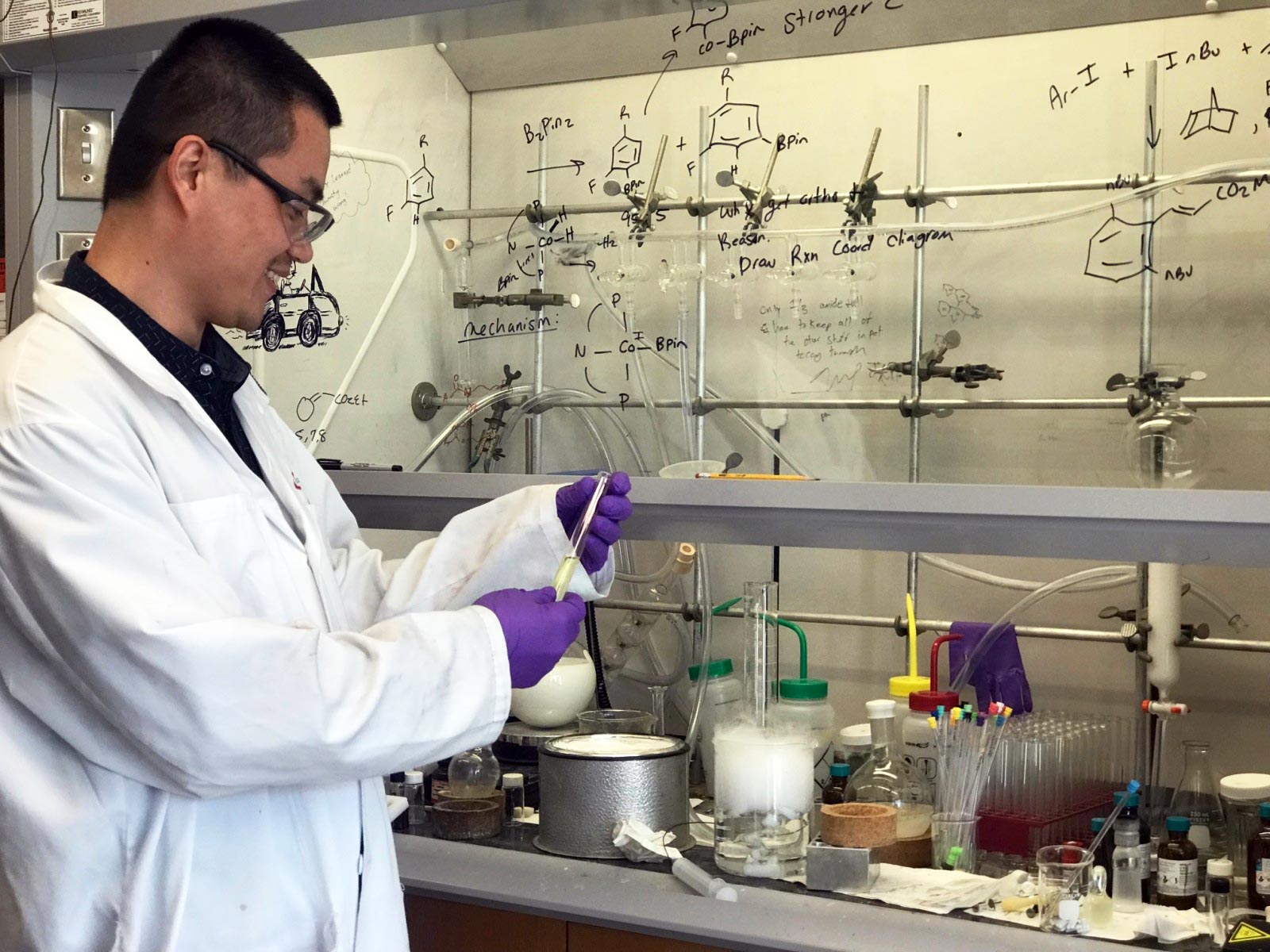
    Zuxiao Zhang in the Nagib lab at the Ohio State University
    Zuxiao Zhang in the Nagib lab at the Ohio State University. Zhang and other organic chemists have figured out how to create a synthetic molecule that is a crucial building block for making certain medicines, including an oral pill that treats ovarian cancer. Credit: Ohio State University

    Chemists find a new way of creating the building blocks of many drugs.

    Organic chemists at Ohio State University have figured out how to synthesize the most common molecule arrangement in medicine, a scientific discovery that could change the way a number of drugs – including one most commonly used to treat ovarian cancer – are produced.

    Their discovery, published on October 17, 2019, in the journal Chem, gives drug makers a crucial building block for creating medicines that, so far, are made with complex processes that result in a lot of waste.

    This new finding may allow drug makers to create this building block in just one step, said David Nagib, the study’s senior author and assistant professor in the Department of Chemistry and Biochemistry at Ohio State.

    A drug’s molecules must interact in just the right way with the molecules inside the human body to be effective. It’s like when two people meet: Each person must use their right hand to shake hands with the other. If one person tries to use their left hand, it just doesn’t work.

    “Another way to look at it is that drugs work like a lock and key, and you have to put a left-handed key into a left-handed lock,” Nagib said.

    The most common arrangement of molecules used in drugs so they can interact effectively with human molecules is called a chiral piperidine.

    Currently, drug makers synthesize this molecule arrangement using a circuitous process that involves creating a mixture and essentially throwing half that mixture out.

    “Previously, there was no available method that simply swapped a single carbon-hydrogen bond for a carbon-carbon bond like this,” said Zuxiao Zhang, the study’s lead author and a postdoctoral researcher in Nagib’s lab. “And what we figured out is, through free radicals, we can make this happen.”

    The heart of their discovery lies in the chemical bonds that make up a molecule. The researchers considered a number of drugs and looked at the way their molecules are created. One, the anti-cancer drug niraparib – a pill used to treat ovarian cancer – uses a chiral piperidine. But to produce it, the drug’s makers have to create a number of symmetric mixtures, then strip parts away until they get to the asymmetric molecule necessary to make the drug effective.

    Creating that chiral six-sided ring synthetically was a problem that had troubled chemists for decades. It was so tricky, in fact, that when Zhang first approached Nagib about tackling it, Nagib was unsure it was the right problem to solve.

    “The success of this chemistry was entirely thanks to Zuxiao’s courage and ambition to tackle such a hard problem,” Nagib said.

    It is a fundamental change that Nagib hopes might make a number of medicines easier to produce.

    “It’s a different way of doing things,” he said. “It’s like flying an airplane over the Atlantic. Is that a shortcut, instead of having a boat? Yes, it’s a more efficient way of going, but it’s also a fundamentally different way. If you fly across the Atlantic, now you can do other things – you can fly to other places. That’s what this.”

    ###

    Reference: “Chiral Piperidines from Acyclic Amines via Enantioselective, Radical-Mediated δ C–H Cyanation” by Zuxiao Zhang, Xin Zhang and David A. Nagib, 17 October 2019, Chem.
    DOI: 10.1016/j.chempr.2019.09.010

    This work was supported by the National Institutes of Health and the National Science Foundation.

    Never miss a breakthrough: Join the SciTechDaily newsletter.
    Follow us on Google and Google News.

    Medicine National Institutes of Health National Science Foundation Ohio State University
    Share. Facebook Twitter Pinterest LinkedIn Email Reddit

    Related Articles

    Scientists Discover Biological Differences Between Liberals and Conservatives

    Luminescent Sensor Identifies Valuable Rare Earth Element Terbium in Unexpected Locations

    MIT Automated Tabletop Fast Protein Synthesis Machine May Accelerate Drug Development

    Genetic Analysis Reveals the Fascinating Evolutionary Origins of Catmint AKA Catnip

    After More Than 40 Years, Evidence Found for Existence of Elusive ‘Metabolon’

    Unusual Bacterial Enzyme Discovered That Could Become a New Target for Antibiotics

    Chemists Design New Compounds That Thwart Viruses – Blocks Replication of Coronavirus

    Cobalt Is Used for Electric Vehicle and Electronics Batteries – Can Supply Meet Demand?

    Degradable Polymers Synthesized by MIT Chemists – Can Break Down in the Body

    Leave A Reply Cancel Reply

    • Facebook
    • Twitter
    • Pinterest
    • YouTube

    Don't Miss a Discovery

    Subscribe for the Latest in Science & Tech!

    Trending News

    Millions Take These IBS Drugs, But a New Study Finds Serious Risks

    Scientists Unlock Hidden Secrets of 2,300-Year-Old Mummies Using Cutting-Edge CT Scanner

    Bread Might Be Making You Gain Weight Even Without Eating More Calories

    Scientists Discover Massive Magma Reservoir Beneath Tuscany

    Europe’s Most Active Volcano Just Got Stranger – Here’s Why Scientists Are Rethinking It

    Alzheimer’s Symptoms May Start Outside the Brain, Study Finds

    Millions Take This Popular Supplement – Scientists Discover a Concerning Link to Heart Failure

    The Universe Is Expanding Too Fast and Scientists Can’t Explain Why

    Follow SciTechDaily
    • Facebook
    • Twitter
    • YouTube
    • Pinterest
    • Newsletter
    • RSS
    SciTech News
    • Biology News
    • Chemistry News
    • Earth News
    • Health News
    • Physics News
    • Science News
    • Space News
    • Technology News
    Recent Posts
    • Simple Blood Test May Predict Alzheimer’s Years Before Brain Scans Show Signs
    • Scientists Say Adding This Unusual Seafood to Your Diet Could Reverse Signs of Aging
    • U.S. Waste Holds $5.7 Billion Worth of Crop Nutrients
    • Scientists Say a Hidden Structure May Exist Inside Earth’s Core
    • Doctors Surprised by the Power of a Simple Drug Against Colon Cancer
    Copyright © 1998 - 2026 SciTechDaily. All Rights Reserved.
    • Science News
    • About
    • Contact
    • Editorial Board
    • Privacy Policy
    • Terms of Use

    Type above and press Enter to search. Press Esc to cancel.