
Close Menu
    Facebook X (Twitter) Instagram
    SciTechDaily
    • Biology
    • Chemistry
    • Earth
    • Health
    • Physics
    • Science
    • Space
    • Technology
    Facebook X (Twitter) Pinterest YouTube RSS
    SciTechDaily
    Home»Health»New Molecular Target Could Result in Cancer Drugs With Fewer Side Effects
    Health

    New Molecular Target Could Result in Cancer Drugs With Fewer Side Effects

    By Ohio State University Wexner Medical CenterJune 25, 2022No Comments3 Mins Read
    Facebook Twitter Pinterest Telegram LinkedIn WhatsApp Email Reddit
    Share
    Facebook Twitter LinkedIn Pinterest Telegram Email Reddit
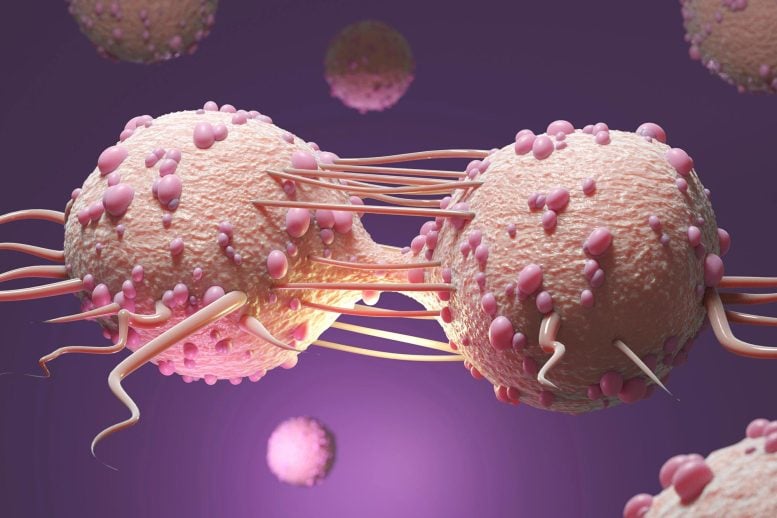
    Cancer Cells Dividing
    Researchers found that, unlike the currently available anti-VEGF-A anti-angiogenic agents, the new selective dopamine D2 receptor agonists are inexpensive and have well-established and manageable side effects.

    New Molecular Target for Cancer Treatment

    The Ohio State University Comprehensive Cancer Center – Arthur G. James Cancer Hospital and Richard J. Solove Research Institute (OSUCCC – James) researchers have discovered a new molecular drug target that might lead to new cancer medicines with fewer side effects.

    Previous research has shown that vascular endothelial growth factor-A (VEGF-A) – a powerful cytokine (signaling protein) – and dopamine (a neurotransmitter/neurohormone) play critical roles in a variety of physiological and pathological functions. Dr. Sujit Basu and colleagues performed further preclinical analysis of VEGF-A as a target for the development of novel cancer therapy approaches in a new laboratory study.

    Anti-Angiogenic Therapy for Cancer

    For the first time, the researchers discovered that VEGF-A can increase the expression of dopamine D2 receptors on endothelial cells, which can then be stimulated to stop the growth of blood vessels, which fuel the growth and spread of several diseases such as colon cancer, endometriosis, and ovarian hyperstimulation syndrome. Such blood vessel growth is called angiogenesis. The team’s recent study was published in the Journal of Cell Science.

    “This is a very compelling discovery that opens up new pathways for developing effective new anti-angiogenic therapy for the treatment of cancer and other diseases where VEGF-A is a known driver of disease growth and spread,” said Basu, who also serves as a professor at The Ohio State University College of Medicine and is a member of the Translational Therapeutics Program at the OSUCCC – James.

    Basu notes that, unlike the presently available anti-VEGF-A anti-angiogenic agents, selective dopamine D2 receptor agonists are inexpensive and have well-established and manageable side effects.

    “These drugs are devoid of the serious side effects of the currently used anti-VEGF-A anti-angiogenic agents in the clinics. We believe they merit further investigation as a viable treatment approach in cancer and other diseases driven by the VEGF-A pathway,” Basu said.

    Researchers expect to begin testing these drugs through clinical trials in the near future.

    This study was funded by grants from the National Cancer Institute, National Institutes of Health, and the U.S. Department of Defense. Additional coauthors in this study include Chandrani Sarkar, Debanjan Chakroborty, Sandeep Goswami, Hao Fan, and Xiaokui Mo.

    Reference: “VEGF-A controls the expression of its regulator of angiogenic functions, dopamine D2 receptor, on endothelial cells” by Chandrani Sarkar, Debanjan Chakroborty, Sandeep Goswami, Hao Fan, Xiaokui Mo and Sujit Basu, 31 May 2022, Journal of Cell Science.
    DOI: 10.1242/jcs.259617

    Never miss a breakthrough: Join the SciTechDaily newsletter.
    Follow us on Google and Google News.

    Cancer Drugs National Institutes of Health Ohio State University Tumor
    Share. Facebook Twitter Pinterest LinkedIn Email Reddit

    Related Articles

    Brain Tumor Breakthrough: New Cancer Vulnerability Discovered

    Groundbreaking Method “Starves” Highly-Lethal Cancer Tumors of Energy, Eradicating Them

    New Cancer Drug Combination Reduced Risk of Death by 31%

    Why Do Cancer Cells Need Fat?

    New “Masked” Cancer Drug Kills Cancer Cells With Minimal Side Effects

    Encouraging Tumor Growth: How Breast Cancer Causes Diabetes

    Scientists Have Created Worms That Can Kill Cancer Cells

    How Erectile Dysfunction Drugs Can Help Treat Cancer and Save Thousands of Lives

    New Medical Treatments Possible With “Right-Handed” Nanoparticles

    Leave A Reply Cancel Reply

    • Facebook
    • Twitter
    • Pinterest
    • YouTube

    Don't Miss a Discovery

    Subscribe for the Latest in Science & Tech!

    Trending News

    Even Occasional Binge Drinking May Triple Liver Damage Risk

    Liftoff! NASA’s Artemis II Launch Sends Astronauts Around the Moon for First Time in 50 Years

    Scientists Discover New Way To Eliminate “Zombie Cells” Driving Aging

    This New Quantum Theory Could Change Everything We Know About the Big Bang

    This One Vitamin May Help Protect Your Brain From Dementia Years Later

    Stopping Weight-Loss Drugs Like Ozempic Can Quickly Erase Heart Benefits

    A 500-Million-Year-Old Surprise Is Forcing Scientists to Rethink Spider Evolution

    Coffee and Blood Pressure: What You Need To Know Before Your Next Cup

    Follow SciTechDaily
    • Facebook
    • Twitter
    • YouTube
    • Pinterest
    • Newsletter
    • RSS
    SciTech News
    • Biology News
    • Chemistry News
    • Earth News
    • Health News
    • Physics News
    • Science News
    • Space News
    • Technology News
    Recent Posts
    • Breakthrough Study Reveals Why Damaged Nerves Struggle To Heal
    • 20-Year Study Reveals Cholera’s Surprising Weakness
    • $220 Billion Problem: Scientists Uncover the Secret Weapon Bacteria Use To Take Over Crops
    • Collapsing Plasma May Hold the Key to Cosmic Magnetism
    • DNA Meets Electronics: Scientists Create Ultra-Low Power Memory Breakthrough
    Copyright © 1998 - 2026 SciTechDaily. All Rights Reserved.
    • Science News
    • About
    • Contact
    • Editorial Board
    • Privacy Policy
    • Terms of Use

    Type above and press Enter to search. Press Esc to cancel.