
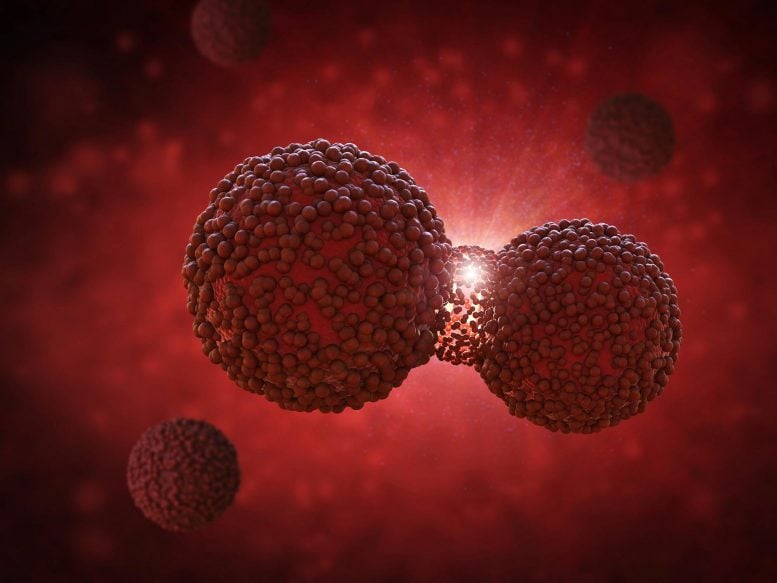
A Study Explains Why Many Cancer Cells Need the Import of Fat
The unexpected causes of cancer cells’ frequent reliance on fat imports are being revealed by Columbia and MIT researchers. This discovery could help us better understand and control tumor development.
The study, which was co-led by Matthew G. Vander Heiden, MD, Ph.D., director of the Koch Center at MIT, and Dennis Vitkup, Ph.D., associate professor of systems biology at Columbia University Vagelos College of Physicians, was recently published in the journal Nature Metabolism.
The oxygen we breathe and common nutrients like fat that we consume is likely to be crucial in the development of cancer cells.
The Role of Oxygen in Cancer Cell Growth
Oxygen plays a major part in the body’s production of energy. This causes breathing to become more difficult while we exercise. It is often believed that cancer cell growth is constrained by energy since many cancer cells exist in environments that are oxygen-depleted.
However, oxygen also plays a less well-known function in the production of the biomolecules required for the formation of new cells by acting as an oxidizing agent in these chemical reactions. When oxygen is scarce, cells cannot produce the growth-promoting cofactor NAD+, which is needed for several biosynthetic reactions. This also stops their key synthetic reactions.
Surprisingly, the new study discovered that hypoxic cancer cells often have more energy than they need for growth. Cancer cells did not react when the researchers added extra nutrients for energy production to the cells.
Instead, when researchers used various methods to unclog biosynthetic pathways inhibited by lack of oxygen, cancer cells robustly increased proliferation.
The researchers found that while various biosynthetic pathways are sensitive to oxygen availability, the synthesis of fats was among the most affected. Fat molecules are used to create membranes of new cells, and fat synthesis is especially challenging for cancer cells that need to synthesize new membranes for their growth. Without access to oxygen, cells cannot adequately supply their fat synthesis pathways.
Counterintuitive Role of Oxygen in Fat Synthesis
“What makes our result very counterintuitive”, Vitkup says, “is that fat synthesis is not considered to be a process requiring a lot of oxygen. But our experiments demonstrated that up to 30% of oxygen used by cancer cells is not for energy generation but for synthesizing fats.”
As a result of oxygen’s impact on biosynthesis, cancer cells growing in oxygen-limited environments are strongly dependent on the import of fats from the environment. This creates a crucial vulnerability for cancer cells, such that cutting their supply of imported fats may slow or stop cancer growth.
Vitkup’s team is now trying to identify the receptors that cancer cells use to import fats into different tumors and which receptors could be targeted by drugs. The study also suggests that changing the composition of fats in the diet may play a vital role in influencing cancer growth.
“We usually think of cancer as being driven primarily by genetic mutations, but for cancer cells living in challenging conditions, such as oxygen-starvation, their environment is equally important,” Vitkup says. “Mutations stimulating the uptake of fats, for example, will only promote tumor growth if these fats are actually available in their environment.”
Reference: “Cancer cells depend on environmental lipids for proliferation when electron acceptors are limited” by Zhaoqi Li, Brian W. Ji, Purushottam D. Dixit, Konstantine Tchourine, Evan C. Lien, Aaron M. Hosios, Keene L. Abbott, Justine C. Rutter, Anna M. Westermark, Elizabeth F. Gorodetsky, Lucas B. Sullivan, Matthew G. Vander Heiden, and Dennis Vitkup, 23 June 2022, Nature Metabolism.
DOI: 10.1038/s42255-022-00588-8
The results published here are in part based upon data generated by the TCGA Research Network. The study was funded by the National Institutes of Health (NIH) (grants R01CA201276, T32GM007367, U54CA209997, T32GM007287, T32GM007753, K99CA218679/R00CA218679, R35CA242379, and P30CA014051); the MD-PhD program at Columbia University; Damon Runyon Cancer Research Foundation; the Harvard/MIT MD-PhD Program; the MIT MSRP program; Lustgarten Foundation; SU2C; Ludwig Center at MIT; the MIT Center for Precision Cancer Medicine; Emerald Foundation; and Howard Hughes Medical Institute (International Student Fellowship and a Faculty Scholar award).
Anna M. Westermark is a current employee of Revitope. Matthew G. Vander Heiden is a consultant and scientific advisor for Agios Pharmaceuticals, iTeos Therapeutics, Droia Ventures, Faeth Therapeutics, Sage Therapeutics, and Auron Therapeutics. All other authors declare no competing interests.
Never miss a breakthrough: Join the SciTechDaily newsletter.
Follow us on Google and Google News.