
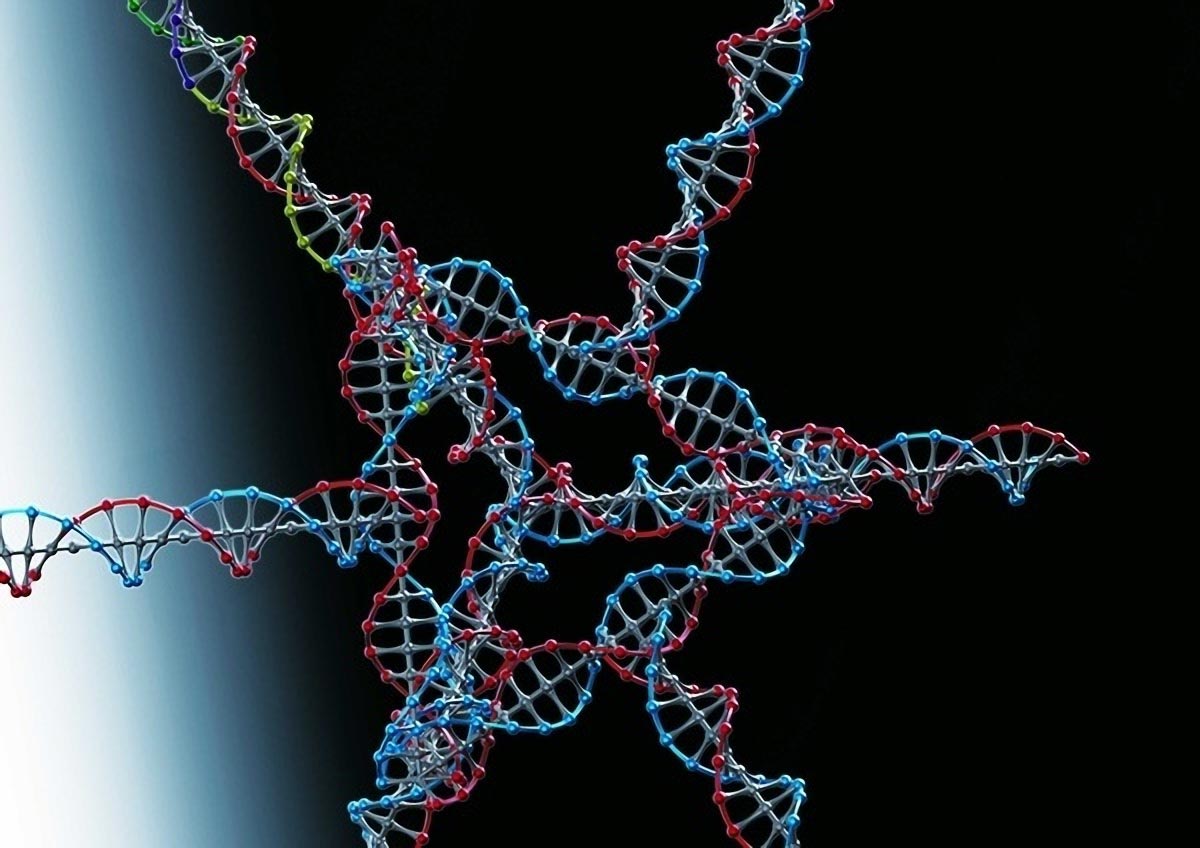
Researchers at MIT and Harvard Medical School have created biodegradable nanoparticles made from stands of DNA and RNA that can deliver snippets of RNA directly to tumors, turning off genes expressed in cancer cells while posing no threat to the body.
Using a technique known as “nucleic acid origami,” chemical engineers have built tiny particles made out of DNA and RNA that can deliver snippets of RNA directly to tumors, turning off genes expressed in cancer cells.
To achieve this type of gene shutdown, known as RNA interference, many researchers have tried — with some success — to deliver RNA with particles made from polymers or lipids. However, those materials can pose safety risks and are difficult to target, says Daniel Anderson, an associate professor of health sciences and technology and chemical engineering, and a member of the David H. Koch Institute for Integrative Cancer Research at MIT.
The new particles, developed by researchers at MIT, Alnylam Pharmaceuticals, and Harvard Medical School, appear to overcome those challenges, Anderson says. Because the particles are made of DNA and RNA, they are biodegradable and pose no threat to the body. They can also be tagged with molecules of folate (vitamin B9) to target the abundance of folate receptors found on some tumors, including those associated with ovarian cancer — one of the deadliest, hardest-to-treat cancers.
Anderson is senior author of a paper on the particles appearing in the June 3 issue of Nature Nanotechnology. Lead author of the paper is former MIT postdoc Hyukjin Lee, now an assistant professor at Ewha Womans University in Seoul, South Korea.
Genetic disruption
RNA interference (RNAi), a natural phenomenon that cells use to control their gene expression, has intrigued researchers since its discovery in 1998. Genetic information is normally carried from DNA in the nucleus to ribosomes, cellular structures where proteins are made. Short interfering RNA (siRNA) disrupts this process by binding to the messenger RNA molecules that carry DNA’s instructions, destroying them before they reach the ribosome.
siRNA-delivering nanoparticles made of lipids, which Anderson’s lab and Alnylam are also developing, have shown some success in turning off cancer genes in animal studies, and clinical trials are now underway in patients with liver cancer. Nanoparticles tend to accumulate in the liver, spleen and lungs, so liver cancer is a natural target — but it has been difficult to target such particles to tumors in other organs.
“When you think of metastatic cancer, you don’t want to just stop in the liver,” Anderson says. “You also want to get to more diverse sites.”
Another obstacle to fulfilling the promise of RNAi has been finding ways to deliver the short strands of RNA without harming healthy tissues in the body. To avoid those possible side effects, Anderson and his colleagues decided to try delivering RNA in a simple package made of DNA. Using nucleic acid origami — which allows researchers to construct 3-D shapes from short segments of DNA — they fused six strands of DNA to create a tetrahedron (a six-edged, four-faced pyramid). A single RNA strand was then affixed to each edge of the tetrahedron.
“What’s particularly exciting about nucleic acid origami is the fact that you can make molecularly identical particles and define the location of every single atom,” Anderson says.
To target the particles to tumor cells, the researchers attached three folate molecules to each tetrahedron. Short protein fragments could also be used to target the particles to a variety of tumors.
Using nucleic acid origami, the researchers have much more control over the composition of the particles, making it easier to create identical particles that all seek the right target. This is not usually the case with lipid nanoparticles, says Vinod Labhasetwar, a professor of biomedical engineering at the Lerner Research Institute at the Cleveland Clinic. “With lipid particles, you’re not sure what fraction of the particles are really getting to the target tissue,” says Labhasetwar, who was not involved in this study.
Circulate and accumulate
In studies of mice implanted with human tumors, the researchers found that once injected, the nucleic acid nanoparticles circulated in the bloodstream with a half-life of 24 minutes — long enough to reach their targets. The DNA tetrahedron appears to protect the RNA from rapid absorption by the kidneys and excretion, which usually happens with RNA administered on its own, Anderson says.
“If you take a short interfering RNA and inject it into the bloodstream, it is typically gone in six minutes. If you make a bigger nanoparticle using origami methods, it increases its ability to avoid excretion through the kidneys, thereby increasing its time circulating in the blood” he says.
The researchers also showed that the nucleic acid nanoparticles accumulated at the tumor sites. The RNA delivered by the particles was designed to target a gene for luciferase, which had been added to the tumor cells to make them glow. They found that in treated mice, luciferase activity dropped by more than half.
The team is now designing nanoparticles to target genes that promote tumor growth, and is also working on shutting off genes involved in other genetic diseases.
Reference: “Molecularly self-assembled nucleic acid nanoparticles for targeted in vivo siRNA delivery” by Hyukjin Lee, Abigail K. R. Lytton-Jean, Yi Chen, Kevin T. Love, Angela I. Park, Emmanouil D. Karagiannis, Alfica Sehgal, William Querbes, Christopher S. Zurenko, Muthusamy Jayaraman, Chang G. Peng, Klaus Charisse, Anna Borodovsky, Muthiah Manoharan, Jessica S. Donahoe, Jessica Truelove, Matthias Nahrendorf, Robert Langer & Daniel G. Anderson, 3 June 2012, Nature Nanotechnology.
DOI: 10.1038/nnano.2012.73
The research was funded by the National Institutes of Health, the Center for Cancer Nanotechnology Excellence, Alnylam Pharmaceuticals and the National Research Foundation of Korea.
Never miss a breakthrough: Join the SciTechDaily newsletter.
Follow us on Google and Google News.