
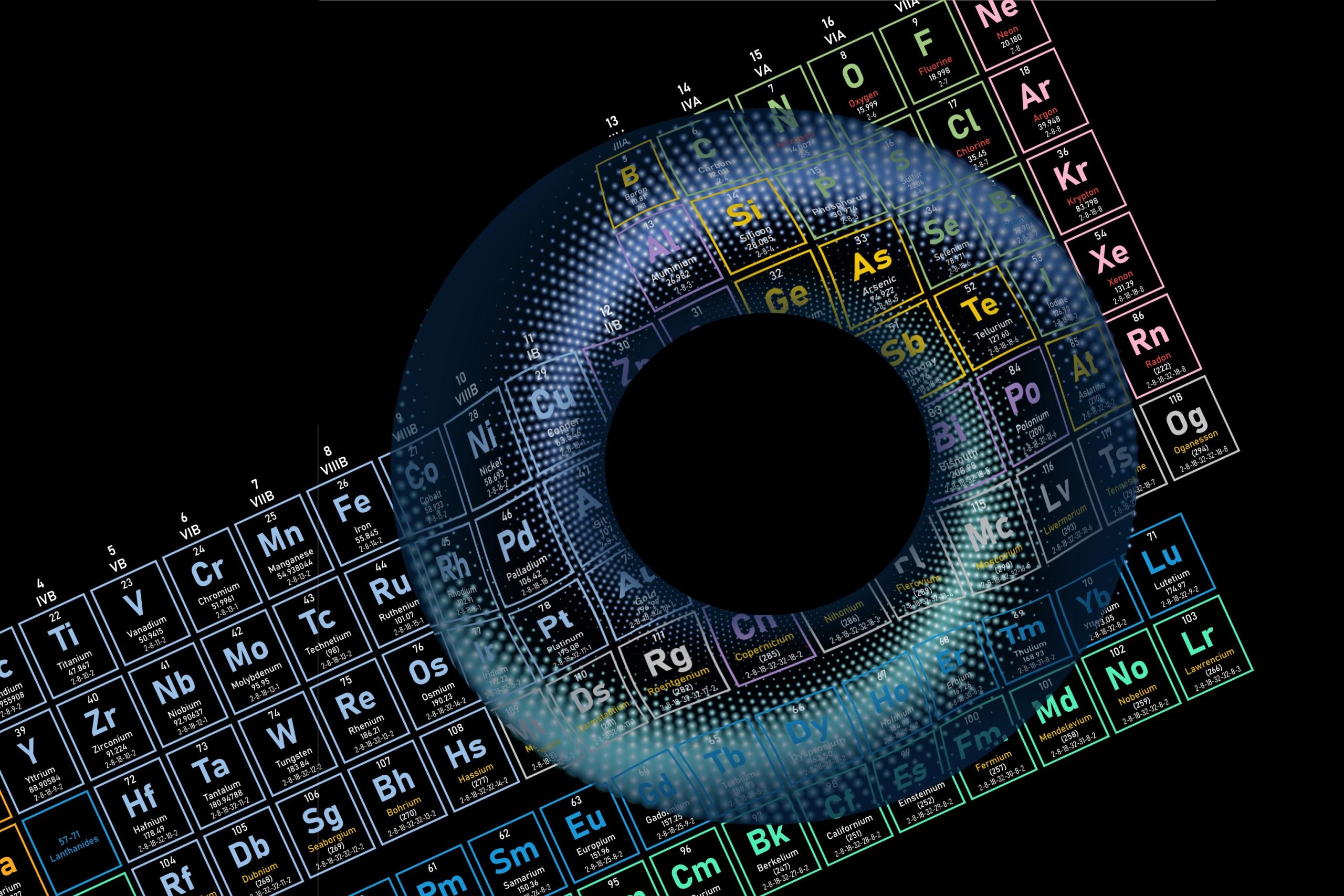
Searchable tool reveals more than 90,000 known materials with electronic properties that remain unperturbed in the face of disruption.
What will it take for our electronics to become smarter, faster, and more resilient? One idea is to build them out of topological materials.
Topology stems from a branch of mathematics that studies shapes that can be manipulated or deformed without losing certain essential properties. A donut is a common example: If it were made of rubber, a donut could be twisted and squeezed into a completely new shape, such as a coffee mug, while retaining a key trait — namely, its center hole, which takes the form of the cup’s handle. The hole, in this case, is a topological trait, robust against certain deformations.
In recent years, scientists have applied concepts of topology to the discovery of materials with similarly robust electronic properties. In 2007, researchers predicted the first electronic topological insulators — materials in which electrons that behave in ways that are “topologically protected,” or persistent in the face of certain disruptions.
Since then, scientists have searched for more topological materials with the goal of constructing better, more resilient electronic devices. Until recently, only a handful of such materials had been identified, and they were therefore assumed to be a rarity.
Now researchers at MIT and elsewhere have discovered that, in fact, topological materials are everywhere. You just need to know how to look for them.
In a paper published on May 20, 2022, in the journal Science, the team, led by Nicolas Regnault of Princeton University and the École Normale Supérieure Paris, reports harnessing the power of multiple supercomputers to map the electronic structure of more than 96,000 natural and synthetic crystalline materials. They applied sophisticated filters to determine whether and what kind of topological traits exist in each structure.
Overall, they found that 90 percent of all known crystalline structures contain at least one topological property, and more than 50 percent of all naturally occurring materials exhibit some sort of topological behavior.
“We found there’s a ubiquity — topology is everywhere,” says Benjamin Wieder, the study’s co-lead, and a postdoc in MIT’s Department of Physics.
The team has compiled the newly identified materials into a new, freely accessible Topological Materials Database resembling a periodic table of topology. With this new library, scientists can quickly search materials of interest for any topological properties they might hold, and harness them to build ultra-low-power transistors, new magnetic memory storage, and other devices with robust electronic properties.
The paper includes co-lead author Maia Vergniory of the Donostia International Physics Center, Luis Elcoro of the University of Basque Country, Stuart Parkin and Claudia Felser of the Max Planck Institute, and Andrei Bernevig of Princeton University.
Beyond Intuition
The new study was motivated by a desire to speed up the traditional search for topological materials.
“The way the original materials were found was through chemical intuition,” Wieder says. “That approach had a lot of early successes. But as we theoretically predicted more kinds of topological phases, it seemed intuition wasn’t getting us very far.”
Wieder and his colleagues instead utilized an efficient and systematic method to root out signs of topology, or robust electronic behavior, in all known crystalline structures, also known as inorganic solid-state materials.
For their study, the researchers looked to the Inorganic Crystal Structure Database, or ICSD, a repository into which researchers enter the atomic and chemical structures of crystalline materials that they have studied. The database includes materials found in nature, as well as those that have been synthesized and manipulated in the lab. The ICSD is currently the largest materials database in the world, containing over 193,000 crystals whose structures have been mapped and characterized.
The team downloaded the entire ICSD, and after performing some data cleaning to weed out structures with corrupted files or incomplete data, the researchers were left with just over 96,000 processable structures. For each of these structures, they performed a set of calculations based on fundamental knowledge of the relation between chemical constituents, to produce a map of the material’s electronic structure, also known as the electron band structure.
Screening for Topological Phases Using Supercomputers
The team was able to efficiently carry out the complicated calculations for each structure using multiple supercomputers, which they then employed to perform a second set of operations, this time to screen for various known topological phases, or persistent electrical behavior in each crystal material.
“We’re looking for signatures in the electronic structure in which certain robust phenomena should occur in this material,” explains Wieder, whose previous work involved refining and expanding the screening technique, known as topological quantum chemistry.
From their high-throughput analysis, the team quickly discovered a surprisingly large number of materials that are naturally topological, without any experimental manipulation, as well as materials that can be manipulated, for instance with light or chemical doping, to exhibit some sort of robust electronic behavior. They also discovered a handful of materials that contained more than one topological state when exposed to certain conditions.
“Topological phases of matter in 3D solid-state materials have been proposed as venues for observing and manipulating exotic effects, including the interconversion of electrical current and electron spin, the tabletop simulation of exotic theories from high-energy physics, and even, under the right conditions, the storage and manipulation of quantum information,” Wieder notes.
For experimentalists who are studying such effects, Wieder says the team’s new database now reveals a menagerie of new materials to explore.
Reference: “All topological bands of all nonmagnetic stoichiometric materials” by Maia G. Vergniory, Benjamin J. Wieder, Luis Elcoro, Stuart S. P. Parkin, Claudia Felser, B. Andrei Bernevig and Nicolas Regnault, 20 May 2022, Science.
DOI: 10.1126/science.abg9094
This research was funded, in part, by the U.S. Department of Energy, the National Science Foundation, and the Office of Naval Research.
Never miss a breakthrough: Join the SciTechDaily newsletter.
Follow us on Google and Google News.