
Close Menu
    Facebook X (Twitter) Instagram
    SciTechDaily
    • Biology
    • Chemistry
    • Earth
    • Health
    • Physics
    • Science
    • Space
    • Technology
    Facebook X (Twitter) Pinterest YouTube RSS
    SciTechDaily
    Home»Space»Image of Twister in Action on the Surface of Mars
    Space

    Image of Twister in Action on the Surface of Mars

    By Guy Webster, Jet Propulsion LaboratoryMarch 8, 2012No Comments3 Mins Read
    Facebook Twitter Pinterest Telegram LinkedIn WhatsApp Email Reddit
    Share
    Facebook Twitter LinkedIn Pinterest Telegram Email Reddit
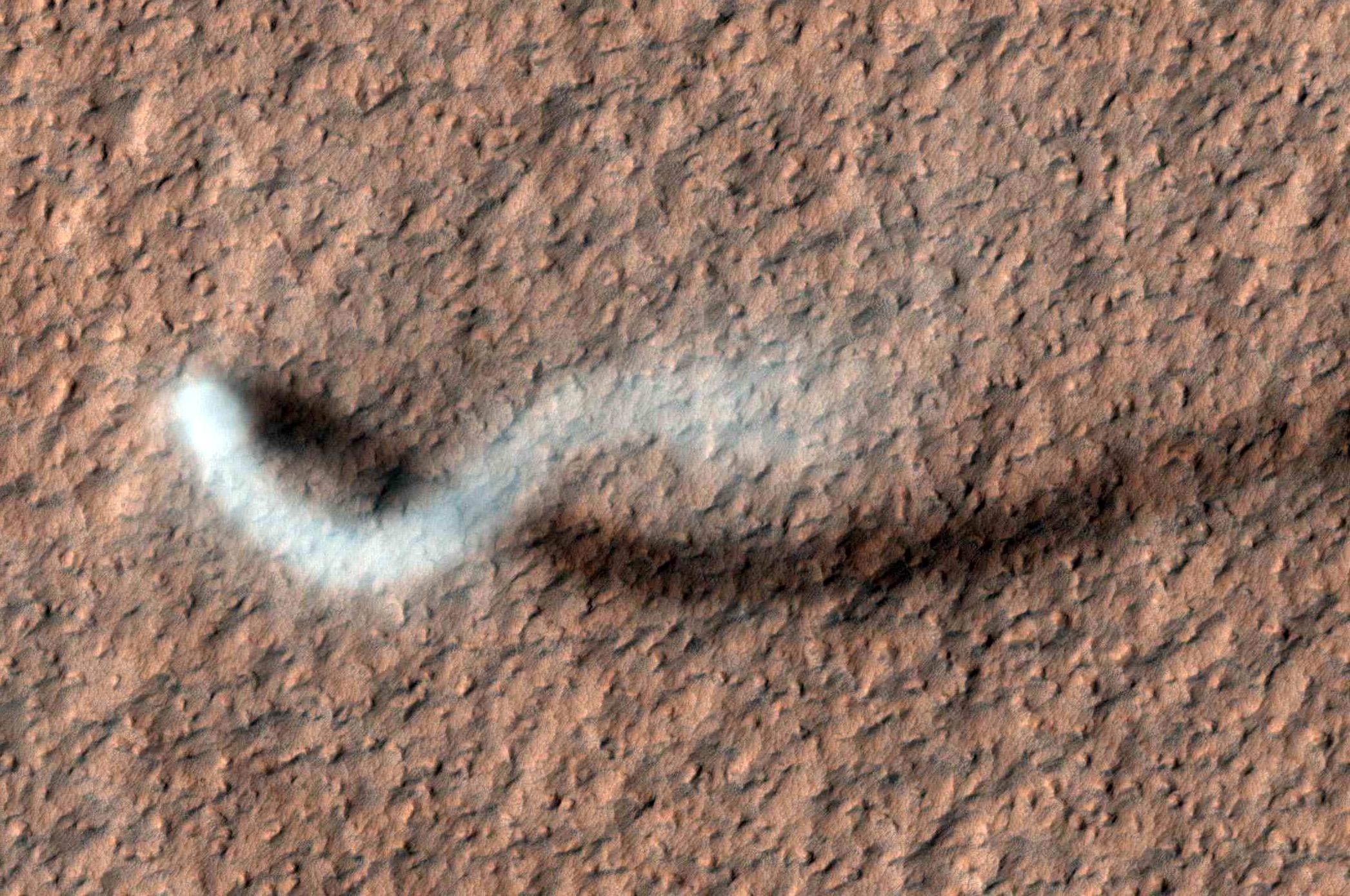
    Serpent Dust Devil of Mars
    A towering dust devil, casts a serpentine shadow over the Martian surface in this image acquired by the High Resolution Imaging Science Experiment (HiRISE) camera on NASA’s Mars Reconnaissance Orbiter. Credit: NASA/JPL-Caltech/University of Arizona

    A recent image captured by the High Resolution Imaging Science Experiment camera on NASA’s Mars Reconnaissance Orbiter shows a twisting column of dust more than half a mile high on the surface of Mars.

    An afternoon whirlwind on Mars lofts a twisting column of dust more than half a mile (800 meters) high in an image from the High Resolution Imaging Science Experiment (HiRISE) camera on NASA’s Mars Reconnaissance Orbiter.

    HiRISE captured the image on February 16, 2012, while the orbiter passed over the Amazonis Planitia region of northern Mars. In the area observed, paths of many previous whirlwinds, or dust devils, are visible as streaks on the dusty surface.

    The active dust devil displays a delicate arc produced by a westerly breeze partway up its height. The dust plume is about 30 yards or meters in diameter.

    The image was taken during the time of Martian year when that planet is farthest from the sun. Just as on Earth, winds on Mars are powered by solar heating. Exposure to the sun’s rays declines during this season, yet even now, dust devils act relentlessly to clean the surface of freshly deposited dust, a little at a time.

    Dust devils occur on Earth as well as on Mars. They are spinning columns of air, made visible by the dust they pull off the ground. Unlike a tornado, a dust devil typically forms on a clear day when the ground is heated by the sun, warming the air just above the ground. As heated air near the surface rises quickly through a small pocket of cooler air above it, the air may begin to rotate, if conditions are just right.

    The Mars Reconnaissance Orbiter has been examining Mars with six science instruments since 2006. Now in an extended mission, the orbiter continues to provide insights into the planet’s ancient environments and how processes such as wind, meteorite impacts and seasonal frosts continue to affect the Martian surface today. This mission has returned more data about Mars than all other orbital and surface missions combined.

    More than 21,700 images taken by HiRISE are available for viewing on the instrument team’s website: http://hirise.lpl.arizona.edu. Each observation by this telescopic camera covers several square miles, or square kilometers, and can reveal features as small as a desk.

    HiRISE is operated by the University of Arizona, Tucson. The instrument was built by Ball Aerospace & Technologies Corp., Boulder, Colo. The Mars Reconnaissance Orbiter Project and the Mars Exploration Rover Project are managed by the Jet Propulsion Laboratory, Pasadena, California, for NASA’s Science Mission Directorate, Washington. JPL is a division of the California Institute of Technology, also in Pasadena. Lockheed Martin Space Systems, Denver, built the orbiter.

    Never miss a breakthrough: Join the SciTechDaily newsletter.
    Follow us on Google and Google News.

    HiRISE JPL Mars Mars Reconnaissance Orbiter NASA Weather
    Share. Facebook Twitter Pinterest LinkedIn Email Reddit

    Related Articles

    Strange Circular Sand Dunes Discovered on Mars by NASA Spacecraft

    Mars Reconnaissance Orbiter Captured Perseverance During Descent to Red Planet

    Mars Reconnaissance Orbiter Examines a New Impact Crater

    Data Indicates Temperatures Rise and Fall Twice a Day on Mars

    Linear Gullies on Mars Caused by Sliding Dry-Ice

    Mars Orbiter Shows McLaughlin Crater May Have Once Held a Groundwater-Fed Lake

    Color HiRISE Image of Curiosity Rover on Mars

    NASA Detects Movement in Martian Sand Dunes

    HiRISE Images Show Old NASA Mars Lander

    Leave A Reply Cancel Reply

    • Facebook
    • Twitter
    • Pinterest
    • YouTube

    Don't Miss a Discovery

    Subscribe for the Latest in Science & Tech!

    Trending News

    Scientists Discover How Obesity May Trigger Alzheimer’s Disease

    Scientists Confirm Alcohol Causes Widespread Health Damage

    Researchers Discover Cannabis Compounds That May Fight Obesity Without the High

    Scientists Just Found Evidence That Asteroids May Have Helped Create Life on Earth

    Scientists Create “Trojan Horse” Weight Loss Drug That Supercharges Results

    Cats Have a Unique Kidney Chemistry That Could Be Harming Their Health

    Scientists Discover Major Errors in Al Gore-Founded Climate Pollution Database

    New Vitamin B12-Based Therapy Could Change How Brain Cancer Is Treated

    Follow SciTechDaily
    • Facebook
    • Twitter
    • YouTube
    • Pinterest
    • Newsletter
    • RSS
    SciTech News
    • Biology News
    • Chemistry News
    • Earth News
    • Health News
    • Physics News
    • Science News
    • Space News
    • Technology News
    Recent Posts
    • Researchers Say NASA Could Be Overlooking Signs of Alien Life
    • Loneliness May Hurt Memory but Not in the Way You Think
    • Scientists Identify Hidden Brain Pathway Behind GLP-1 Weight-Loss Effects
    • Study Warns Widely Used Food Preservatives Linked to High Blood Pressure and Heart Disease
    • Scientists Uncover Hidden Rare Earth Treasure Map Beneath Ancient Continents
    Copyright © 1998 - 2026 SciTechDaily. All Rights Reserved.
    • Science News
    • About
    • Contact
    • Editorial Board
    • Privacy Policy
    • Terms of Use

    Type above and press Enter to search. Press Esc to cancel.