
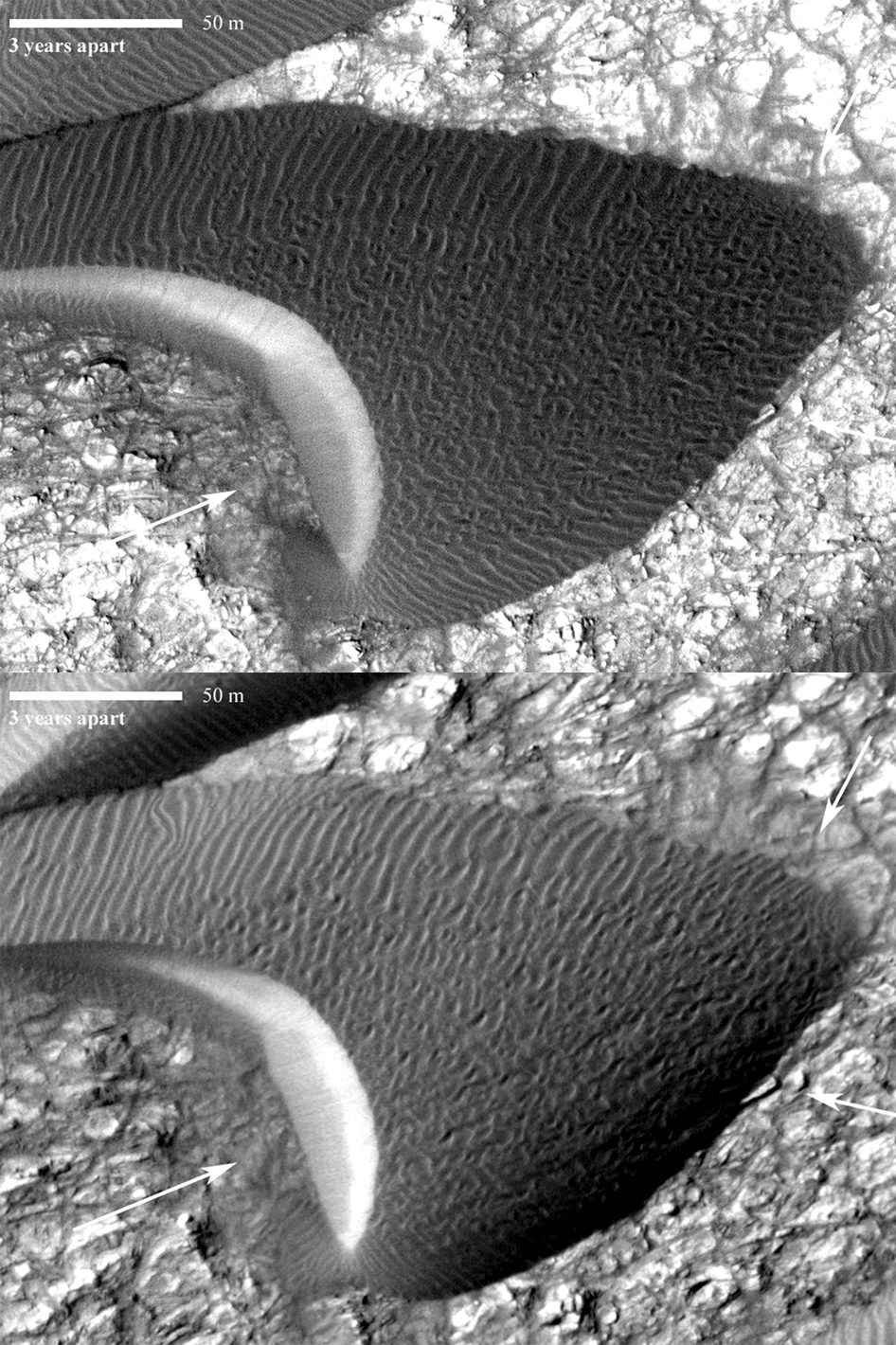
Over the last two years researchers have been monitoring the sand movement on Mars with the HiRISE camera. They found that even with a thinner atmosphere and less high-speed wind, movement in sand dune fields occurs at about the same rate as in dune fields on Earth.
NASA’s Mars Reconnaissance Orbiter has revealed that movement in sand dune fields on the Red Planet occurs on a surprisingly large scale, about the same as in dune fields on Earth.
This is unexpected because Mars has a much thinner atmosphere than Earth, is only about one percent as dense, and its high-speed winds are less frequent and weaker than Earth’s.
For years, researchers debated whether sand dunes observed on Mars were mostly fossil features related to past climate, rather than currently active. In the past two years, researchers using images from Mars Reconnaissance Orbiter’s High Resolution Imaging Science Experiment (HiRISE) camera have detected and reported sand movement.
Now, scientists using HiRISE images have determined that entire dunes as thick as 200 feet (61 meters) are moving as coherent units across the Martian landscape. The study was published online today in the journal Nature.
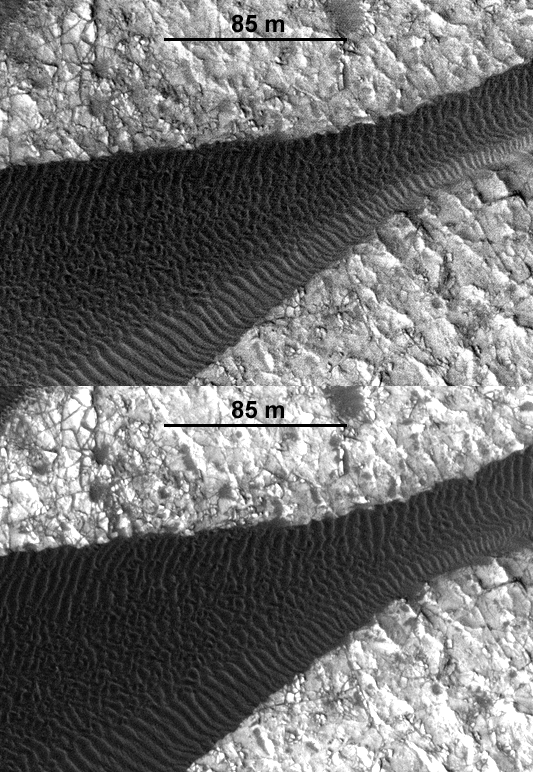
“This exciting discovery will inform scientists trying to better understand the changing surface conditions of Mars on a more global scale,” said Doug McCuistion, director, of NASA’s Mars Exploration Program, Washington. “This improved understanding of surface dynamics will provide vital information in planning future robotic and human Mars exploration missions.”
Researchers analyzed before-and-after images using a new software tool developed at the California Institute of Technology (Caltech) in Pasadena, California. The tool measured changes in the position of sand ripples, revealing the ripples move faster the higher up they are on a dune.
The study examined images taken in 2007 and 2010 of the Nili Patera sand dune field located near the Martian equator. By correlating the ripples’ movement to their position on the dune, the analysis determined the entire dune was moving. This allows researchers to estimate the volume, or flux, of moving sand.
“We chose Nili Patera because we knew there was sand motion going on there, and we could quantify it,” said Nathan Bridges, a planetary scientist at Johns Hopkins University Applied Physics Laboratory in Laurel, Md., and lead author of the Nature paper. “The Nili dunes also are similar to dunes in places like Antarctica and to other locations on Mars.”
The study adds important information about the pace at which blowing sand could be actively eroding rocks on Mars. Using the new information about the volume of sand that is moving, scientists estimate rocks in Nili Patera would be worn away at about the same pace as rocks near sand dunes in Antarctica, where similar sand fluxes occur.
“Our new data shows wind activity is indeed a major agent of evolution of the landscape on Mars,” said Jean-Philippe Avouac, Caltech team leader. “This is important because it tells us something about the current state of Mars and how the planet is working today, geologically.”
Scientists calculate that if someone stood in the Nili Patera dunes and measured out a one-yard (one-meter) width, they would see more than two cubic yards (1,500 liters) of sand pass by in an Earth year, about as much as in a child’s sandbox.
“No one had estimates of this flux before,” said Bridges. “We had seen with HiRISE that there was dune motion, but it was an open question how much sand could be moving. Now, we can answer that.”
Scientists will use the information to understand broader mysteries on Mars, like why so much of the surface appears heavily eroded, how that occurred, and whether it is a current process or it was done in the past. Scientists can now point to sand flux as a mechanism capable of creating significant erosion today on the Red Planet.
Reference: “Earth-like sand fluxes on Mars” by N. T. Bridges, F. Ayoub, J-P. Avouac, S. Leprince, A. Lucas and S. Mattson, 9 May 2012, Nature.
DOI: 10.1038/nature11022
Never miss a breakthrough: Join the SciTechDaily newsletter.
Follow us on Google and Google News.
1 Comment
Looks like the difference seen in the 85 m scale bar pictures is mostly from lighting and shadows…