
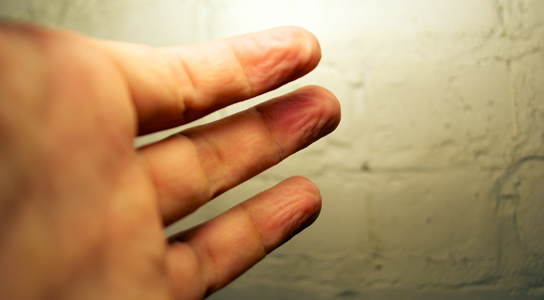
Scientists have discovered the reason why the skin on human fingers and toes shrivels up when soaked in water. Laboratory tests confirmed that wrinkly fingers improve the grip on wet or submerged objects, working away the water like rain treads in car tires.
The scientists published their findings in the journal Biology Letters¹. People wrongly assume that wrinkling is the result of water passing into the outer layer of the skin, making it swell up. Researchers have known since the 1930s that the effect doesn’t occur when there is nerve damage in the fingers. This indicates that the change is an involuntary reaction by the body’s autonomic nervous system, which also controls breathing, heart rate, and perspiration. Distinctive wrinkling is caused by blood vessels constricting below the skin.
In 2011, Mark Changizi, an evolutionary neurobiologist at 2AI Labs in Boise, Idaho, suggested that wrinkling must have an evolutionary function. The team demonstrated that the pattern of wrinkling appeared to be optimized for providing a drainage network which improved grip. Until now, there was no proof that wrinkly fingers did offer an actual advantage.
In this study, participants picked up wet or dry objects, which included marbles of different sizes with normal hands or with fingers wrinkled after soaking in warm water for 30 minutes. The participants were faster at picking up wet marbles with wrinkled fingers than with dry ones. Wrinkles made no difference for moving dry objects around.
Human ancestors could have used this adaptation to gather food from wet vegetation or streams. The analogous effect in toes could have helped them get a better footing in the rain. The scientists will have to check whether wrinkling occurs in other animals, besides humans and macaques.
Scientists believe permanently wrinkled fingers could diminish the sensitivity in human fingertips, or could increase the risk of damage through catching on objects, which is why human hands aren’t permanently wrinkled.
References:
“Water-induced finger wrinkles improve handling of wet objects” by Kyriacos Kareklas, Daniel Nettle and Tom V. Smulders, 23 April 2013, Biology Letters.
DOI: 10.1098/rsbl.2012.0999
“Are Wet-Induced Wrinkled Fingers Primate Rain Treads?” by M. Changizi, R. Weber, R. Kotecha and J. Palazzo, August 2011, Brain, Behavior and Evolution.
DOI: 10.1159/000328223
Never miss a breakthrough: Join the SciTechDaily newsletter.
Follow us on Google and Google News.
3 Comments
Just because finger wrinkles improve some kind of function, does not mean they were evolved for that purpose. We are not perfectly evolved specimens, lots of our traits are incidental quirks. This is precisely what is wrong with our societal assumptions of evolution.
The actual context of the article is forgotten. If you take a bath or swim the whole body is not wrinkled except the palm, when exposed more to water. Water does not pass through epidermis and make it bloat, as it happens when a person is drowned. It is only the neural response in the palm that makes the skin to wrinkle by shrinking blood vessels and hence it is stated that this may be due to evolutionary traits to find more grip. After all evolution has given shiny and water resistant surface to fishes and other aquatic birds to glide in the water. Man solely depends on his hands for survival in water and better grip is called for. Thank YOu.
“Human ancestors could have used this adaptation to gather food from wet vegetation or streams.”
🙂
Yes, it fits our “littoral theory” (or “coastal dispersal model”) that early-Pleistocene archaic Homo (during the Ice Ages on the exposed continental shelves?) followed the coasts as far as Indonesia, Angola & England (coastal sites of Mojokerto, Dungo V & Happisburgh), where they collected shallow aquatic & waterside foods, and from the coasts trekked inland along the rivers, possibly at first only seasonally, eg, following trekking fish?
Google
-econiche Homo
-misinterpretations Verhaegen
-Rhys Evans vaneechoutte