
Artist’s illustration of a star with an Earth-like planet. Credit: IAC
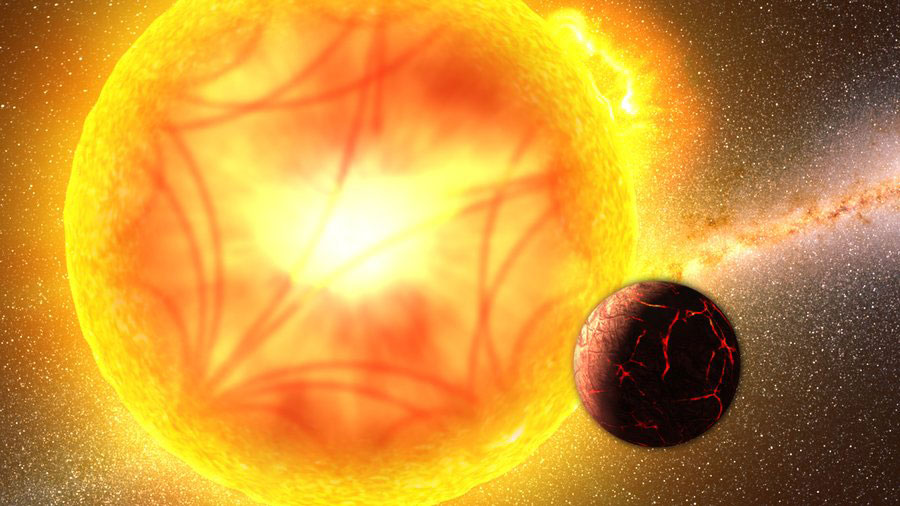
A newly published study has shown with high precision that even stars older than 11 billion years have Earth-like planets.
A new study of 33 Kepler stars with solar-like oscillations to be published in Monthly Notices of the Royal Astronomical Society. According to lead author of the article Víctor Silva Aguirre from the Stellar Astrophysics Center at Aarhus University, Denmark: ” Our team has determined ages for individual host stars before with similar levels of accuracy, but this constitutes the best characterized set of exoplanet host stars currently available.”
Measuring the ages of stars is one of the very tough problems that contemporary astronomers are faced with. Up to now only the age of the Sun has been determined with high precision (it is 4.57 billion years, with a precision of 10 million years to each side). The international group of astronomers have determined the ages, diameters, densities, masses, and distances for 33 stars better than ever before. As an extra, all of these stars have earth-like planets, giving us a clear indication that such planets have formed in our Milky Way Galaxy long before the Earth and are still being formed out there.
The 33 stars have been carefully selected from the more than 1,200 stars with planets around them that have been observed with the highly successful Kepler satellite. The stars have to be sufficiently bright to give a good statistical basis for the results, and they have to show some of the same characteristics similar to the Sun to make them comparable.
Stars pulsate, vibrate, and resonate just like sound waves in a musical instrument. The advanced technique of measuring these starry tunes is called asteroseismology – a method quite similar to the one used by geologists to sound out the composition of the interior of the Earth by means of earthquakes.
The NASA-launched Kepler satellite has constantly measured tiny variations in the light from some 145,000 stars over a period of a little more than four years. Analyzing these variations over time gives the periods of the many simultaneous pulsations in each star, and from that the scientists can derive the important basic properties of the individual stars.
Why is it important
Knowing the ages, sizes, and other basic parameters of the stars, apart from being interesting in itself, is important if one wants to study the large scale development of our galaxy and the Universe as a whole – a relatively new discipline named “galactic archeology”. We all wish to know where we came from! On a more practical level, the stars function in largely the same way as a fusion reactor. Precise knowledge of the internal machines in stars might help in future energy production here on Earth.
It is not the first time that the precise ages of individual stars have been determined. But using a large sample and studying them with the same instrument – the Kepler satellite – and the same theoretical and statistical methods gives us a much higher confidence in the precision of the results. Comparing the stars may also reveal unusual and so far unknown stellar properties.
With a large, and hopefully growing, set of well-studied stars it will be possible to expand our knowledge even to stars which are too faint to obtain asteroseismological values for. The precise knowledge especially of stellar ages can be related to the properties of the light; the spectra, from the same stars. This gives us a set of well-known calibration stars and thus it enables us to work backwards from spectroscopy of faint stars to their ages.
How is it done
The 33 stars selected for the study are not all similar to the Sun, but they behave in much the same way as the Sun does. They are technically referred to as “solar-like oscillators.” Víctor Silva Aguirre explains: “The term solar-like oscillators means that the stars exhibit pulsations excited by the same mechanism as in the Sun: gas bubbles moving up and down. These bubbles produce sound waves that travel across the interior of stars, bouncing back and forth between the deep interior and the surface producing tiny variations in the stellar brightness.”
How precise?
The new study gives us values for the selected stars with unprecedented precision. On the average stellar properties are better than the percentages below. If a star e.g. has a calculated age of 5 billion years, the 14% means that its true age lies between 4.3 and 5.7 billion years:
1.2% (radius),
1.7% (density),
3.3% (mass),
4.4% (distance),
and 14% (age).
Are they representative?
All the stars studied by the Kepler satellite lie in a small area of the sky, close to the constellation of Cygnus. The 33 stars in this study span distances between 100 and 1600 light-years from the Sun. With such a small area of the Milky Way Galaxy studied over such relatively short time, one could wonder if the stars selected for the study are at all representative for the more than 300 billion stars in our galaxy. The answer is a qualified “yes”. Certainly the astronomers would like to study many more stars for much longer time, but for the time being and compared to what was previously known this is a large first step. In the future, we will be able to study larger samples of stars, selected from a larger area of sky with the current Kepler2 project and from 2017 on hopefully from all over the sky with the TESS-satellite. Even better results are expected from the PLATO-satellite due to be launched by the European Space Agency in the mid-2020’ies.
What about those planets
The Kepler satellite is able to provide two very different types of results with the same sort of measurements. From the small variations in the intensity of starlight, one can both deduce asteroseismic values of the stars and also discover any exoplanets circling the stars. Determining the exact properties of these exoplanets is only possible if we also know the basics of the host stars, and these come from asteroseismology. The two fields of astronomy are closely connected. Assistant Professor Silva Aguirre sums up:
“One of the biggest questions in astrophysics is: does life exists beyond Earth? To even begin answering this, we need to know how many planets like ours exist out there, and when they formed. However determining ages of stars (and thus of their orbiting planets) is extremely difficult; precise ages are only available for a handful of host stars thanks to asteroseismic observations made with the Kepler satellite.
Our study provides the first sample of homogeneously determined ages for tens of exoplanet host stars with a high level of precision. The stars we studied harbor exoplanets of size comparable to Earth (between 0.3 and 15 Earth radii), and our results reveal a wide range of ages for these host stars, both younger (down to half the solar age) and older (up to 2.5 times the solar age) than the Sun. This is regardless of the size of the exoplanets in the system or multiplicity, showing that formation of exoplanets similar in size to Earth has occurred throughout the history of our Galaxy (and is still taking place!). Actually some of these planets were of the same age as the Earth is now, at the time when the Earth itself formed. This in itself is a remarkable finding.”
Reference: “Ages and fundamental properties of Kepler exoplanet host stars from asteroseismology” by V. Silva Aguirre, G.R. Davies, S. Basu, J. Christensen-Dalsgaard, O. Creevey, T.S. Metcalfe, T.R. Bedding, L. Casagrande, R. Handberg, M.N. Lund, P.E. Nissen, W.J. Chaplin, D. Huber, A.M. Serenelli, D. Stello, V. Van Eylen, T.L. Campante, Y. Elsworth, R.L. Gilliland, S. Hekker, C. Karoff, S.D. Kawaler, H. Kjeldsen and M.S. Lundkvist, 23 July 2015, MNRAS.
DOI: 10.1093/mnras/stv1388
arXiv: 1504.07992
Never miss a breakthrough: Join the SciTechDaily newsletter.
Follow us on Google and Google News.
2 Comments
Am baffled. The high precision referred to is based on Earth, meteorites from the inner planets which if the sun, Sol, is a result of a planetary nova means that the ‘evidence’ is circular reasoning. The reason the asteroid belt was not recognized as a destroyed planet is that there was not sufficient material present. Perhaps if you count the now phenomenally greater amounts of dust around Saturn and the orbiting bodies around Jupiter and Saturn subtracted from the supposed required weight for the missing planet, one might have the mass that created the giant red spot on Jupiter.
Also confused as to age of stars discovered to have earth-like planets. If 11 by old stars have earth like planets that would mean that this is typical of very aged suns. That earth-like planets are an indicator of old suns.
The Sun, like the Milk Way, has an age very close to the formation of the Universe. Earth itself abandoned the solar corona, proto-star at a date close to the universal age. Studies have shown that the planet Earth left the protostar at least 14,181,000,000 years ago, when the universe was 1,043,000,000 years old. Neptun abandoned the proto-sun when the universe had 195,900,000 years ago, that is, 15,028,000,000 years ago
http://www.sciepub.com/IJP/abstract/12459