
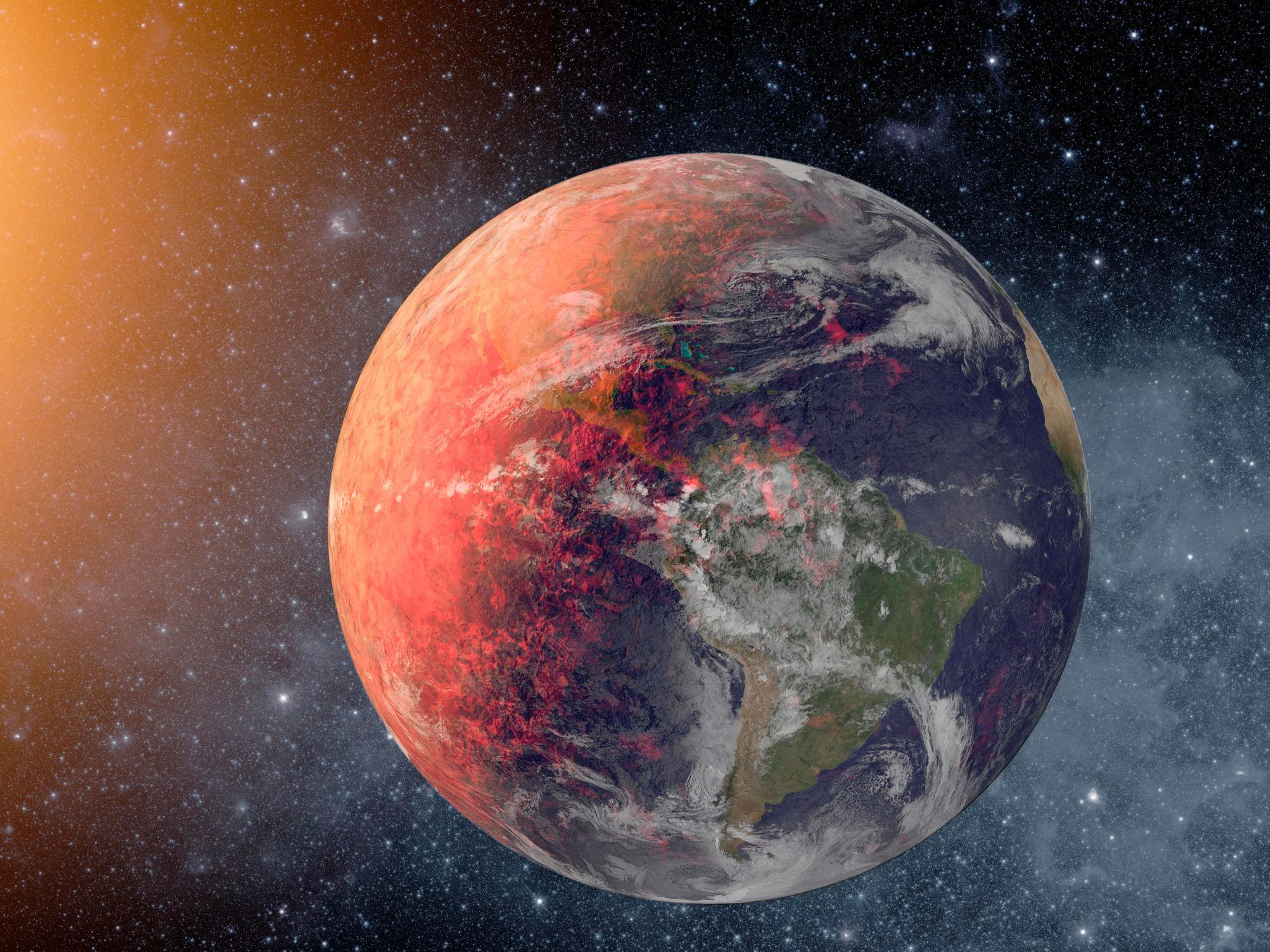
A team from UNIGE analyzed 56 million-year-old sediments to determine the rise in soil erosion due to global warming, which is associated with significant flooding.
Around 56 million years ago, Earth underwent significant and swift climate warming, likely triggered by greenhouse gases emitted from volcanic eruptions. Researchers from the University of Geneva (UNIGE) have studied sediments from this era to evaluate the effects of this climate change on the environment, focusing particularly on soil erosion.
The study revealed a four-fold increase in soil erosion due to heavy rainfall and river flooding. These results suggest that current warming could have a similar effect over time, significantly increasing flood risks. They are published in the journal Geology.
Because of its similarities to current warming, the Paleocene-Eocene Thermal Maximum is closely studied to understand how the Earth’s environment reacts to a global rise in temperature. Occurring 56 million years ago, this episode saw the Earth warm by 5 to 8°C within 20,000 years, a very short time at the geological scale. It lasted for 200,000 years, causing major disruption to flora and fauna. According to recent IPCC reports, the Earth is now on the brink of a similar warming.
Scientists are analyzing sediments from this period to obtain a more accurate ‘‘picture’’ of this past warming and its consequences and to make predictions for the future. These natural deposits are the result of soil erosion by water and wind. They were carried by rivers into the oceans. Now preserved in rocks, these geological archives provide valuable information about our past, but also our future.
Four times more erosion
‘‘Our starting hypothesis was that, during such a period of warming, the seasonality and intensity of rainfall increases. This alters the dynamics of river flooding and intensifies sediment transport from the mountains to the oceans. Our objective is to test this hypothesis and, above all, to better quantify this change,’’ explains Marine Prieur, a doctoral student in the Section of Earth and Environmental Sciences at the UNIGE Faculty of Science, and first author of this study funded by the European Union’s Horizon 2020 program.
The research team studied a specific type of sediment, Microcodium grains, collected in the Pyrenees (around 20kg). These prisms of calcite, no more than a millimeter in size, were specifically formed at this period around the roots of plants, in the soil. However, they are also found in marine sediments, proving their erosion on the continent. Therefore, Microcodium grains are a good indicator of the intensity of soil erosion on the continents.
‘‘By quantifying the abundance of Microcodium grains in marine sediments, based on samples taken from the Spanish Pyrenees, which were submerged during the Palaeocene-Eocene, we have shown a four-fold increase in soil erosion on the continent during the climate change that occurred 56 million years ago,’’ reveals Sébastien Castelltort, a full professor in the Section of Earth and Environmental Sciences at the UNIGE Faculty of Science, who led the study.
Human action will exacerbate the phenomenon
This discovery highlights the significant impact of global warming on soil erosion through the intensification of rainfall during storm events and the increase in river flooding. This is an indicator of heavy flooding. ‘‘These results relate specifically to this area of the Pyrenees, and each geographical zone is dependent on certain unique factors. However, increased sedimentary input in the Paleocene-Eocene strata is observed worldwide. It is, therefore, a global phenomenon, on an Earth-wide scale, during a significant warming event,’’ points out Marine Prieur.
These results provide new information that can be incorporated into predictions about our future climate. In particular, to better assess the risks of flooding and soil collapse in populated areas. ‘‘We need to bear in mind that this increase in erosion has occurred naturally, under the effect of global warming alone. Today, to predict what lies ahead, we must also consider the impact of human action, such as deforestation, which amplifies various phenomena, including erosion,’’ conclude the scientists.
Reference: “Fingerprinting enhanced floodplain reworking during the Paleocene–Eocene Thermal Maximum in the Southern Pyrenees (Spain): Implications for channel dynamics and carbon burial” by Marine Prieur, Alexander C. Whittaker, Perach Nuriel, Rocío Jaimes-Gutierrez, Eduardo Garzanti, Marta Roigé, Tor O. Sømme, Fritz Schlunegger and Sébastien Castelltort, 23 May 2024, Geology.
DOI: 10.1130/G52180.1
Never miss a breakthrough: Join the SciTechDaily newsletter.
Follow us on Google and Google News.
4 Comments
The other side of the coin is that the warm Eocene epoch was a time of rapid evolution of mammals, with diversification and increase in size, including the development of primates, from which humans are derived. The PETM is blamed on vulcanism, yet during the following epoch, the Oligocene, it was clearly volcanically more active, with volcanoes burying the Eocene landscape in the western USA in ash and lava, and an extinction event happened at the boundary between the Eocene and Oligocene, resulting in part from the Oligocene cooling. The Eocene in California is characterized by the development of deep (200-300′) lateritic soils obtained by chemical weathering, and several south-draining rivers, some rivaling the present day Mississippi. The large rivers had low grades and were meandering like the modern Mississippi, moving primarily fine-grained material. The animals and plants living on the flood plains were obviously adapted to that environment. Worrying about what might be in the future, using a model of a salubrious climate that fostered biological diversity does not result in a convincing argument for concern. When climate or landforms change, there is always disruption to the status quo, which drives evolution. Unless one can present a convincing argument that evolution is bad for the biosphere, and humans should do whatever they can to prevent it, the concern falls flat. The only thing that has been constant on Earth is change.
How many millions? Is this data posted as fact, observed, replicable, and documented? Looks to me like the clang of the Uniformitarian bell, the presuppositional god of evolutionary ancient age pandering. The truth is an Occams Razor reality. Here, change is inevitable, both slow and rapid.
Man want change over millions of years, not supported by observed evidence.
Funny that. All this time the scientific documentaries kept telling us that historic volcanic eruptions caused global cooling. Guess they will have to burn the BBC archive now.
I suspect that the effects are variable, depending on where the eruptions take place, how high the ejecta reach, and the amount of H2O, SO2, and CO2 that are present, which varies with the kind of rock the magma is composed of.