
Close Menu
    Facebook X (Twitter) Instagram
    SciTechDaily
    • Biology
    • Chemistry
    • Earth
    • Health
    • Physics
    • Science
    • Space
    • Technology
    Facebook X (Twitter) Pinterest YouTube RSS
    SciTechDaily
    Home»Space»How Space Weather, Such As Stellar Flares, Affects a Planet’s Habitability
    Space

    How Space Weather, Such As Stellar Flares, Affects a Planet’s Habitability

    By New York UniversityNovember 8, 2020No Comments3 Mins Read
    Facebook Twitter Pinterest Telegram LinkedIn WhatsApp Email Reddit
    Share
    Facebook Twitter LinkedIn Pinterest Telegram Email Reddit
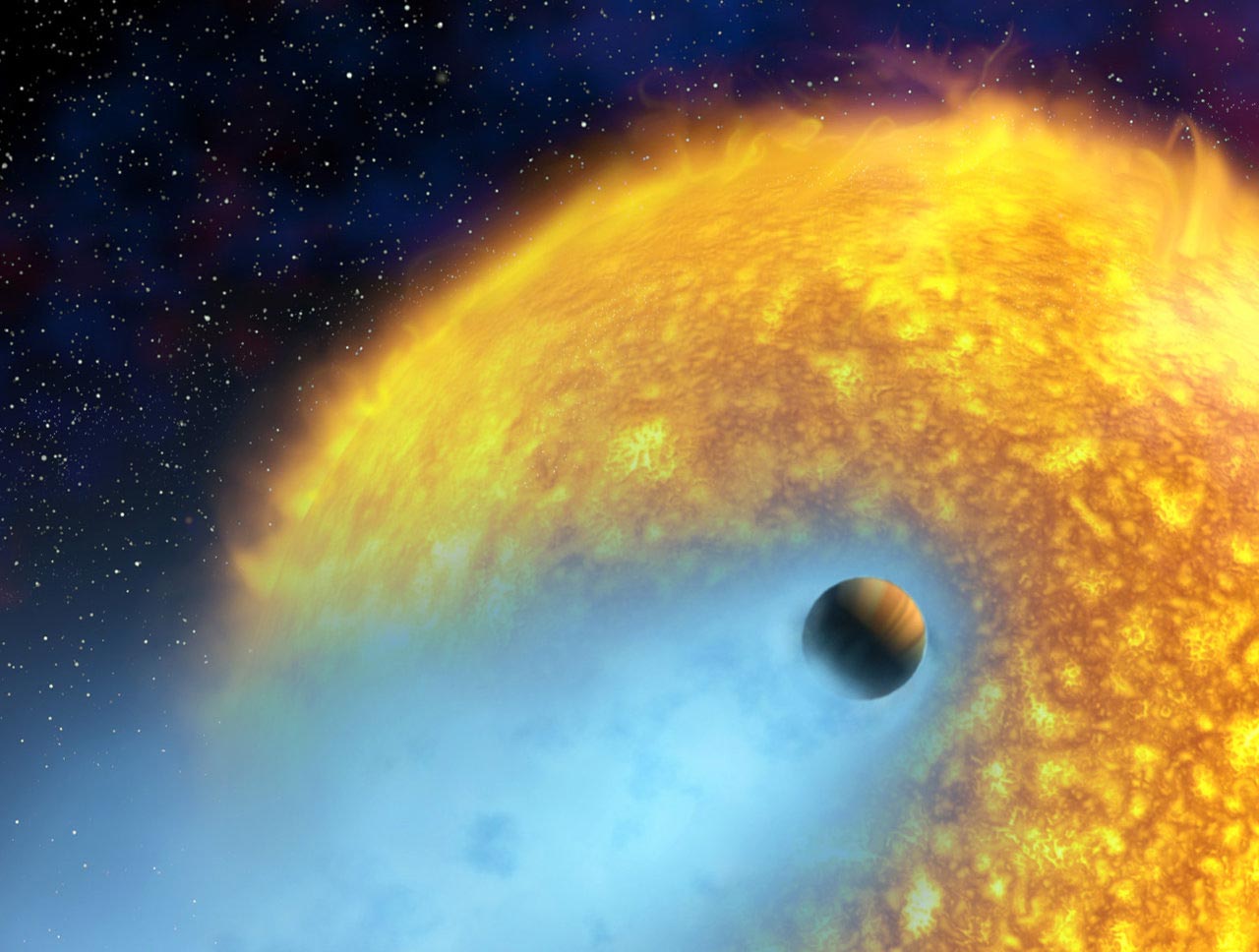
    Exoplanet HD 209458 b
    An artist’s conception of HD 209458 b, an exoplanet whose atmosphere is being torn off at more than 35,000 km/hour by the radiation of its close-by parent star. This hot Jupiter was the first alien world discovered via the transit method, and the first planet to have its atmosphere studied. Credit: NASA/European Space Agency/Alfred Vidal-Madjar (Institut d’Astrophysique de Paris, CNRS)
    • Planetary habitability, defined by a planet’s ability to sustain liquid water on its surface, is one of the most important concepts in exoplanet science.
    • Exoplanets (planets that orbit stars outside of our solar system) are subject to space weather in the form of stellar flares, emissions of radiation from stars.
    • These emissions consist of extreme ultraviolet (XUV) photons and charged particles and can alter the upper atmosphere of the exoplanet. Current methods to determine a planet’s ability to support life do not take stellar activity into consideration.

    In a new study researchers, led by Research Scientist Dimitra Atri of the Center for Space Science at NYU Abu Dhabi (NYUAD), identified which stars were most likely to host habitable exoplanets based on the calculated erosion rates of the planetary atmospheres.

    In the paper titled “Stellar flares versus luminosity: XUV-induced atmospheric escape and planetary habitability,” published in the journal Monthly Notices of Royal Astronomical Society: Letters, Atri and graduate student Shane Carberry Mogan present the process of analyzing flare emission data from NASA’s TESS (Transiting Exoplanet Survey Satellite) observatory.

    It was found that more frequent, lower energy flares had a greater impact on an exoplanet’s atmosphere than less frequent, higher energy flares. The researchers also determined how different types of stars extreme ultraviolet radiation (XUV) through stellar flares, and how nearby planets are affected.

    The ability to sustain an atmosphere is one of the most important requirements for a habitable planet. This research provides new insights into the habitability of exoplanets, as the effects of stellar activity were not well understood. This study also highlights the need for better numerical modeling of atmospheric escape — how planets release atmospheric gases into space — as it can lead to the erosion of atmosphere and the diminishment of the planet’s habitability.

    “Given the close proximity of exoplanets to host stars, it is vital to understand how space weather events tied to those stars can affect the habitability of the exoplanet,” said Atri. “The next research step would be to expand our data set to analyze stellar flares from a larger variety of stars to see the long-term effects of stellar activity, and to identify more potentially habitable exoplanets.”

    Reference: “Stellar flares versus luminosity: XUV-induced atmospheric escape and planetary habitability” by Dimitra Atri and Shane R Carberry Mogan, 9 November 2020, Monthly Notices of Royal Astronomical Society: Letters.
    DOI: 10.1093/mnrasl/slaa166

    Never miss a breakthrough: Join the SciTechDaily newsletter.
    Follow us on Google and Google News.

    Astrobiology Astronomy New York University Planets Space Weather Stars
    Share. Facebook Twitter Pinterest LinkedIn Email Reddit

    Related Articles

    Astronomers Discover Pair of Lonely Exotic Planet-Like Objects Born Like Stars

    Stellar Flares With a Chance of Radio Bursts: Space Weather Discovery Puts “Habitable Planets” at Risk

    Rapid-Forming Giant Planets Could Disrupt Spiral Protoplanetary Discs

    Signs of Life on Venus? What This Means for Earthlings

    Some Planets May Be Better for Life Than Earth: Researchers Identify 24 Superhabitable Exoplanets

    If It Wasn’t for Jupiter, Venus Might Be Habitable Today

    Astronomers Find Possible Signs of Life on Venus

    Extreme Solar Events and the Search for Habitable Exoplanets

    Scientists Determine the Interior Rotation of a Sun-Like Star

    Leave A Reply Cancel Reply

    • Facebook
    • Twitter
    • Pinterest
    • YouTube

    Don't Miss a Discovery

    Subscribe for the Latest in Science & Tech!

    Trending News

    Scientists Finally Uncover How a “Forever Chemical” Causes Birth Defects

    Scientists Uncover the Earliest Brain Changes That May Predict Alzheimer’s Decades Before Symptoms

    Surprising New Study Challenges a Century-Old Theory of Habit Formation

    Scientists Turn Seawater Into Drinking Water Without Toxic Brine

    Vitamin D Drug Shows Surprising Promise Against One of the Deadliest Cancers

    NASA’s X-59 Sonic Boom Killer Is Ready for Its Biggest Test Yet

    The Best Exercise Combination for Longevity, According to a 30-Year Study

    Popular Weight-Loss Drug Found To Slow Biological Aging in Landmark Human Trial

    Follow SciTechDaily
    • Facebook
    • Twitter
    • YouTube
    • Pinterest
    • Newsletter
    • RSS
    SciTech News
    • Biology News
    • Chemistry News
    • Earth News
    • Health News
    • Physics News
    • Science News
    • Space News
    • Technology News
    Recent Posts
    • The Probiotic Breakthrough for Natural Anxiety Relief and Better Mental Health
    • Animal vs. Plant Protein: Scientists Found a Surprising Nutritional Difference
    • Tiny Genetic Change Turns Female Mice Into Males, Scientists Discover
    • Scientists Discover Strange New Spider Species That Disguises Itself as a Fungus
    • This Simple Drink Could Help Calm the Inflammation Behind Many Diseases
    Copyright © 1998 - 2026 SciTechDaily. All Rights Reserved.
    • Science News
    • About
    • Contact
    • Editorial Board
    • Privacy Policy
    • Terms of Use

    Type above and press Enter to search. Press Esc to cancel.