
An analysis of more than 1,000 gene activity profiles from mouse brains reveals shared molecular patterns that vary by sex and respond differently to experimental drugs.
Autism spectrum disorder (ASD), a condition involving differences in brain development, has been linked to more than 1,200 risk genes. Studying mutations individually has revealed many effects on the brain, while leaving researchers searching for the biology those changes share. A large study of mice now suggests that genetically different models can fall into two groups with opposing patterns of gene activity.
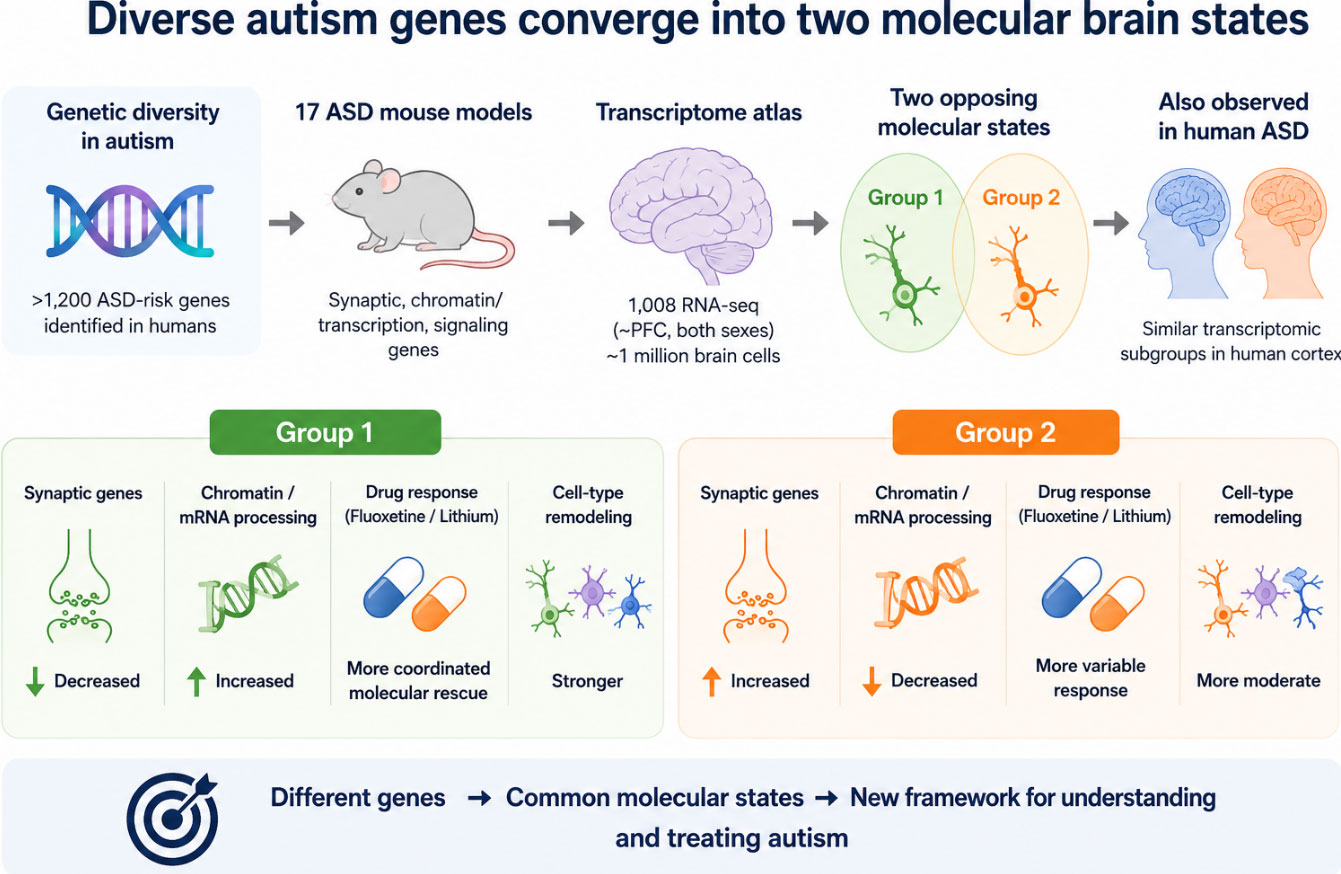
The research team, led by Professor Eunjoon Kim of the Center for Synaptic Brain Dysfunctions within the Institute for Basic Science (IBS), analyzed more than 1,000 mouse brain transcriptomes, RNA-based readouts of gene activity. The two patterns offered a way to compare different mutations and investigate why their responses to experimental drugs might differ.
“Instead of asking which gene is mutated, we asked whether different mutations produce common molecular patterns in the brain,” said Kim. “That perspective revealed a surprising level of convergence across genetically distinct forms of autism.”
Two opposing patterns of gene activity
The analysis drew on RNA-sequencing data from the prefrontal cortex, a region at the front of the brain, in 17 genetically engineered mouse lines. Their mutations affected genes involved in communication between nerve cells, regulation of gene activity, and cell signaling. The study included both male and female mice.
Genes involved in synaptic communication, the exchange of signals at connections between nerve cells, were generally less active in Group 1 and more active in Group 2. Genes involved in RNA processing and chromatin regulation followed the reverse pattern, with higher activity in Group 1 and lower activity in Group 2. Chromatin is the combination of DNA and proteins whose organization helps control which genes are active.
The division appeared across complementary analyses of gene activity, RNA splicing, the process of joining RNA segments together, and networks of genes that tend to be active together. Finding the distinction through different approaches suggested that it reflected recurring biological patterns rather than the results of a single analytical method.
Different gene responses to experimental drugs
Those patterns gave the team a basis for comparing responses to fluoxetine, commonly known as Prozac, and lithium. Both drugs have previously been investigated for their effects on autism-related behaviors in selected mouse models, although neither is an established treatment for the core features of autism.
The study included mice exposed to the drugs during early postnatal development. In Group 1, treatment shifted certain sets of genes more consistently toward the activity patterns seen in control mice. Group 2 responded more variably, with effects depending on the gene set and cell type examined.
To understand the cellular changes underlying these patterns, the researchers also analyzed gene activity in approximately one million individual cell nuclei from 205 mice. Both groups showed distinct changes across several types of brain cells. Group 1 also had broader differences in the relative proportions of certain neuronal populations and glial cells, which support and interact with neurons.
Together, these findings suggested that the opposing patterns involved coordinated changes across multiple cell types rather than a single population of nerve cells. The drugs did not reverse the differences in the relative proportions of brain-cell populations. Their effects were concentrated in particular programs of gene activity, including those in selected neuronal populations.
The treatment results could help researchers investigate why genetically different mouse models respond differently to experimental drugs. Changes in gene activity, however, do not necessarily mean improvements in behavior, and the study did not establish the clinical effectiveness of either medication.
The same mutation, different molecular patterns
Males and females carrying the same mutation belonged to different molecular groups in seven of the 17 mouse lines. Group assignments could also change during development. Among four representative mouse lines examined at a later developmental stage, some retained their original assignments while others switched.
The distinction between the groups was much less pronounced in the hippocampus, a brain region involved in memory, than in the prefrontal cortex. The groups therefore described patterns of gene activity that depended on sex, developmental stage, and brain region, rather than permanent categories assigned to individual mutations.
“Genetic discoveries have revealed extraordinary diversity in autism, but diversity alone does not explain the biology,” said co-corresponding author Dr. Mihyun Bae. “Our study suggests that many different genetic mutations converge into a limited number of molecular brain states, providing a framework for understanding autism at the level of shared biology rather than individual genes.”
Opposing synaptic gene activity in humans
Beyond the original mouse models, three additional mouse lines could be provisionally assigned to the two groups. The researchers also examined previously collected prefrontal-cortex transcriptomic data from 40 autistic individuals and 17 neurotypical controls, identifying two human subgroups with opposing patterns of synaptic gene activity.
The human findings differed from the mouse results in several respects. Changes in immune-related pathways were more prominent in the human samples, while some other molecular differences were less pronounced. The available data also could not connect human subgroup membership to specific autism-risk mutations.
These preliminary findings do not establish two clinical types of autism or provide a way to predict a person’s symptoms, support needs, or response to medication. Determining whether the molecular patterns can help guide therapy development and evaluation will require further research combining gene-activity measurements with behavioral assessments, studies of brain circuits, and additional experimental treatments.
Reference: “Transcriptome-based classification in mice with ASD-risk mutations” by Junyeop Daniel Roh, Yukyung Jun, Heesu Jeon, Junyoung Kim, Yunho Yi, Minji Kim, Heejin Cho, Yusang Oh, Heera Moon, Jinkyeong Kim, Seongbin Kim, Jeseung Ryu, Muwon Kang, Jisoo Kim, Yeonghyeon Kim, Yewon Jung, Taesun Yoo, Hyoseon Oh, Hyosang Kim, Chunmei Jin, Yeji Yang, Gahyeon Choi, Sunjoo Ahn, Jin Young Kim, Hyojin Kang, Mihyun Bae and Eunjoon Kim, 17 September 2026, Science.
DOI: 10.1126/science.adz6688
Funding: Institute for Basic Science
Never miss a breakthrough: Join the SciTechDaily newsletter.
Follow us on Google and Google News.
1 Comment
i have a very strong theory as to the origins of autism and other neurological conditions, the environment. just think scientists are finding gardening herbicides and pesticides causing cancer today, so whats to say that for the last 100+ years the environment has been polluted by the industrial revolution, the leaded petrol in cars, the stuff buried in the ground cars, vans, agricultural machinery, etc. all of that is causing more issues later on