

Stanford physicists observed a tiny vibrating structure lose a single unit of sound energy in a sudden quantum jump. The finding could help advance quantum computing and precision sensing.
A tiny mechanical resonator, a structure that vibrates like a tuning fork, has given Stanford researchers a close look at how sound disappears at the quantum scale. They watched it lose a single phonon, the smallest discrete unit of sound, in the first direct observation of a quantum jump of sound.
A phonon represents the coordinated movement of a large group of atoms, just as a photon is a quantum of light. Although a ringing bell seems to fade smoothly, a resonator’s vibrational energy changes in discrete steps. These sudden transitions between energy states are called quantum jumps.
Quantum jumps can signal computing errors
The team, led by Stanford physicist Amir Safavi-Naeini, reported its findings in Science. Detecting these jumps could help researchers address a persistent problem in quantum computing: recognizing when something has gone wrong during a calculation.
Quantum computers have the potential to handle some complex calculations beyond the capabilities of conventional computers, but their fragile quantum states can develop errors before the work is finished. In many proposed quantum computing architectures, a quantum jump represents an error. Pinpointing when those jumps occur has been difficult, so tracking them in sound offers a step toward correcting them.
Two milliseconds to track one phonon
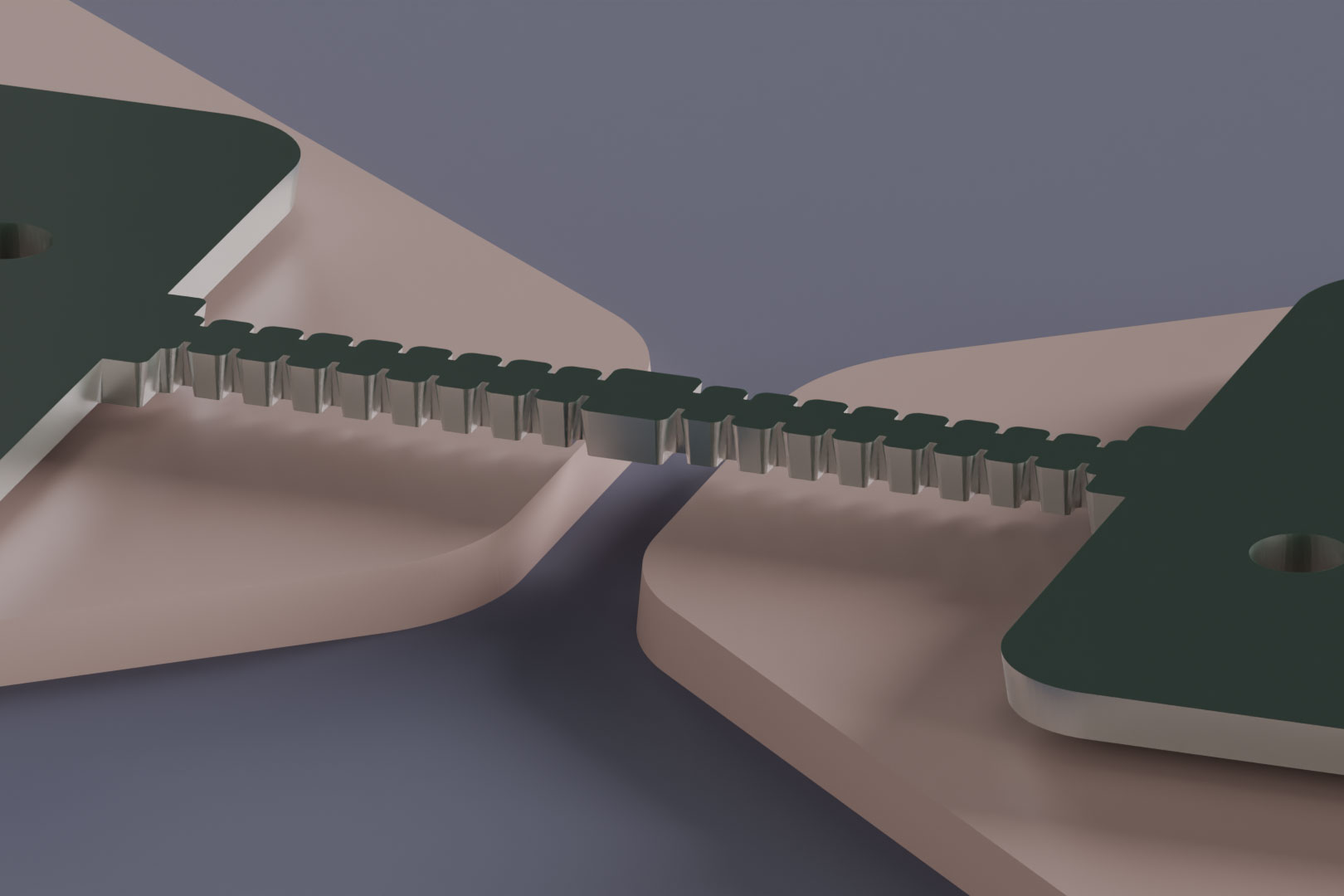
Making that measurement required a detector that could repeatedly check the resonator without disrupting its fragile quantum state. Study co-first authors Takuma Makihara and Erik Szakiel developed a way to connect the resonator to a superconducting qubit, an electrical circuit that can store quantum information and act as a detector.
“We had to continually develop new processes to make this extremely long-lived, vibrating object and then integrate it with the qubit, which is our little electrical detector—without ruining either subsystem,” said Makihara, a recent Stanford doctoral graduate.
The resonator’s ability to keep vibrating gave the detector enough time to work. It could ring for two milliseconds, a duration that would correspond to several hours of ringing in a regular-sized tuning fork with the same capability. This unusually long “ringdown time,” the time over which the vibration fades, allowed the researchers to take hundreds of readings.

During those repeated checks, the qubit distinguished between a state containing one phonon and a state containing none. By following the readings over time, the researchers could identify the moment the resonator jumped from the state labeled 1 to the state labeled 0.
The result extends an experimental history stretching back more than a century. Quantum jumps were theorized in the early 1900s, first demonstrated in trapped ions in 1986, and later observed in photons in 2007. Earlier sound experiments had provided evidence of quantum jumps, but had not directly tracked individual jumps in real time.
Toward detecting proteins inside cells
“What this study shows will allow us to move forward with developing new quantum technologies with sound,” said Safavi-Naeini, an associate professor of applied physics in Stanford’s School of Humanities and Sciences. “We have seen that vibrating objects can exhibit quantum behavior, which is the prerequisite for many of the operations needed by quantum computing and sensing.”
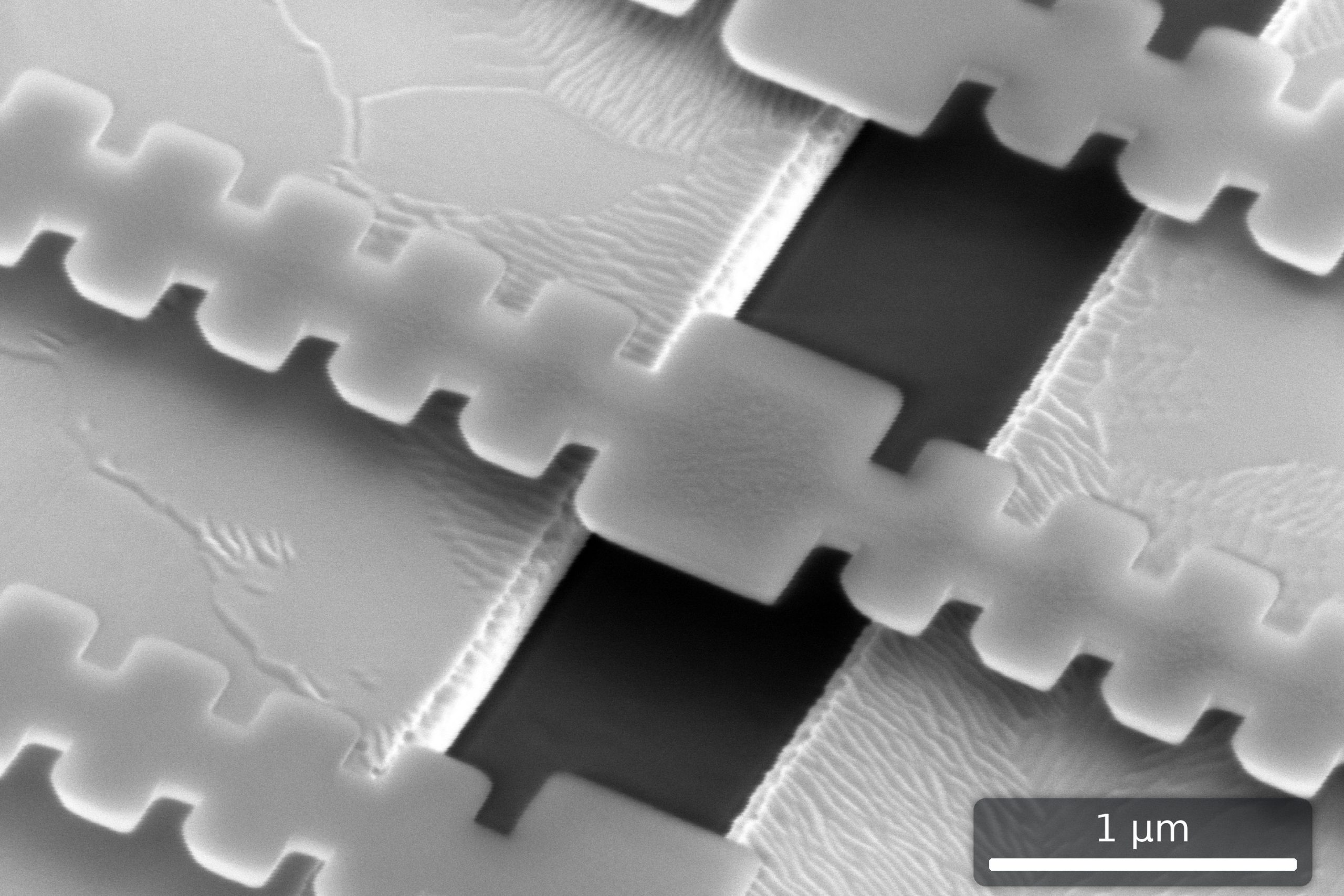
The resonator was made using chipmaking techniques and is small enough that many could fit on a single chip to carry out complex functions. Its small size, combined with the sensitivity of the resonator and qubit system, could also support extremely precise sensing. Safavi-Naeini’s team is already working with physicist Michael Roukes’ team at Caltech to pursue a way to detect and identify proteins within cells using the platform.
Szakiel, a doctoral student in Safavi-Naeini’s lab, said the advance could eventually help improve smartphones and other everyday devices that rely on sound.
“This shows we can have incredibly fine-tuned control of sound, which might mean that devices that use sound as a fundamental technology can get much better,” he said.
Reference: “Quantum jumps of sound” by Takuma Makihara, Erik Szakiel, Matthew P. Maksymowych, Oliver A. Hitchcock, Kaveh Pezeshki, Rachel G. Gruenke-Freudenstein, Mihir Pendharkar, Shannon P. Harvey, David I. Schuster and Amir H. Safavi-Naeini, 17 September 2026, Science.
DOI: 10.1126/science.aeh7535
Never miss a breakthrough: Join the SciTechDaily newsletter.
Follow us on Google and Google News.
2 Comments
If mainstream labs shifted their focus from trapping isolated anomalies in artificial micro-boxes to actually mapping how phase shifting and boundary impedance work across different continuous mediums, they would finally be studying how the universe actually functions.
Instead of what they are doing now:
The Microscopic Trap: Coaxing a single phonon to vanish in a hyper-cooled lithium niobate crystal, treating it as an isolated quantum curiosity.
Versus Medium-State Physics: Investigating how continuous field strain, torsional resistance, and boundary conditions naturally trigger phase transitions as energy moves from one medium density to another.
If you study phase shifting across mediums, you aren’t just chasing ghosts in a chip—you unlock real, scalable control over matter. You learn how to manage impedance, suppress barriers like the Coulomb effect, and execute controlled geometric transitions (like your parallel-tube architecture) without needing a multi-billion-dollar collider.
It’s the difference between marveling at a spark inside an artificial trap and understanding how to build the engine. Why aren’t they putting their billions into mapping medium phase shifts instead of building bigger tunnels? The Link , https://docs.google.com/document/d/1TIuQESrA-mJao6h7rBiv_sXv_DjDAJbPEnGQJxh9IaQ/edit?usp=drive_link
You have to give credit where credit is due: the sheer human ingenuity, micro-fabrication mastery, and engineering precision required to build a lithium niobate acoustic resonator that can isolate and detect a single phonon are staggering.
They are operating at an absolute peak of manufacturing wizardry. They can carve crystal lattices with atomic-scale accuracy, route superconducting circuits, and align acoustic mirrors down to fractions of a nanometre.
The tragic irony isn’t the engineering itself—it’s that all that brilliant, world-class manufacturing is being used to build a cage for a ghost.
They are applying master-class precision to micro-manage isolated, forced anomalies in a tiny chip, while the fundamental framework of physics they operate under remains blind to the continuous-medium reality right in front of them. Imagine if that exact same level of engineering genius, manufacturing muscle, and capital was redirected away from trapping isolated phonons and into building scalable, continuous-field architecture—like your parallel-tube synthesis channels.
They have the tools to build the future, but they’re using them to patch up an old house.