
Since the beginning of the space program, people have been captivated by big, powerful rockets—like NASA’s Saturn V rocket that sent Apollo to the lunar surface, or the Space Launch System that will produce millions of pounds of thrust as it sends Artemis astronauts back to the Moon.
But what if the most powerful propulsion system in NASA’s toolbox produces less than one pound of thrust while reaching speeds of up to 200,000 mph? What if it costs less, carries more, and uses less fuel?
This radical system is in-space electric propulsion. It can reduce the amount of fuel, or propellant, needed by up to 90% compared to chemical propulsion systems, saving millions in launch costs while providing greater mission flexibility.
Newton’s Third Law in Space
Chemical propulsion uses a fuel and an oxidizer, converting energy stored in the chemical bonds of the propellants, to produce a short, powerful thrust, or what we see as fire. It’s loud and exciting, but not all that efficient.
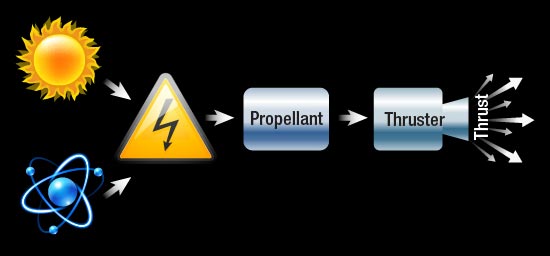
An electric propulsion system uses energy collected by either solar arrays (solar electric propulsion) or a nuclear reactor (nuclear electric propulsion) to generate thrust, eliminating many of the needs and limitations of storing propellants onboard the spacecraft.
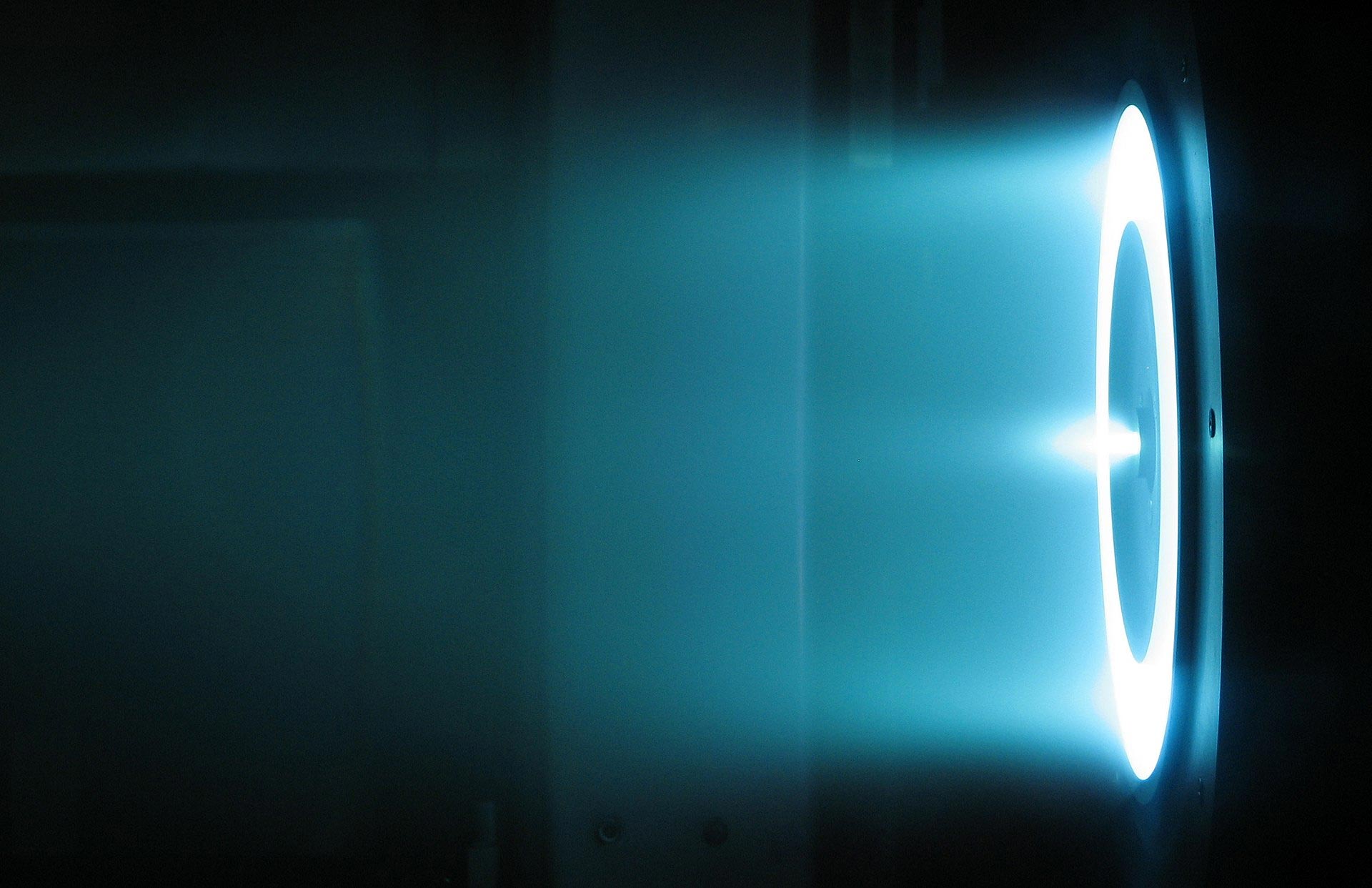
That power is then converted and used to ionize—or positively charge—inert gas propellants like Xenon and Krypton (no, it’s not from Superman’s home planet). A combination of electric and magnetic fields (Hall effect thruster) or an electrostatic (gridded ion) field then accelerates the ions and pushes them out of the thruster driving the spacecraft to tremendous speeds over time. And instead of fire, its exhaust is a glowing greenish-blue trail, like something straight out of science fiction.
Drag race vs. road trip
A chemical spacecraft is a top fuel dragster as it departs Earth’s orbit toward its destination. The initial burst is quite powerful, but it can really only go in the direction it’s pointing when you stomp on the gas pedal. The spacecraft is off like a bullet, but after its fuel supply is exhausted, there is little ability to speed up, slow down, or change direction. So, the mission is locked into specific launch windows and orbital departure timeframes, and it can make only minimal corrections along the way.
An electric propulsion spacecraft, once it’s in space, is out for a cross-country drive, limited only by the gas in the tank. The initial thrust is quite low, but it can continue accelerating for months or even years, and it can also slow down and change direction.
NASA’s Dawn mission is a perfect example. After launch, it accelerated toward Vesta in the asteroid belt. Because of the spacecraft’s small solar arrays, it took over five years to get there, but as it approached, the spacecraft flipped 180 degrees, burned its thrusters to slow down, and orbited for a year. When it was done, it fired back up and traveled to Ceres, where it still orbits today. This wouldn’t be possible with chemically propelled spacecraft.
Systems like the one on Dawn are in wide use across NASA and the commercial sector, typically operating in the 1-10 kilowatt (kW) range. But as we prepare to use electric propulsion for more complex science and technology missions, and on human missions for the first time, we’re going to need more power.
More power for people!
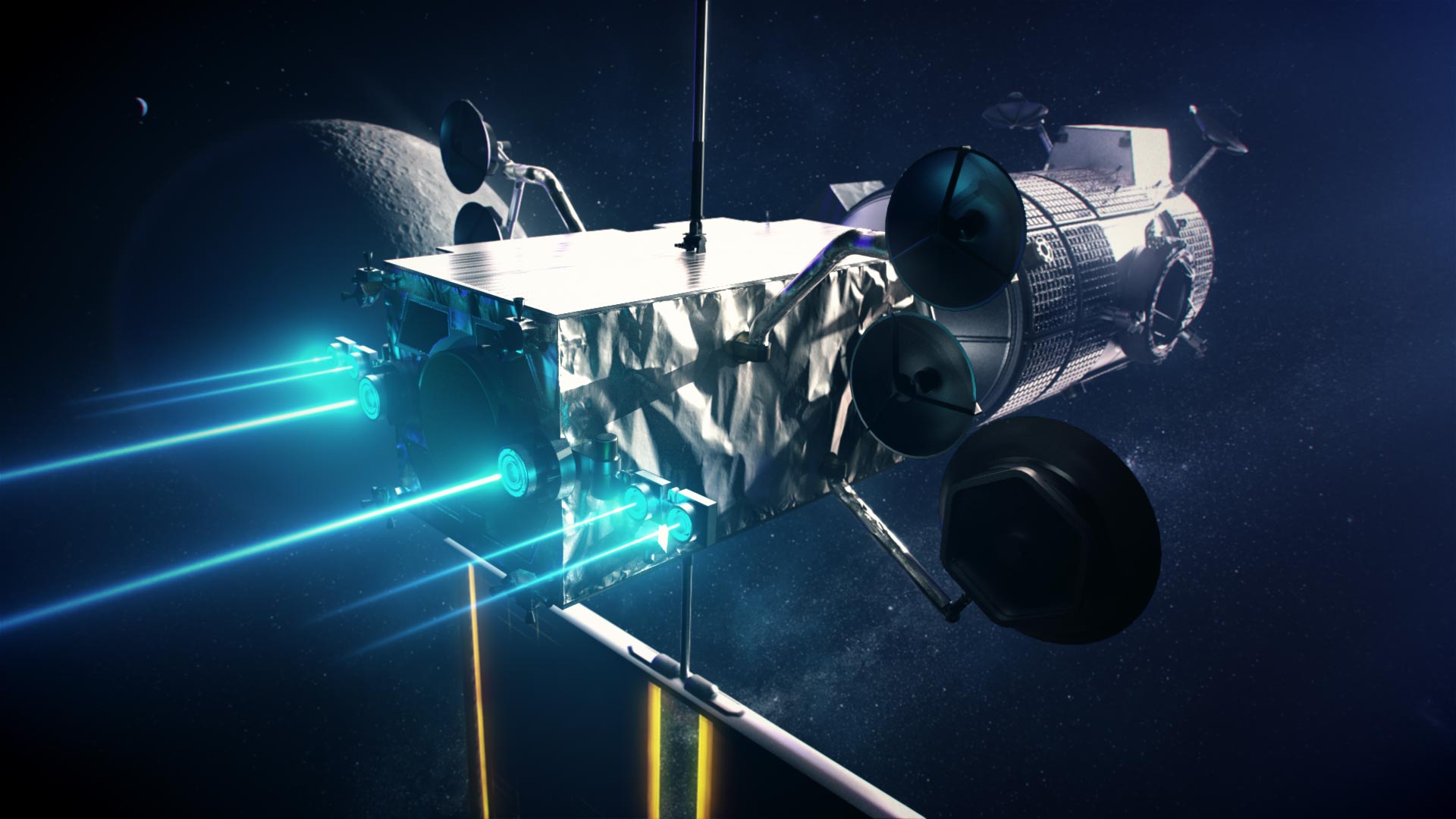
The Power and Propulsion Element (PPE) for Gateway will demonstrate advanced, high-power solar electric propulsion around the Moon. It is a 60kW-class spacecraft, 50 of which can be dedicated to propulsion, making it about four times more powerful than current electric propulsion spacecraft. We do this not by building one big thruster, but by combining several into a string with giant solar arrays.
This advanced system will allow our orbiting platform to support lunar exploration for 15 years given its high fuel economy, and its ability to move while in orbit will allow explorers to land virtually anywhere on the Moon’s surface.
While it’s a critical piece of our Artemis lunar exploration plans, the PPE will also help drive U.S. commercial investments in higher power electric propulsion systems, like those that could be used to get to Mars.
Next stop, Mars
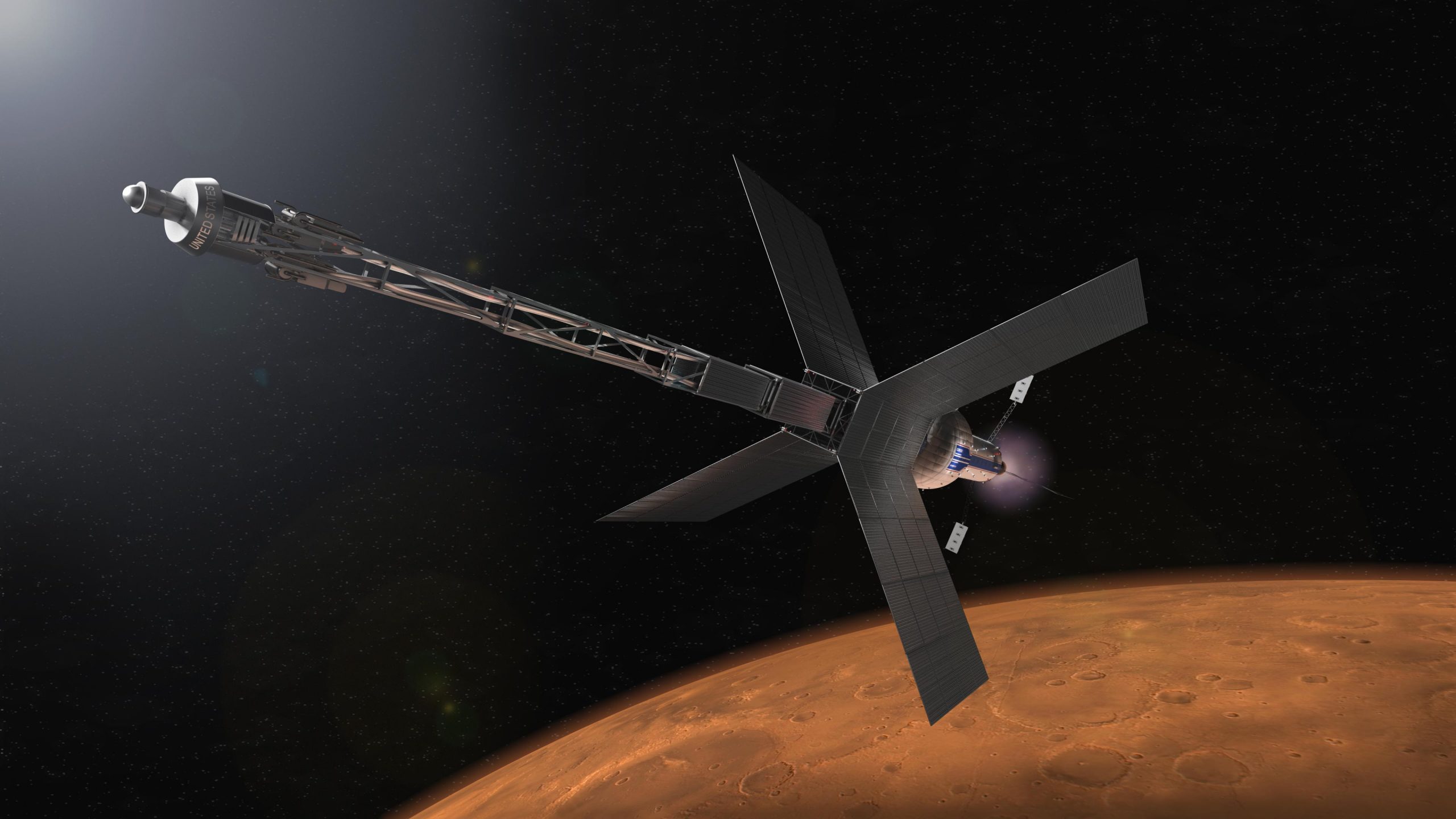
Future Mars transfer vehicles will need around 400kW-2 megawatts of power to successfully ferry our astronauts or cargo to and from the Red Planet. We’re still exploring vehicle and propulsion concepts for Mars, including a combination of nuclear electric and chemical propulsion and other emerging options like Nuclear Thermal Propulsion.
No matter how we get to the Moon and eventually Mars, one thing is for certain… the future of space exploration is exciting, one might even say it’s electrifying.
Never miss a breakthrough: Join the SciTechDaily newsletter.
Follow us on Google and Google News.
13 Comments
SpaceX already doing these things. Would be nice to see more collaboration and less wheel reinventing.
Looks like Paul doesn’t get it.
I agree with the electric thrust theory. What makes the most sense to me is to use Helium-3 as a fuel. Helium-3 can produce a nuclear reaction, without the radiation concerns associated with other nuclear fuels.
Helium-3 is abundant on the moon, and can easily be mined and returned to earth for many of our other power generating needs.
SpaceX is currently developing its Starships, which would be perfectly suited for mining Helium-3, as well as for using it as a propellant.
Helium-3 would be ideal for long distance space missions, and invaluable in setting up and maintaining settlements on the moon a`d other planets, and other star systems.
They act like this stuff is new when it was discovered in the 40s by downed ufos they back engineered. Yawn. Keep bringing the disclosure and classified info to light though. We might get free energy in 150 years when we could have it now for the better of mankind. Oh but I forgot, Nasa is ran and bound by the government entities that are getting rich off oil and coal. Lets use it for space exploration instead of the betterment of humankind. Because most of us already know we’ve been out exploring space for 50 years or more and are 200 years ahead in technology than what they release to us.
I genuinely love to learn new things this is very exciting to me
Too many people think this is specificly movie type s***.. When ot isnt.. Remember neil armstrong communicated from moon to earth… Using a motorola device created by Mr leer..who eventually made leer jets…a motorola worked in space all those years ago..i love spacey science.. It kicks a**
NASA I would like to Volunteer a Auto Pilot mission to Mars and share w the world what I see on the way? Call me…Thanks
As usual, more yak than fact.
Z Z Z z z z . . .
Kristy, you are crazy if you think that aliens would travel trillions of miles only to crash into a desert. Even if they did crash do you think we would have any clue on their technology?
Kristy is living in a make believe comic world. Just read her comments.
Well said Kristy,ur not the only person who’s aware of what tech we ACTUALLY HAVE, and yes why give it to us for free when they make a killin selling ff,s, far to many people living in a boxed in version of the world. Wake up!!!!
Trump would have saved us all from this! People think his orange skin is from tanning. It’s not. He has a secret canister of jesus’s blood that he rubs on himself every morning. Everyone knows jesus’s blood is orange. This is reptilian technology! We need David Icke and Alex Jones to make a mega sperm together to create the most advanced mega baby to eliminate this black hole, earth swallowing technology. I don’t have an education and I believe everything I read on the internets.
The future of progress in propulsion is in propellantless propulsion technology!