
Close Menu
    Facebook X (Twitter) Instagram
    SciTechDaily
    • Biology
    • Chemistry
    • Earth
    • Health
    • Physics
    • Science
    • Space
    • Technology
    Facebook X (Twitter) Pinterest YouTube RSS
    SciTechDaily
    Home»Space»Incredibly Sharp Webb Space Telescope Test Images Hint at New Possibilities for Science
    Space

    Incredibly Sharp Webb Space Telescope Test Images Hint at New Possibilities for Science

    By Alise Fisher, NASAMay 10, 20226 Comments2 Mins Read
    Facebook Twitter Pinterest Telegram LinkedIn WhatsApp Email Reddit
    Share
    Facebook Twitter LinkedIn Pinterest Telegram Email Reddit
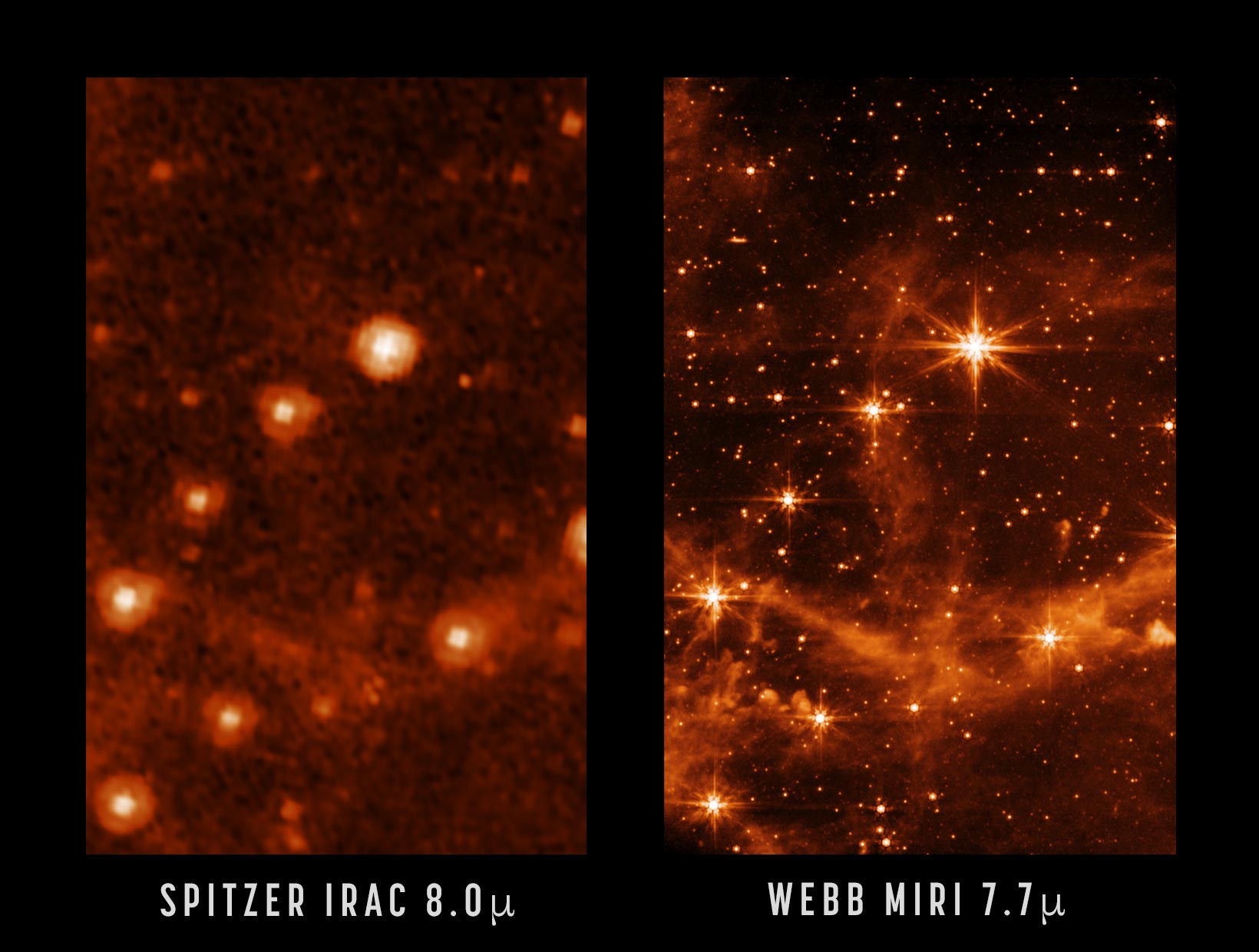
    Webb MIRI and Spitzer Comparison Image
    Comparison of a Webb Space Telescope Mid-Infrared Instrument image of the Large Magellanic Cloud and a past image of the same view using the Spitzer Space Telescope Infrared Array Camera. Credit: NASA/JPL-Caltech (left), NASA/ESA/CSA/STScI (right)

    NASA’s James Webb Space Telescope is aligned across all four of its science instruments, as seen in a previous engineering image showing the observatory’s full field of view. Now, we take a closer look at that same image, focusing on Webb’s coldest instrument: the Mid-Infrared Instrument, or MIRI.

    The MIRI test image (at 7.7 microns) shows part of the Large Magellanic Cloud (LMC). This small satellite galaxy of the Milky Way, located about 160,000 light-years away, provided a dense star field to test Webb’s performance.

    Here, a close-up of the MIRI image is compared to a past image of the same target taken with NASA’s Spitzer Space Telescope’s Infrared Array Camera (at 8.0 microns). The retired Spitzer telescope was one of NASA’s Great Observatories and the first to provide high-resolution images of the near- and mid-infrared universe. Webb, with its significantly larger primary mirror and improved detectors, will allow us to see the infrared sky with improved clarity, enabling even more discoveries.
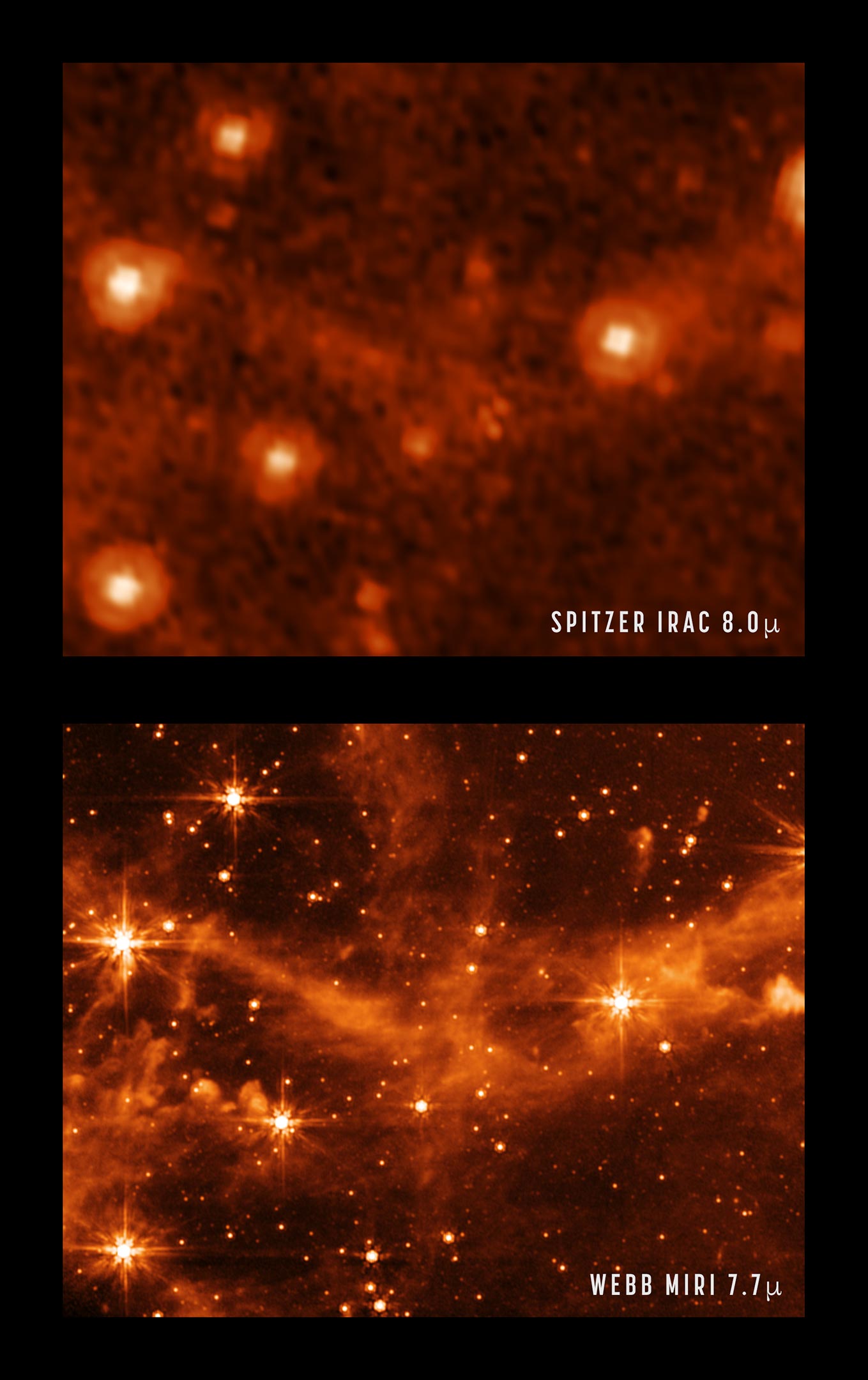
    Webb MIRI vs Spitzer IRAC
    Comparison of a Webb MIRI image of the Large Magellanic Cloud and a past image of the same view using the Spitzer IRAC. Credit: NASA/JPL-Caltech (top), NASA/ESA/CSA/STScI (bottom)

    For example, Webb’s MIRI image shows the interstellar gas in unprecedented detail. Here, you can see the emission from “polycyclic aromatic hydrocarbons,” or molecules of carbon and hydrogen that play an important role in the thermal balance and chemistry of interstellar gas. When Webb is ready to begin science observations, studies such as these with MIRI will help give astronomers new insights into the birth of stars and protoplanetary systems.

    In the meantime, the Webb team has begun the process of setting up and testing Webb’s instruments to begin science observations this summer.
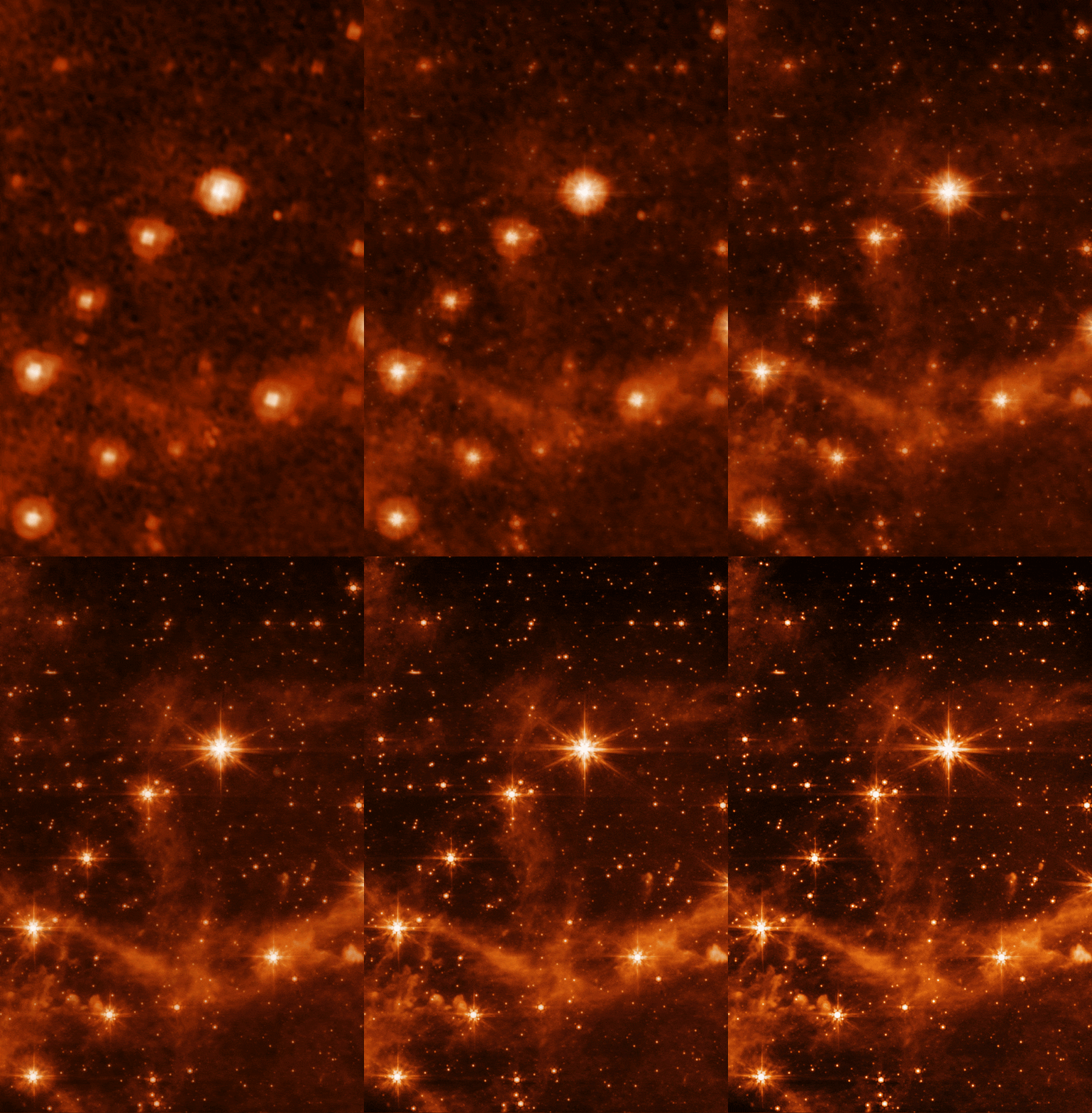
    Webb MIRI Spitzer IRAC Comparison
    Credit: NASA/ESA/CSA/STScI

    The James Webb Space Telescope is an international partnership between NASA, the European Space Agency (ESA), and the Canadian Space Agency (CSA). MIRI is part of Europe’s contribution to the Webb mission. It is a partnership between Europe and the USA; the main partners are ESA, a consortium of nationally funded European institutes, the Jet Propulsion Laboratory (JPL), and NASA’s Goddard Space Flight Center (GSFC).

    Never miss a breakthrough: Join the SciTechDaily newsletter.
    Follow us on Google and Google News.

    Astronomy James Webb Space Telescope NASA Popular Spitzer Space Telescope
    Share. Facebook Twitter Pinterest LinkedIn Email Reddit

    Related Articles

    Webb Does the “Impossible” – Space Telescope Captures First Glimpse of an Exoplanet’s Interior

    Webb Space Telescope Cracks Case of Puffy “Microwaved Marshmallow” Exoplanet

    Super-Earth Surprise: Webb Finds Atmosphere on Rocky Exoplanet For the First Time

    Webb Space Telescope Reveals Extreme Starburst Galaxy’s Hidden Secrets

    Webb’s Ethanol Discovery Fuels Search for Alien Life

    Webb’s Historic Discovery: The Farthest Active Supermassive Black Hole Ever Found

    Webb Space Telescope Reveals “Mind-Blowing” Structure in 19 Nearby Spiral Galaxies

    Webb Telescope’s Startling Reveal: Many Early Galaxies Looked Like Pool Noodles and Surfboards

    Webb’s Infrared Eye Uncovers Bizarre “Cat’s Tail” Dust Structure in Beta Pictoris

    6 Comments

    1. Sekar on May 10, 2022 2:58 am

      Interesting.

      Just a thought. How accurately can we use the image database to rebuild the reality out their to Scale, of the information captured?

      Mapping the Universe is a arduous task, and will need a NEW but old skill – “Geographers” also known as cartographers. However in this effort, we wont be mapping continents, but stars, planets, galaxies and such!

      It may be a smart thing to put in place cross functional teams to make sense of the data which will start flowing in.

      Views expressed are personal and not binding on anyone.

      Reply
    2. Lens Flare on May 10, 2022 3:54 am

      Will there be a final adjustment to reduce the major 8 sided lens flare? Software may possibly reduce these image distortions but any artificial manipulation of the data will be unfortunate.

      Reply
    3. Tom on May 10, 2022 4:56 am

      Don’t care what people think, this is worth every dime we spend on it.

      Reply
      • Barneygoogle on May 11, 2022 4:09 am

        Yes – absolutely!

        Reply
    4. Phi In The Sky on May 12, 2022 5:30 am

      Fascinating how much movement/ disappearance (as well as clarification) occurs between Spitzer features and those in the JWST image. Foreground, but faint, Milky Way objects moving relative to the LMC, presumably, rather than variables.

      Reply
    5. Michael F L May on May 12, 2022 10:14 am

      Fantastic combined images they have such clarity it’s amazing. I can’t wait for the new images.

      Reply
    Leave A Reply Cancel Reply

    • Facebook
    • Twitter
    • Pinterest
    • YouTube

    Don't Miss a Discovery

    Subscribe for the Latest in Science & Tech!

    Trending News

    Scientists Warn That This Common Pet Fish Can Wreck Entire Ecosystems

    Scientists Make Breakthrough in Turning Plastic Trash Into Clean Fuel Using Sunlight

    This Popular Supplement May Interfere With Cancer Treatment, Scientists Warn

    Scientists Finally Solved One of Water’s Biggest Mysteries

    Could This New Weight-Loss Pill Disrupt the Entire Market? Here’s What You Should Know About Orforglipron

    Earth’s Crust Is Tearing Open in Africa, and It Could Form a New Ocean

    Breakthrough Bowel Cancer Trial Leaves Patients Cancer-Free for Nearly 3 Years

    Natural Compound Shows Powerful Potential Against Rheumatoid Arthritis

    Follow SciTechDaily
    • Facebook
    • Twitter
    • YouTube
    • Pinterest
    • Newsletter
    • RSS
    SciTech News
    • Biology News
    • Chemistry News
    • Earth News
    • Health News
    • Physics News
    • Science News
    • Space News
    • Technology News
    Recent Posts
    • College Student Identifies Bizarre New Carnivorous Dinosaur Three Times Older Than T. rex
    • The Most Effective Knee Arthritis Treatments Aren’t What You Expect
    • Scientists Develop Bioengineered Chewing Gum That Could Help Fight Oral Cancer
    • Popular Weight-Loss Drugs Found To Cut Heart Attack and Stroke Risk
    • After 37 Years, the World’s Longest-Running Soil Warming Experiment Uncovers a Startling Climate Secret
    Copyright © 1998 - 2026 SciTechDaily. All Rights Reserved.
    • Science News
    • About
    • Contact
    • Editorial Board
    • Privacy Policy
    • Terms of Use

    Type above and press Enter to search. Press Esc to cancel.