
Close Menu
    Facebook X (Twitter) Instagram
    SciTechDaily
    • Biology
    • Chemistry
    • Earth
    • Health
    • Physics
    • Science
    • Space
    • Technology
    Facebook X (Twitter) Pinterest YouTube RSS
    SciTechDaily
    Home»Space»NASA’s James Webb Space Telescope Alignment Complete – Capturing Crisp, Focused Images
    Space

    NASA’s James Webb Space Telescope Alignment Complete – Capturing Crisp, Focused Images

    By Thaddeus Cesari, NASA GoddardApril 28, 20221 Comment5 Mins Read
    Facebook Twitter Pinterest Telegram LinkedIn WhatsApp Email Reddit
    Share
    Facebook Twitter LinkedIn Pinterest Telegram Email Reddit
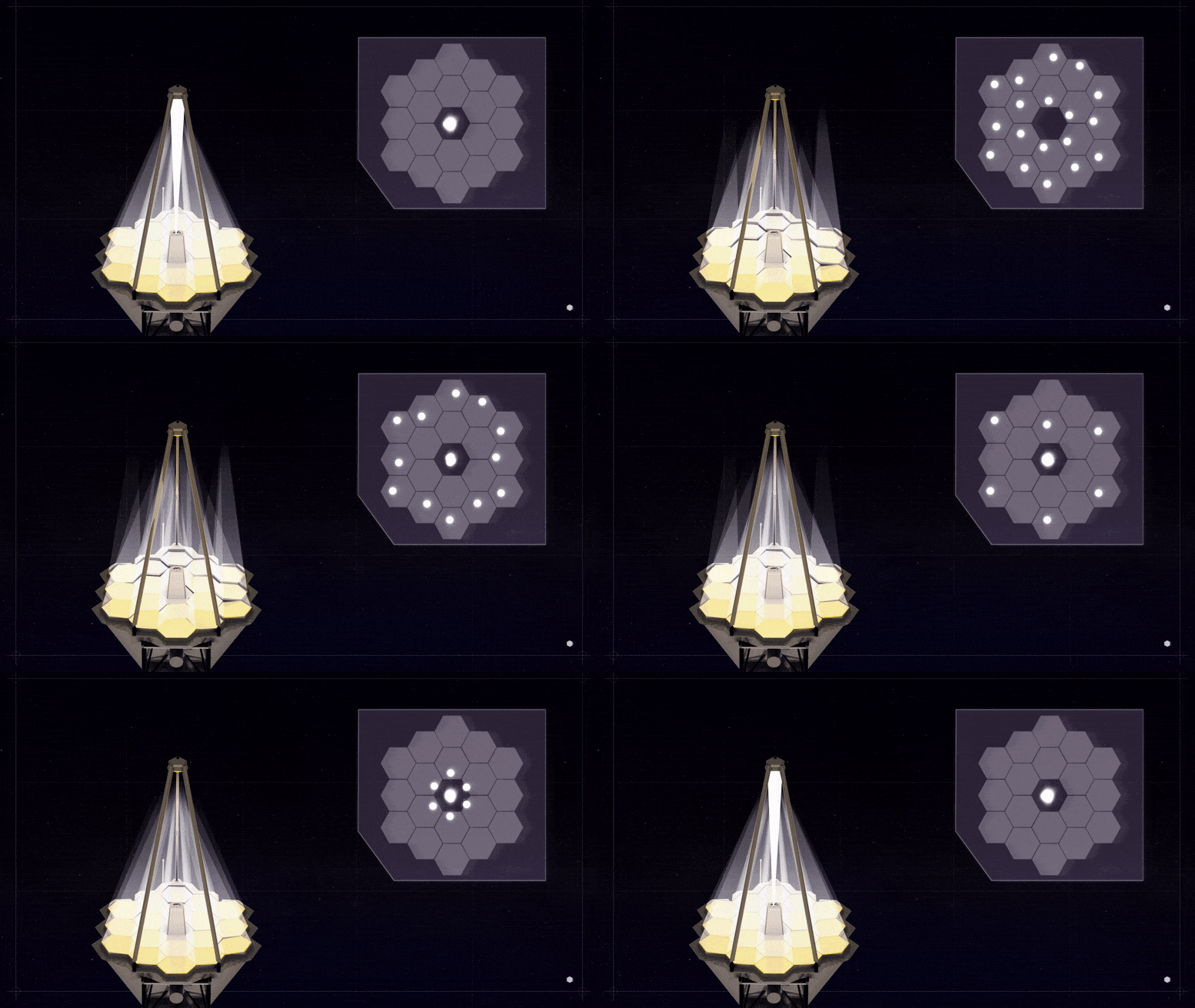
    James Webb Space Telescope Primary Mirror Alignment
    James Webb Space Telescope primary mirror alignment. Credit: NASA’s Goddard Space Flight Center

    NASA’s Webb In Full Focus, Ready for Instrument Commissioning

    The alignment of NASA’s James Webb Space Telescope is now complete. After a full review, the observatory has been confirmed to be capable of capturing sharp, well-focused images with each of its four powerful onboard science instruments. Upon completing the seventh and final stage of telescope alignment, the team held a set of key decision meetings and unanimously agreed that Webb is ready to move forward into its next and final series of preparations, known as science instrument commissioning. This process will take about two months before scientific operations begin in the summer.
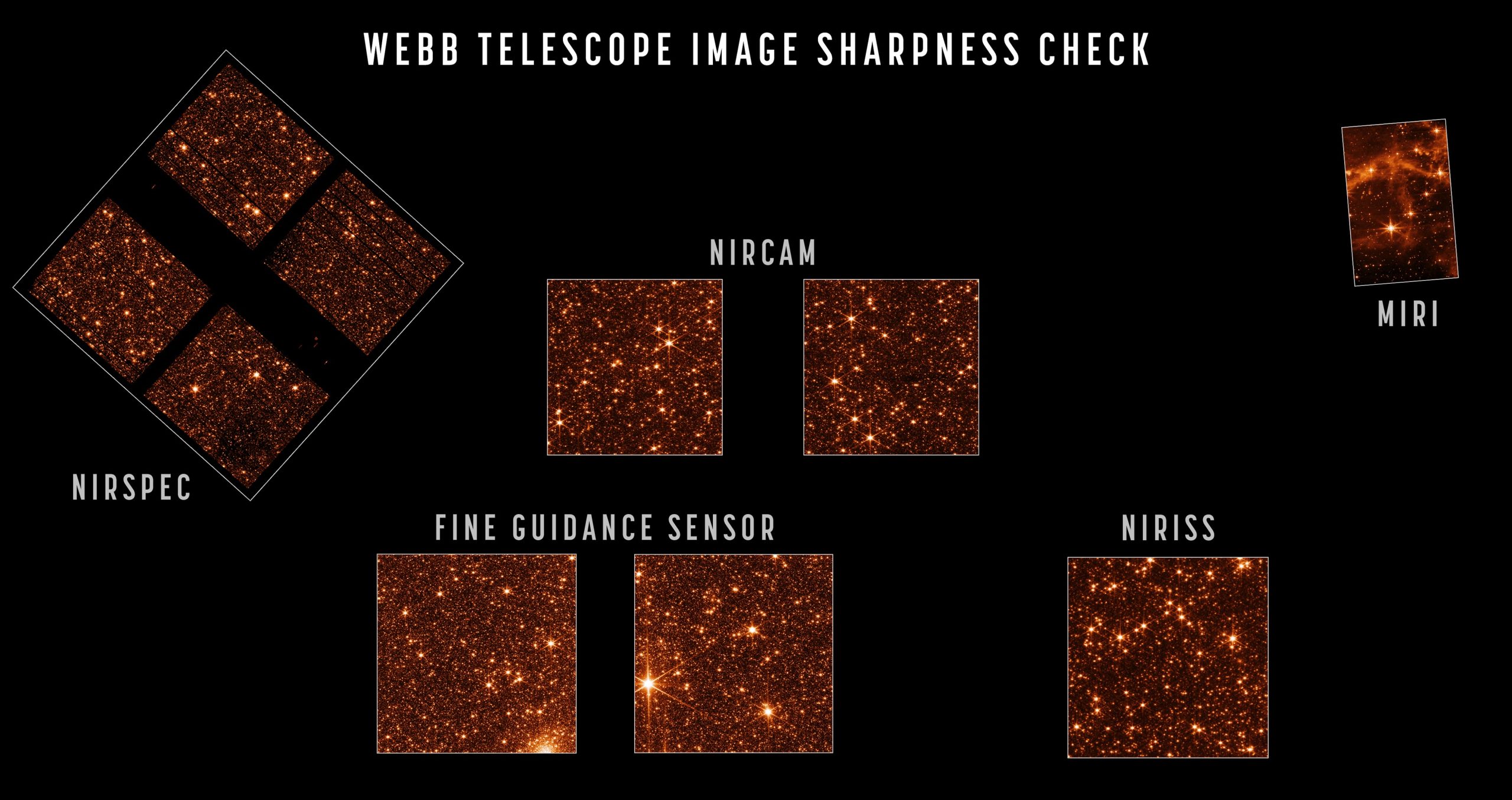
    Webb Space Telescope Image Sharpness Test
    Webb Space Telescope Image Sharpness Test. Credit: NASA/STScI

    The alignment of the telescope across all of Webb’s instruments can be seen in a series of images that captures the observatory’s full field of view.

    “These remarkable test images from a successfully aligned telescope demonstrate what people across countries and continents can achieve when there is a bold scientific vision to explore the universe,” said Lee Feinberg, Webb optical telescope element manager at NASA’s Goddard Space Flight Center.


    Webb Telescope Completes Alignment Phase. Credit: NASA’s Goddard Space Flight Center

    The optical performance of the telescope continues to be better than the engineering team’s most optimistic predictions. Webb’s mirrors are now directing fully focused light collected from space down into each instrument, and each instrument is successfully capturing images with the light being delivered to them. The image quality delivered to all instruments is “diffraction-limited,” meaning that the fineness of detail that can be seen is as good as physically possible given the size of the telescope. From this point forward the only changes to the mirrors will be very small, periodic adjustments to the primary mirror segments.

    “With the completion of telescope alignment and half a lifetime’s worth of effort, my role on the James Webb Space Telescope mission has come to an end,” said Scott Acton, Webb wavefront sensing and controls scientist, Ball Aerospace. “These images have profoundly changed the way I see the universe. We are surrounded by a symphony of creation; there are galaxies everywhere! It is my hope that everyone in the world can see them.”

    Webb Telescope Image Sharpness Test
    Engineering images of sharply focused stars in the field of view of each instrument demonstrate that the telescope is fully aligned and in focus. For this test, Webb pointed at part of the Large Magellanic Cloud, a small satellite galaxy of the Milky Way, providing a dense field of hundreds of thousands of stars across all the observatory’s sensors. The sizes and positions of the images shown here depict the relative arrangement of each of Webb’s instruments in the telescope’s focal plane, each pointing at a slightly offset part of the sky relative to one another. Webb’s three imaging instruments are NIRCam (images shown here at a wavelength of 2 microns), NIRISS (image shown here at 1.5 microns), and MIRI (shown at 7.7 microns, a longer wavelength revealing emission from interstellar clouds as well as starlight). NIRSpec is a spectrograph rather than imager but can take images, such as the 1.1 micron image shown here, for calibrations and target acquisition. The dark regions visible in parts of the NIRSpec data are due to structures of its microshutter array, which has several hundred thousand controllable shutters that can be opened or shut to select which light is sent into the spectrograph. Lastly, Webb’s Fine Guidance Sensor tracks guide stars to point the observatory accurately and precisely; its two sensors are not generally used for scientific imaging but can take calibration images such as those shown here. This image data is used not just to assess image sharpness but also to precisely measure and calibrate subtle image distortions and alignments between sensors as part of Webb’s overall instrument calibration process. Credit: NASA/STScI

    Now, the Webb team will turn its attention to science instrument commissioning. Each instrument is a highly sophisticated set of detectors equipped with unique lenses, masks, filters, and customized equipment that helps it perform the science it was designed to achieve. The specialized characteristics of these instruments will be configured and operated in various combinations during the instrument commissioning phase to fully confirm their readiness for science. With the formal conclusion of telescope alignment, key personnel involved with the commissioning of each instrument have arrived at the Mission Operations Center at the Space Telescope Science Institute in Baltimore, and some personnel involved with telescope alignment have concluded their duties.

    Though telescope alignment is complete, some telescope calibration activities remain: As part of scientific instrument commissioning, the telescope will be commanded to point to different areas in the sky where the total amount of solar radiation hitting the observatory will vary to confirm thermal stability when changing targets. Furthermore, ongoing maintenance observations every two days will monitor the mirror alignment and, when needed, apply corrections to keep the mirrors in their aligned locations.

    Never miss a breakthrough: Join the SciTechDaily newsletter.
    Follow us on Google and Google News.

    Astronomy James Webb Space Telescope NASA NASA Goddard Space Flight Center Popular
    Share. Facebook Twitter Pinterest LinkedIn Email Reddit

    Related Articles

    Webb Space Telescope Rewrites the Origin Story of the Crab Nebula’s Supernova

    Webb and Hubble Unite: A Breathtaking 3D Journey Through the Pillars of Creation

    Surprising Cosmic Alignment Unveiled: Webb Telescope Reveals Stunning Stellar Jets in Serpens Nebula

    Webb Is a Supernova Discovery Machine: 10x More Supernovae in Early Universe

    Webb Space Telescope Cracks Case of Puffy “Microwaved Marshmallow” Exoplanet

    Super-Earth Surprise: Webb Finds Atmosphere on Rocky Exoplanet For the First Time

    Webb Space Telescope Reveals Extreme Starburst Galaxy’s Hidden Secrets

    Webb Telescope’s Startling Reveal: Many Early Galaxies Looked Like Pool Noodles and Surfboards

    Webb’s Infrared Eye Uncovers Bizarre “Cat’s Tail” Dust Structure in Beta Pictoris

    1 Comment

    1. AlphaMale1 on May 7, 2022 10:55 pm

      The JWST will be the most wondrous SPACE telescope. We cannot wait for it to be released for all the studies awaiting it. I have read there have been some previous “dogfights” on what scientists gets assigned to use it and where in line the others end up…..some serious jealousies.

      I cannot wait for all it will finally tell us of many the subjects & truths of space and time. No doubt there will be some huge surprises we did not expect…..I know there are many very young- “James T Kirks” & future crew awaiting! God Speed to all.

      Reply
    Leave A Reply Cancel Reply

    • Facebook
    • Twitter
    • Pinterest
    • YouTube

    Don't Miss a Discovery

    Subscribe for the Latest in Science & Tech!

    Trending News

    First-of-Its-Kind Discovery: Homer’s Iliad Found Embedded in a 1,600-Year-Old Egyptian Mummy

    Beyond Inflammation: Scientists Uncover New Cause of Persistent Rheumatoid Arthritis

    A Simple Molecule Could Unlock Safer, Easier Weight Loss

    Scientists Just Built a Quantum Battery That Charges Almost Instantly

    Researchers Unveil Groundbreaking Sustainable Solution to Vitamin B12 Deficiency

    Millions of People Have Osteopenia Without Realizing It – Here’s What You Need To Know

    Researchers Discover Boosting a Single Protein Helps the Brain Fight Alzheimer’s

    World-First Study Reveals Human Hearts Can Regenerate After a Heart Attack

    Follow SciTechDaily
    • Facebook
    • Twitter
    • YouTube
    • Pinterest
    • Newsletter
    • RSS
    SciTech News
    • Biology News
    • Chemistry News
    • Earth News
    • Health News
    • Physics News
    • Science News
    • Space News
    • Technology News
    Recent Posts
    • New Research Challenges Long-Held Beliefs About How the Brain Makes Decisions
    • Breakthrough Technology Reveals New Treatment Targets for Cancer
    • Scientists Discover New Way To Make Drug-Resistant Cancer Treatable Again
    • This Simple Exercise Trick Builds Muscle With Less Effort, Study Finds
    • Middle Age Is Becoming a Breaking Point in America, Study Reveals
    Copyright © 1998 - 2026 SciTechDaily. All Rights Reserved.
    • Science News
    • About
    • Contact
    • Editorial Board
    • Privacy Policy
    • Terms of Use

    Type above and press Enter to search. Press Esc to cancel.