
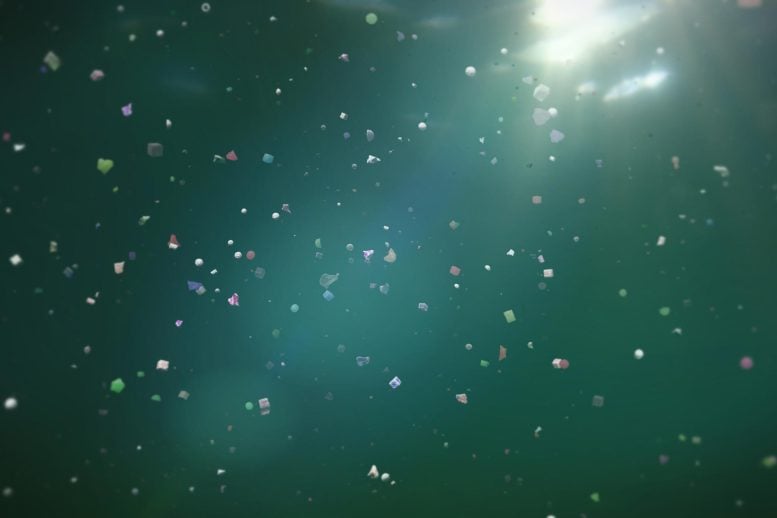
In a new study, an international team of researchers investigates the atmosphere as a relevant source of plastic pollution in our planet’s waters.
According to estimates, by 2040 the level of plastic pollution could reach 80 million metric tons (176 billion pounds) per year. Plastic particles have now been detected in virtually all spheres of the environment, e.g. in water bodies, the soil, and the air. Via ocean currents and rivers, the tiny plastic particles can even reach the Arctic, Antarctic, or ocean depths. A new overview study has now shown that wind, too, can transport these particles great distances – and much faster than water can: in the atmosphere, they can travel from their point of origin to the most remote corners of the planet in a matter of days. In the journal Nature Reviews Earth and Environment, an international team of researchers – including experts from the Alfred Wegener Institute, the Institute for Advanced Sustainability Studies in Potsdam, and the GEOMAR Helmholtz Centre for Ocean Research in Kiel – explains how microplastic finds its way into the atmosphere and how it is subsequently transported.
Today, between 0.013 and 25 million metric tons of micro- and nanoplastic per year are transported up to thousands of kilometers by ocean air, snow, sea spray, and fog, crossing countries, continents, and oceans in the process. This estimate was arrived at by an international team of 33 researchers, including experts from the Alfred Wegener Institute, Helmholtz Centre for Polar and Marine Research (AWI), the Institute for Advanced Sustainability Studies in Potsdam (IASS), and the GEOMAR Helmholtz Centre for Ocean Research in Kiel.
“Air is a much more dynamic medium than water,” says co-author Dr. Melanie Bergmann from the AWI. “As a result, micro- and nanoplastic can much more quickly penetrate those regions of our planet that are most remote and still largely untouched.” Once there, the particles could affect the surface climate and the health of local ecosystems. For example, when these darker particles are deposited on snow and ice, they affect the ice-albedo feedback, reducing their ability to reflect sunlight and promoting melting. Similarly, darker patches of seawater absorb more solar energy, further warming the ocean. And in the atmosphere, microplastic particles can serve as condensation nuclei for water vapor, producing effects on cloud formation and, in the long term, the climate.
How Do Plastic Particles Get Into the Atmosphere?
First of all, through human activities. Particles produced by tires and brakes in road traffic, or by the exhaust gases from industrial processes, rise into the atmosphere, where they are transported by winds. However, according to the overview study, there is also evidence suggesting that a substantial number of these particles are transported by the marine environment. Initial analyses indicate that microplastic from the coastal zone also finds its way into the ocean through eroded beach sand. The combination of sea spray, wind, and waves forms air bubbles in the water containing microplastic. When the bubbles burst, the particles find their way into the atmosphere. As such, transport to remote and even polar regions could be due to the combination of atmospheric and marine transport.
Consequently, it is important to understand interactions between the atmosphere and ocean, so as to determine which particle sizes are transported, and in which quantities. The atmosphere predominantly transports small microplastic particles, which makes it a much faster transport route that can lead to substantial deposits in a broad range of ecosystems. As Melanie Bergmann explains: “We need to integrate micro- and nanoplastic in our measurements of air pollution, ideally on an international scale as part of global networks.” For this purpose, in a first step, first author Deonie Allen and Bergmann began collecting samples of microplastic in the air, seawater and ice during a Polarstern expedition to the Arctic last year.
Joining Forces To Grasp the Microplastic Cycle
Understanding and characterizing the microplastic cycles between the ocean and atmosphere will require joint efforts. In this regard, in the study, the team of researchers led by first authors Deonie Allen and Steve Allen from the University of Strathclyde, Glasgow, outlines a global strategy for creating a seamless, intercomparable database on the flow of micro- and nanoplastic between the ocean and atmosphere. “There are so many aspects of the emissions, transport, and effects of microplastic in the atmosphere that we still don’t fully understand,” says co-author Prof Tim Butler from the IASS. “This publication reveals the gaps in our knowledge – and presents a roadmap for the future.”
Two dedicated working groups from the Joint Group of Experts on the Scientific Aspects of Marine Environmental Protection (GESAMP) prepared the study. According to study co-author and GESAMP member Prof Sylvia Sander from GEOMAR: “The study makes it clear that a comprehensive grasp of the ocean, and of the effects of human influences on it, can only be achieved by networking researchers and their data. The great challenges of our time are at the global scale. Accordingly, we have to pursue answers to pressing questions with expertise that is as comprehensive and international as possible. That can only be done by working together.” GESAMP is a conglomerate of eleven organizations belonging to the United Nations. Its goal is to arrive at a multidisciplinary, science-based understanding of the marine environment. To date, the network has already collaborated with more than 500 experts from countries around the globe on a range of questions.
Micro- and nanoplastic in the air is also relevant for human health. In a recently released British study, microplastic was detected in the lungs of 11 of 13 living human beings. “This is yet another reason why we need to integrate plastic into monitoring programs for air quality,” Bergmann stresses. In order to reduce environmental pollution from plastic, the production of new plastic would also need to be successively reduced on the basis of an international treaty, as Bergmann and other experts recently called for in a letter to the journal Science.
Reference: “Micro- and nanoplastics in the marine-atmospheric environment” by Deonie Allen, Steve Allen, Sajjad Abbasi, Alex Baker, Melanie Bergmann, Janice Brahney, Tim Butler, Robert A. Duce, Sabine Eckhardt, Nikolaos Evangeliou, Tim Jickells, Maria Kanakidou, Peter Kershaw, Paolo Laj, Joseph Levermore, Daoji Li, Peter Liss, Kai Liu, Natalie Mahowald, Pere Masque, Dušan Materić, Andrew G. Mayes, Paul McGinnity, Iolanda Osvath, Kimberly A. Prather, Joseph M. Prospero, Laura E. Revell, Sylvia G. Sander, Won Joon Shim, Jonathan Slade, Ariel Stein, Oksana Tarasova and Stephanie Wright, 10 May 2022, Nature Reviews Earth & Environment.
DOI: 10.1038/s43017-022-00292-x
Never miss a breakthrough: Join the SciTechDaily newsletter.
Follow us on Google and Google News.
2 Comments
Tiny Plastic Particles From the Atmosphere Is Polluting Earth’s Oceans
Fix the typo in this headline. Then, remove “Earth” as this is absurdly redundant.
… that thing it is every where…