
Close Menu
    Facebook X (Twitter) Instagram
    SciTechDaily
    • Biology
    • Chemistry
    • Earth
    • Health
    • Physics
    • Science
    • Space
    • Technology
    Facebook X (Twitter) Pinterest YouTube RSS
    SciTechDaily
    Home»Space»Cassini Images Show Signs That the Seasons Are Turning On Saturn’s Moon Titan
    Space

    Cassini Images Show Signs That the Seasons Are Turning On Saturn’s Moon Titan

    By Jia-Rui C. Cook, Jet Propulsion LaboratoryJuly 11, 2012No Comments3 Mins Read
    Facebook Twitter Pinterest Telegram LinkedIn WhatsApp Email Reddit
    Share
    Facebook Twitter LinkedIn Pinterest Telegram Email Reddit
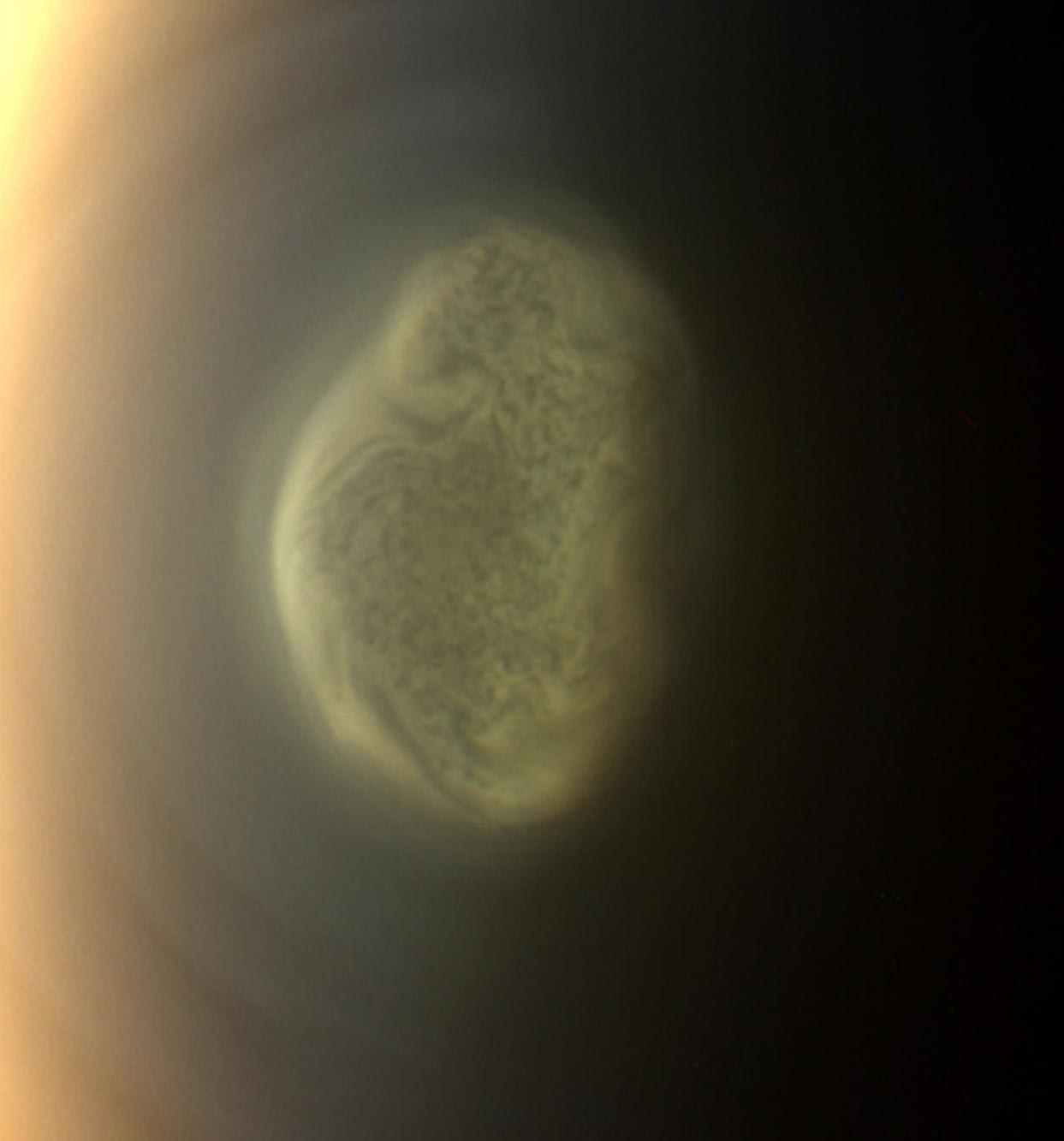
    Saturn’s Moon Titan South Polar Vortex
    This true-color image captured by NASA’S Cassini spacecraft before a distant flyby of Saturn’s moon Titan on June 27, 2012, shows a south polar vortex, or a mass of swirling gas around the pole in the atmosphere of the moon. Credit: NASA/JPL-Caltech/Space Science Institute

    New images from NASA’s Cassini spacecraft show signs that the seasons are turning on Titan, Saturn’s largest moon.

    Images from NASA’s Cassini spacecraft show a concentration of high-altitude haze and a vortex materializing at the south pole of Saturn’s moon Titan, signs that the seasons are turning on Saturn’s largest moon. “The structure inside the vortex is reminiscent of the open cellular convection that is often seen over Earth’s oceans,” said Tony Del Genio, a Cassini team member at NASA’s Goddard Institute for Space Studies, N.Y. “But unlike on Earth, where such layers are just above the surface, this one is at very high altitude, maybe a response of Titan’s stratosphere to seasonal cooling as southern winter approaches. But so soon in the game, we’re not sure.”

    Cassini first saw a “hood” of high-altitude haze and a vortex, which is a mass of swirling gas around the pole in the moon’s atmosphere, at Titan’s north pole when the spacecraft first arrived in the Saturn system in 2004. At the time, it was northern winter. Multiple instruments have been keeping an eye on the Titan atmosphere above the south pole for signs of the coming southern winter.
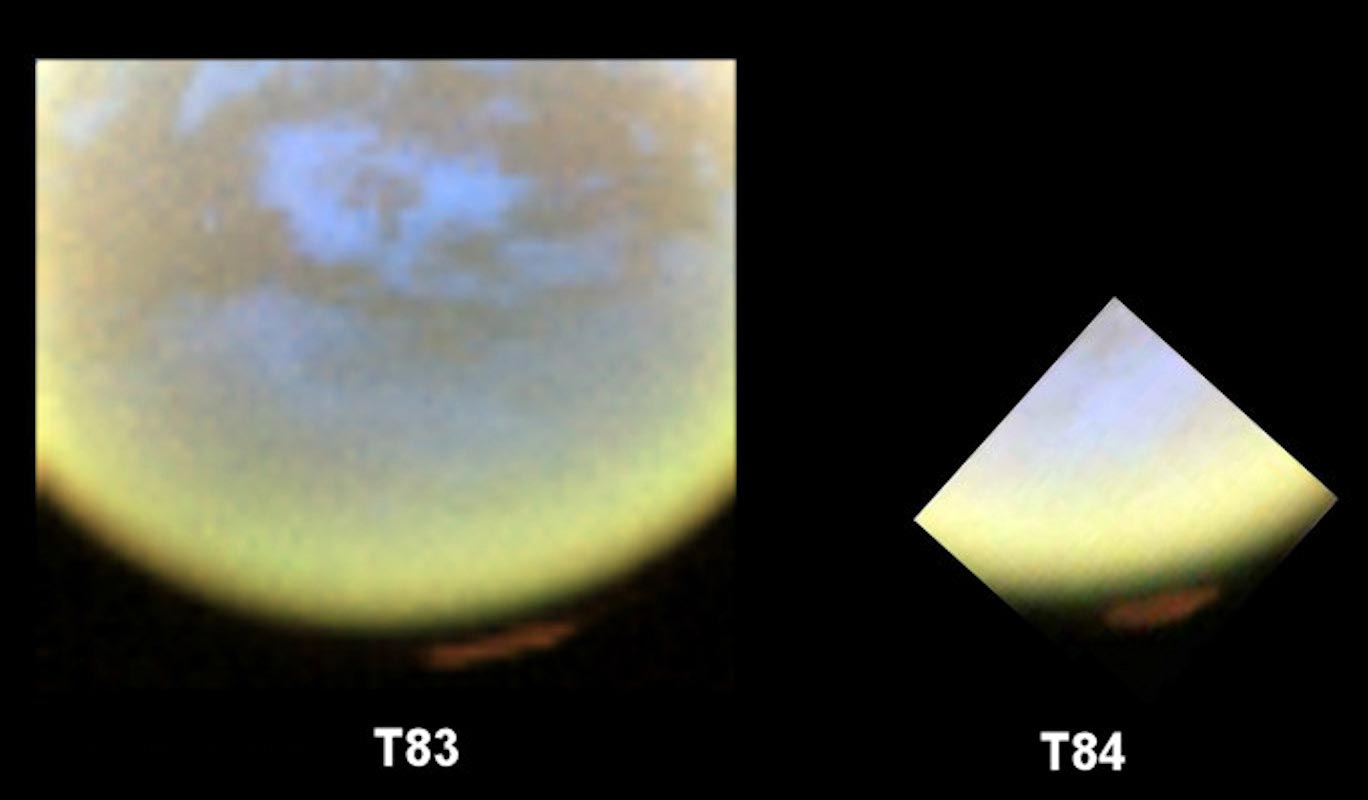
    Hood of High-Altitude Haze Forming Over the South Pole of Saturn’s Moon Titan
    False-color images from NASA’s Cassini spacecraft show the development of a hood of high-altitude haze ­— which appears orange in this image — forming over the south pole of Saturn’s moon Titan. Credit: NASA/JPL-Caltech/University of Arizona/LPGNantes

    While the northern hood has remained, the circulation in the upper atmosphere has been moving from the illuminated north pole to the cooling south pole. This movement appears to be causing downwellings over the south pole and the formation of high-altitude haze and a vortex.

    Cassini’s visible light cameras saw the first signs of hazes starting to concentrate over Titan’s south pole in March, and the spacecraft’s visual and infrared mapping spectrometer (VIMS) obtained false-color images on May 22 and June 7.

    “VIMS has seen a concentration of aerosols forming about 200 miles [300 kilometers] above the surface of Titan’s south pole,” said Christophe Sotin, a VIMS team member at NASA’s Jet Propulsion Laboratory, Pasadena, California. “We’ve never seen aerosols here at this level before, so we know this is something new.”

    During a June 27 distant flyby, Cassini’s imaging cameras captured a crow’s-eye view of the south polar vortex in visible light. These new images show this detached, high-altitude haze layer in stunning new detail.

    “Future observations of this feature will provide good tests of dynamical models of the Titan circulation, chemistry, cloud, and aerosol processes in the upper atmosphere,” said Bob West, deputy imaging team lead at JPL. The Cassini-Huygens mission is a cooperative project of NASA, the European Space Agency, and the Italian Space Agency. The Jet Propulsion Laboratory, a division of the California Institute of Technology in Pasadena, manages the Cassini-Huygens mission for NASA’s Science Mission Directorate, Washington. The Cassini orbiter and its two onboard cameras were designed, developed, and assembled at JPL. The imaging team is based at the Space Science Institute in Boulder, Colorado.

    Never miss a breakthrough: Join the SciTechDaily newsletter.
    Follow us on Google and Google News.

    Astronomy Cassini-Huygens Mission JPL NASA Popular Titan
    Share. Facebook Twitter Pinterest LinkedIn Email Reddit

    Related Articles

    Titan’s Methane May Run Out

    Cassini Data Suggests Saturn’s Moons and Rings Are More Than 4 Billion Years Old

    Cassini Detects Particles Being Accelerated to Ultra-High Energies

    Storm Spawns the Largest Tropospheric Vortex Ever Seen on Saturn

    New Cassini Image of Saturn and Its Rings

    Limited River Erosion on Saturn’s Moon Titan Has Scientists Looking for Possible Explanations

    Cassini Data Reveals Likely Subsurface Ocean on Titan

    Heat from Within the Planet Powers Saturn’s Jet Streams

    Cassini Detects Methane Lakes on Titan

    Leave A Reply Cancel Reply

    • Facebook
    • Twitter
    • Pinterest
    • YouTube

    Don't Miss a Discovery

    Subscribe for the Latest in Science & Tech!

    Trending News

    Scientists May Have Discovered How To Heal Damaged Kidneys

    Interstellar Visitor 3I/ATLAS Is Bursting With an Unexpected Chemical

    Scientists Just Found All 5 Genetic “Letters” of DNA and RNA on an Asteroid

    The 4,000-Year-Old City That Defied History’s Rules on Wealth and Power

    The World’s Biggest Population Fear Has Flipped – and It Could Change Everything

    This “Fake” Pill Improved Memory and Physical Performance in Just 3 Weeks

    Scientists Say Frequent Ejaculation May Improve Sperm Quality and Fertility

    Scientists Have Found “The Heaven Sword” After Years of Looking

    Follow SciTechDaily
    • Facebook
    • Twitter
    • YouTube
    • Pinterest
    • Newsletter
    • RSS
    SciTech News
    • Biology News
    • Chemistry News
    • Earth News
    • Health News
    • Physics News
    • Science News
    • Space News
    • Technology News
    Recent Posts
    • Scientists Create Tiny “Mini Livers” That Could One Day Replace Liver Transplants
    • This Surprising Factor May Predict Heart Disease Decades Before It Strikes
    • New Nonsurgical Knee Treatment Delivers Lasting Pain Relief
    • Scientists Discover Hidden Rule That Could Make Fuel Cells Cheaper and More Powerful
    • New Water-Harvesting Jacket Pulls up to 30 Ounces of Drinking Water From the Air Daily
    Copyright © 1998 - 2026 SciTechDaily. All Rights Reserved.
    • Science News
    • About
    • Contact
    • Editorial Board
    • Privacy Policy
    • Terms of Use

    Type above and press Enter to search. Press Esc to cancel.