
Close Menu
    Facebook X (Twitter) Instagram
    SciTechDaily
    • Biology
    • Chemistry
    • Earth
    • Health
    • Physics
    • Science
    • Space
    • Technology
    Facebook X (Twitter) Pinterest YouTube RSS
    SciTechDaily
    Home»Science»Ancient European Money: Hoards Full of Standardized Bronze Rings, Ribs and Axe Blades
    Science

    Ancient European Money: Hoards Full of Standardized Bronze Rings, Ribs and Axe Blades

    By PLOSJanuary 30, 2021No Comments3 Mins Read
    Facebook Twitter Pinterest Telegram LinkedIn WhatsApp Email Reddit
    Share
    Facebook Twitter LinkedIn Pinterest Telegram Email Reddit
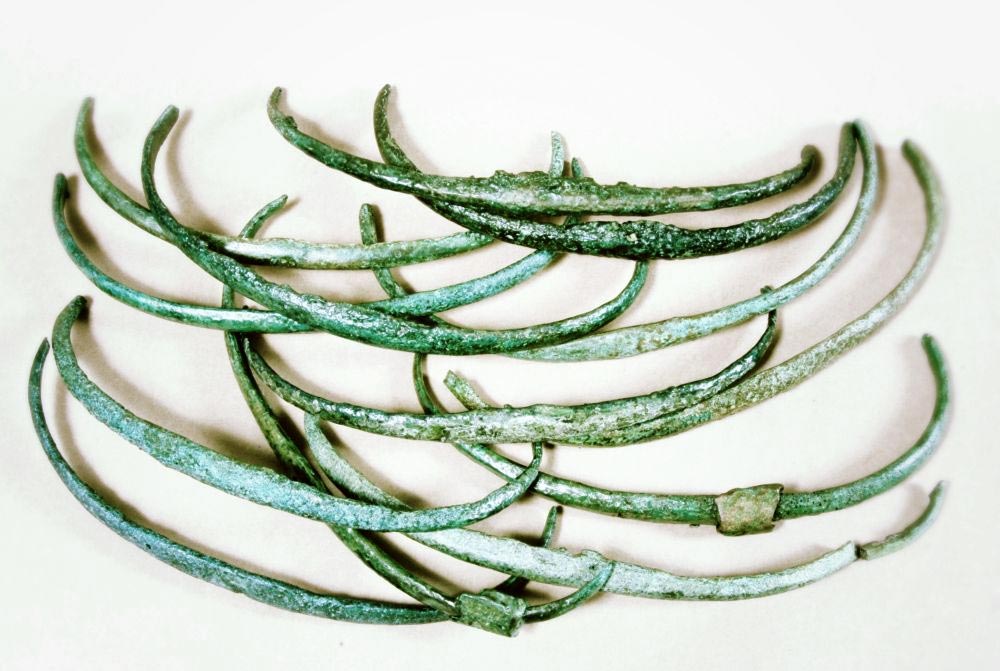
    Spangenbarren Ribs
    Ribs (Spangenbarren). Credit: M.H.G. Kuijpers, author photo (CC-BY 4.0)

    Early Bronze Age cultures traded in bronze objects of standardized weight.

    In the Early Bronze Age of Europe, ancient people used bronze objects as an early form of money, even going so far as to standardize the shape and weight of their currency, according to a study published January 20, 2021, in the open-access journal PLOS ONE by Maikel H. G. Kuijpers and Cătălin N. Popa of Leiden University, Netherlands.

    Money is an important feature of modern human society. One key feature of money is standardization, but this can be difficult to identify in the archaeological record since ancient people had inexact forms of measurement compared with today. In this study, the authors assessed possible money from the Early Bronze Age of Central Europe, comparing the objects based on their perceived — if not precise — similarity.

    Applying Psychology to Archaeology

    The objects studied were made of bronze in shapes described as rings, ribs, and axe blades. The authors examined more than 5,000 such objects from more than 100 ancient hoards. They statistically compared the objects’ weights using a psychology principle known as the Weber fraction, which quantifies the concept that, if objects are similar enough in mass, a human being weighing them by hand can’t tell the difference.
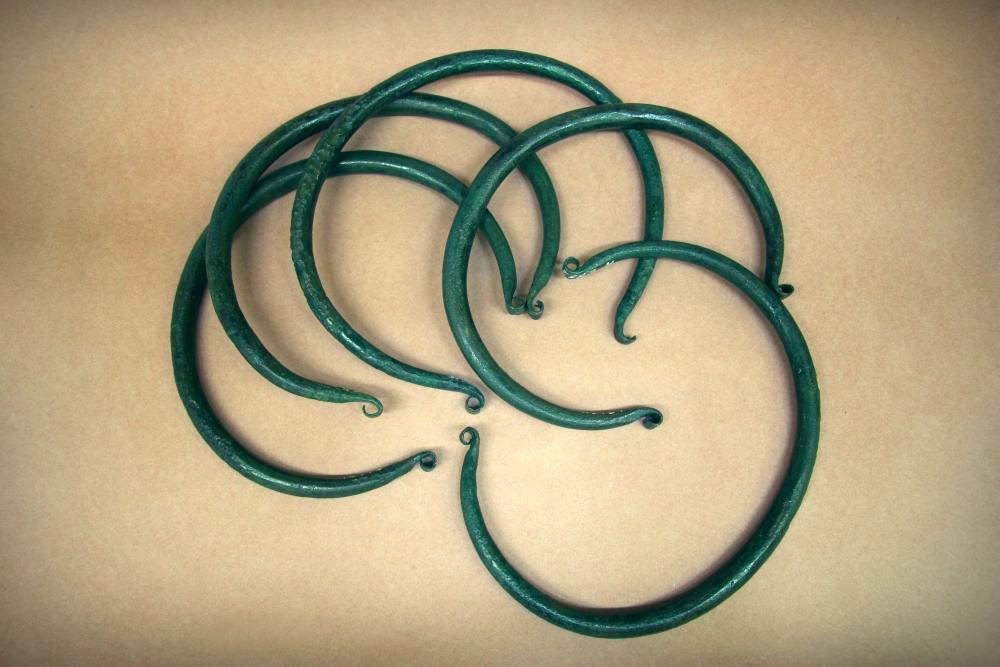
    Osenringen Rings
    Rings (Osenringen). Credit: M.H.G. Kuijpers, author photo (CC-BY 4.0)

    They found that even though the objects’ weights varied, around 70% of the rings were similar enough to have been indistinguishable by hand (averaging about 195 grams or 0.43 pounds), as were subsets of the ribs and axe blades.

    Progression to More Sophisticated Systems

    The authors suggest that this consistent similarity in shape and weight, along with the fact that these objects often occurred in hoards, are signs of their use as an early form of standardized currency. Later, in the Middle Bronze Age of Europe, more precise weighing tools appear in the archaeological record along with an increase in scrap bronze, pointing to a developed system of weighing.

    The authors add: “The euros of Prehistory came in the form of bronze rings, ribs, and axes. These Early Bronze Age artifacts were standardized in shape and weight and used as an early form of money.”

    Reference: “The origins of money: Calculation of similarity indexes demonstrates the earliest development of commodity money in prehistoric Central Europe” by Maikel H. G. Kuijpers and Cătălin N. Popa, 20 January 2021, PLoS ONE.
    DOI: 10.1371/journal.pone.0240462

    Funding: The research was supported by the Talent Programma VICI from the Netherlands Organisation for Scientific Research NWO, Grant number 277-60-001: “Economies of Destruction.” The funders had no role in study design, data collection and analysis, decision to publish, or preparation of the manuscript.

    Never miss a breakthrough: Join the SciTechDaily newsletter.
    Follow us on Google and Google News.

    Archaeology Economics History PLOS
    Share. Facebook Twitter Pinterest LinkedIn Email Reddit

    Related Articles

    New Study Decodes the 4,000-Year-Old Mystery of China’s Tomb Locations

    Study Reveals Italians Spent Thousands of Years Perfecting Grape Cultivation

    1300 Years Ahead: How Medieval China Pioneered Modern Social Mobility Trends

    Archaeologists Discover That Ancient Islamic Tombs Cluster Like Galaxies

    Indiscriminate Killing Revealed in Genetic Analysis of Ancient Massacre

    Medieval Injuries: Inequality in Cambridge Was “Recorded on the Bones” of Its Residents

    Mystifying Puzzle of Early Neolithic House Orientations Finally Solved

    Previously Dismissed As Myths, New Study Boosts Credibility of Columbus’ Cannibal Claims

    Cave Site Reveals 78,000-Year-Old Record of Stone Age Innovation

    Leave A Reply Cancel Reply

    • Facebook
    • Twitter
    • Pinterest
    • YouTube

    Don't Miss a Discovery

    Subscribe for the Latest in Science & Tech!

    Trending News

    The Strange “Spacetime Crystal” That Can Suddenly Turn Into a Black Hole

    The Surprising Way Asteroids May Have Helped Life Begin on Earth

    Vast Hidden Structure Discovered Under Miles of Ice in East Antarctica

    A Surprising Discovery Suggests Autism Is Not One Condition

    New Alzheimer’s Discovery Could Change How Scientists Fight the Disease

    Yale Discovery Overturns Long-Held “Evolutionary Dead End” Theory

    UCLA Scientists Uncover a “Hidden Weakness” in Some of the World’s Deadliest Cancers

    Humpback Whale Stuns Scientists With 15,000 Kilometer Journey Across Oceans

    Follow SciTechDaily
    • Facebook
    • Twitter
    • YouTube
    • Pinterest
    • Newsletter
    • RSS
    SciTech News
    • Biology News
    • Chemistry News
    • Earth News
    • Health News
    • Physics News
    • Science News
    • Space News
    • Technology News
    Recent Posts
    • Food Waste Becomes a Powerful Carbon Trap in Climate Breakthrough
    • Battery-Free Artificial Photosynthesis Turns Sunlight, Water, and CO2 Into Fuel
    • How Ancient People Moved a 6-Ton Stone 700 Kilometers to Stonehenge
    • Scientists Finally See How Antibodies Really Attack Viruses
    • The Unexpected Gut Health Risk of Cutting Out Sugar
    Copyright © 1998 - 2026 SciTechDaily. All Rights Reserved.
    • Science News
    • About
    • Contact
    • Editorial Board
    • Privacy Policy
    • Terms of Use

    Type above and press Enter to search. Press Esc to cancel.