

Burial site distributions reveal how people lived and died over thousands of years.
Tombs scattered across China, constructed from the ancient Xia Dynasty (around 4,000 years ago) to modern times, reveal how political and social changes shaped the nation’s history. This finding comes from a study published on October 29, 2025, in the open-access journal PLOS One by Quanbao Ma of the Beijing University of Civil Engineering and Architecture, China, and his research team.
To uncover historical patterns, the researchers mapped the locations of ancient tombs across the country. Their analysis showed that both economic conditions and geographic factors likely played key roles in determining where these burial sites were built.
The team found that many well-preserved tombs date to eras of stability and prosperity, including the Qin-Han and Yuan-Ming-Qing dynasties. In contrast, periods marked by warfare and unrest, such as the Five Dynasties era, left behind fewer tombs. The researchers suggest that during times of greater wealth and security, people had more resources and opportunity to devote attention to burial practices and beliefs about the afterlife.
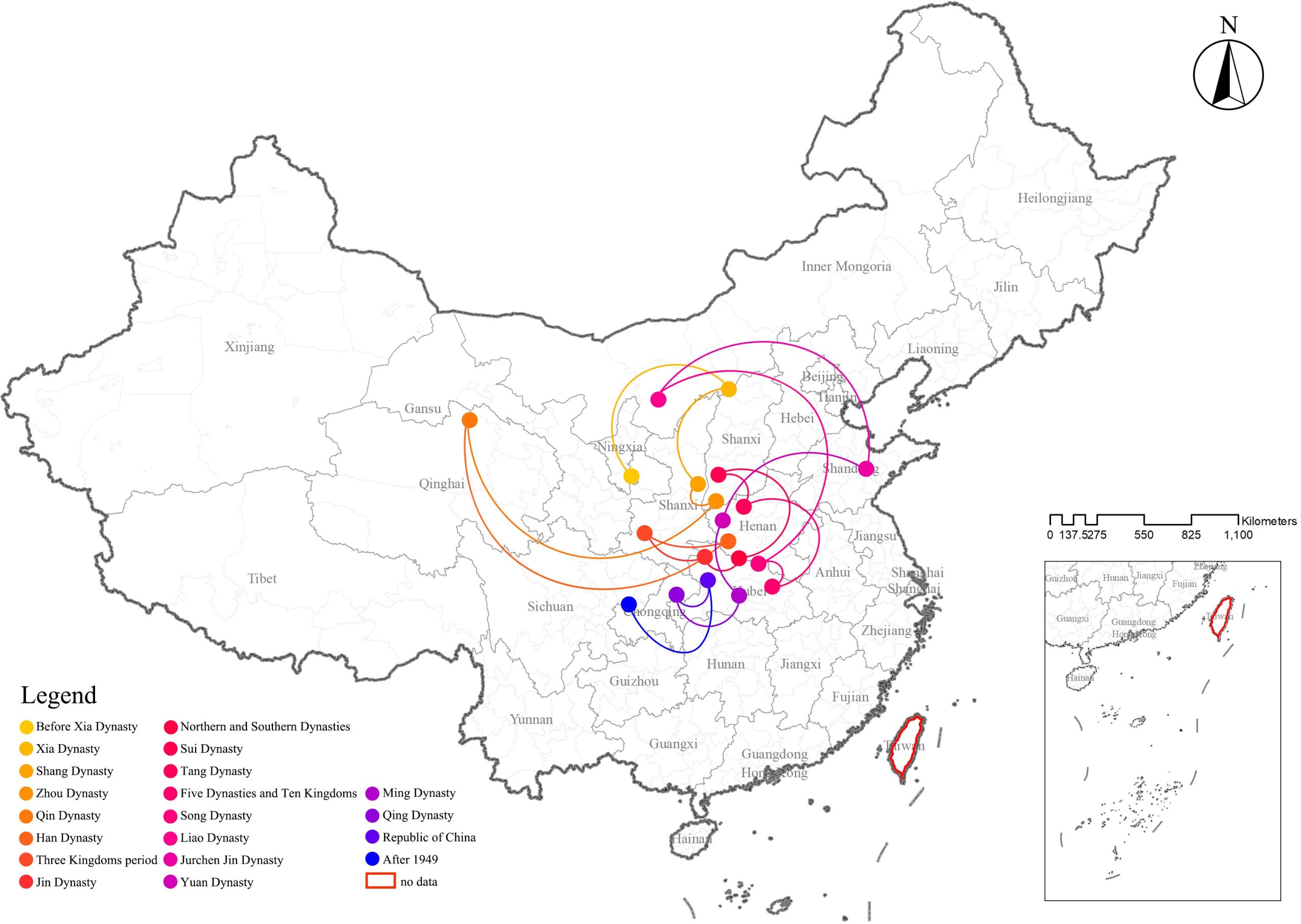
Population Movements and Shifting Tomb Locations
Population trends might also have influenced where tombs were built. The researchers note, for example, that war was common in northern China from the late Eastern Han dynasty through the Northern and Southern dynasties. This led people to move southward, and tombs from this era are clustered in these southern locations.
Both the Chengdu-Chongqing and Central Plains regions have a higher number of surviving tombs. The researchers note that Chengdu-Chongqing has relatively flat land and fertile soil, and the Central Plains have flat land and plenty of water, which would have helped ancient settlements develop in these areas. Both areas are also relatively humid, which likely helped preserve artifacts inside the tombs.
Burial sites represent an indispensable source of cultural heritage knowledge, the research team notes — and they hope that this study will help provide some of the scientific foundations needed to preserve these tombs in the future.
The authors add: “This study conducted a systematic digital survey and analysis of the spatiotemporal distribution characteristics and influencing factors of ancient tombs in China, revealing their evolution patterns and influencing factors, thus laying an important theoretical foundation for building a scientific and precise protection system.”
Reference: “The spatiotemporal distribution characteristics and influencing factors of ancient tombs in China: A study on the conservation of ancient tombs in China” by Quanbao Ma, Yujia Li, Zhen Yang, Xing Zhao, Can Li, Zi Shi and Zimu Li, 29 October 2025, PLOS ONE.
DOI: 10.1371/journal.pone.0333485
This study was supported by the National Social Science Fund of China in the form of a grant awarded to Quanbao Ma (22FYSB019) and the National Social Science Fund of China in the form of a salary for Quanbao Ma.
Never miss a breakthrough: Join the SciTechDaily newsletter.
Follow us on Google and Google News.
2 Comments
Fascinating work. What I like most is the move from “it felt like geomancy” to testable patterns: terrain, water flow, prevailing winds, and sky cues turned into measurable spatial constraints. If tomb placement correlates with specific slope/aspect bands and distances to rivers or ridgelines—even after controlling for settlement density—that’s a strong hint of rule-based site selection rather than pure happenstance. It also squares with how practical needs (drainage, stability) can fuse with cosmology. I’m curious how robust the model is across regions and dynasties: do the same variables predict later burials, or does the signal fade as beliefs shift? Either way, great example of archaeology meeting data science.
The summary of the research tells me only what a general review of history tells me, but perhaps with more rigorous underpinnings. When times are good, people have more disposable effort to build tombs. People move from miserable places to good ones. If that’s it, the results didn’t uncover some other types of rules that overcome the obvious rules. Did the summary omit unique findings, or was the study a reproducibility study that firms up what we expected?