

Close Menu
    Facebook X (Twitter) Instagram
    SciTechDaily
    • Biology
    • Chemistry
    • Earth
    • Health
    • Physics
    • Science
    • Space
    • Technology
    Facebook X (Twitter) Pinterest YouTube RSS
    SciTechDaily
    Home»Space»Searching for Signs of Life on Mars: Perseverance’s Robotic Arm Starts Conducting Science
    Space

    Searching for Signs of Life on Mars: Perseverance’s Robotic Arm Starts Conducting Science

    By Jet Propulsion LaboratoryMay 12, 2021No Comments5 Mins Read
    Facebook Twitter Pinterest Telegram LinkedIn WhatsApp Email Reddit
    Share
    Facebook Twitter LinkedIn Pinterest Telegram Email Reddit
    Mastcam-Z Views 'Santa Cruz' on Mars
    Mastcam-Z Views ‘Santa Cruz’ on Mars: NASA’s Perseverance Mars rover used its dual-camera Mastcam-Z imager to capture this image of “Santa Cruz,” a hill about 1.5 miles (2.5 kilometers) away from the rover, on April 29, 2021, the 68th Martian day, or sol, of the mission. The entire scene is inside of Mars’ Jezero Crater; the crater’s rim can be seen on the horizon line beyond the hill. Credit: NASA/JPL-Caltech/ASU/MSSS

    NASA’s newest Mars rover is beginning to study the floor of an ancient crater that once held a lake.

    NASA’s Perseverance rover has been busy serving as a communications base station for the Ingenuity Mars Helicopter and documenting the rotorcraft’s historic flights. But the rover has also been busy focusing its science instruments on rocks that lay on the floor of Jezero Crater.

    What insights they turn up will help scientists create a timeline of when an ancient lake formed there, when it dried, and when sediment began piling up in the delta that formed in the crater long ago. Understanding this timeline should help date rock samples – to be collected later in the mission – that might preserve a record of ancient microbes.
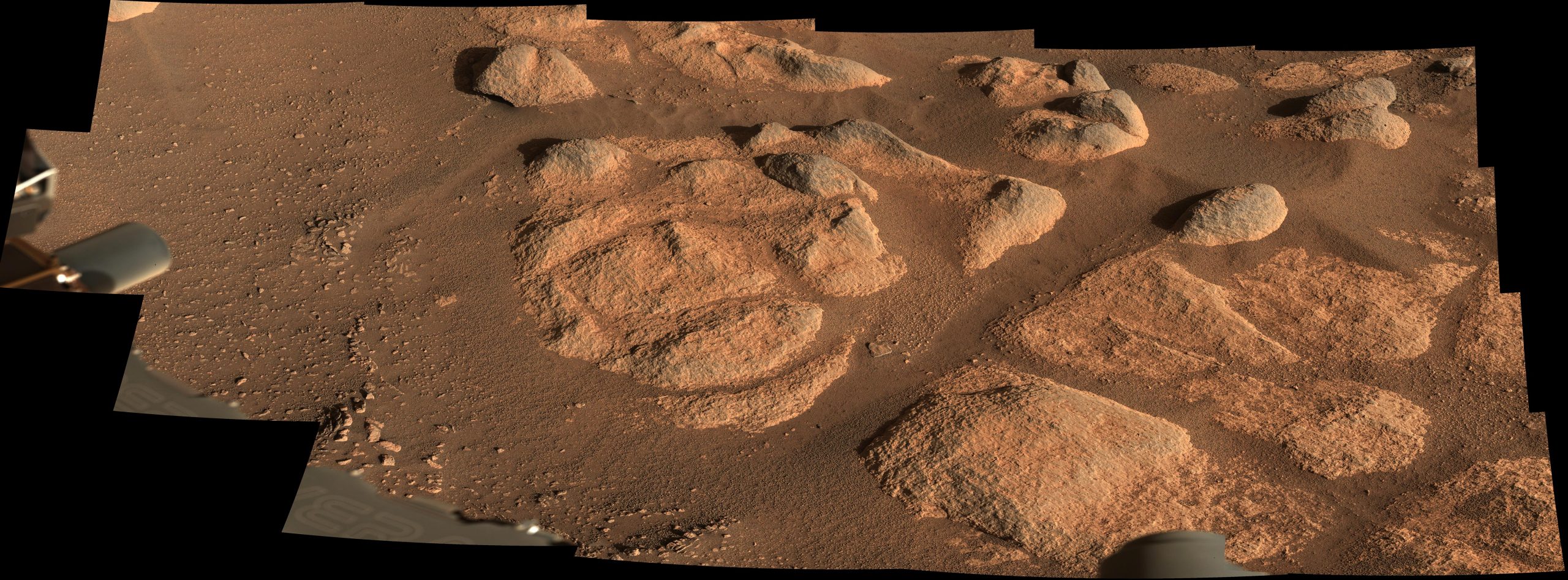
    Perseverance Mastcam-Z Images Intriguing Rocks
    Perseverance’s Mastcam-Z Images Intriguing Rocks: NASA’s Perseverance rover viewed these rocks with its Mastcam-Z imager on April 27, 2021. Credit: NASA/JPL-Caltech/ASU/MSSS

    A camera called WATSON on the end of the rover’s robotic arm has taken detailed shots of the rocks. A pair of zoomable cameras that make up the Mastcam-Z imager on the rover’s “head” has also surveyed the terrain. And a laser instrument called SuperCam has zapped some of the rocks to detect their chemistry. These instruments and others allow scientists to learn more about Jezero Crater and to home in on areas they might like to study in greater depth.

    One important question scientists want to answer: whether these rocks are sedimentary (like sandstone) or igneous (formed by volcanic activity). Each type of rock tells a different kind of story. Some sedimentary rocks – formed in the presence of water from rock and mineral fragments like sand, silt, and clay – are better suited to preserving biosignatures, or signs of past life. Igneous rocks, on the other hand, are more precise geological clocks that allow scientists to create an accurate timeline of how an area formed.
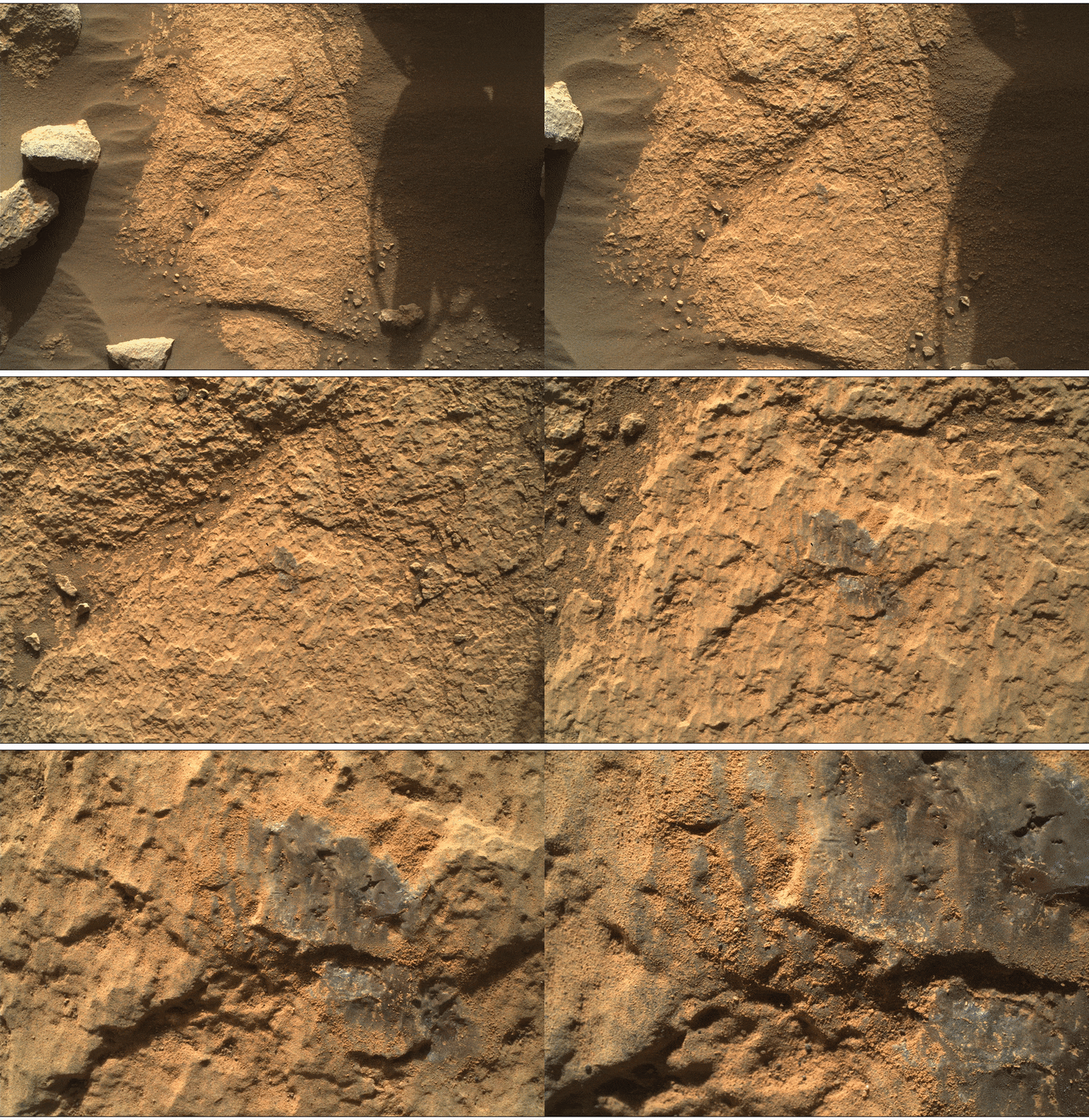
    NASA Perseverance Mars Rover Watson Focus Test
    NASA’s Perseverance Mars rover used the WATSON camera on the end of its robotic arm to conduct a focus test on May 10, 2021, the 79th Martian day, or sol, of the mission. Credit: NASA/JPL-Caltech/MSSS

    One complicating factor is that the rocks around Perseverance have been eroded by wind over time and covered with younger sand and dust. On Earth, a geologist might trudge into the field and break a rock sample open to get a better idea of its origins. “When you look inside a rock, that’s where you see the story,” said Ken Farley of Caltech, Perseverance’s project scientist.

    While Perseverance doesn’t have a rock hammer, it does have other ways to peer past millennia’s worth of dust. When scientists find a particularly enticing spot, they can reach out with the rover’s arm and use an abrader to grind and flatten a rock’s surface, revealing its internal structure and composition. Once they’ve done that, the team gathers more detailed chemical and mineralogical information using arm instruments called PIXL (Planetary Instrument for X-ray Lithochemistry) and SHERLOC (Scanning for Habitable Environments with Raman & Luminescence for Organics & Chemicals).

    NASA's Perseverance Mars Rover Using PIXL
    Perseverance’s PIXL at Work on Mars (Illustration): In this illustration, NASA’s Perseverance Mars rover uses the Planetary Instrument for X-ray Lithochemistry (PIXL). Located on the turret at the end of the rover’s robotic arm, the X-ray spectrometer will help search for signs of ancient microbial life in rocks. Credit: NASA/JPL-Caltech.

    “The more rocks you look at, the more you know,” Farley said.

    And the more the team knows, the better samples they can ultimately collect with the drill on the rover’s arm. The best ones will be stored in special tubes and deposited in collections on the planet’s surface for eventual return to Earth.

    More About the Mission

    A key objective for Perseverance’s mission on Mars is astrobiology, including the search for signs of ancient microbial life. The rover will characterize the planet’s geology and past climate, pave the way for human exploration of the Red Planet, and be the first mission to collect and cache Martian rock and regolith (broken rock and dust).

    Subsequent NASA missions, in cooperation with ESA (European Space Agency), would send spacecraft to Mars to collect these sealed samples from the surface and return them to Earth for in-depth analysis.

    The Mars 2020 Perseverance mission is part of NASA’s Moon to Mars exploration approach, which includes Artemis missions to the Moon that will help prepare for human exploration of the Red Planet.

    JPL, which is managed for NASA by Caltech in Pasadena, California, built and manages operations of the Perseverance rover.

    Never miss a breakthrough: Join the SciTechDaily newsletter.
    Follow us on Google and Google News.

    Astrobiology JPL Mars Mars 2020 Perseverance Rover NASA Popular
    Share. Facebook Twitter Pinterest LinkedIn Email Reddit

    Related Articles

    NASA Perseverance Rover’s Stunning Find May Be Mars’ First Sign of Life

    Inside Krokodillen: NASA Hunts Signs of Life in Mars’ Oldest Rocks

    NASA’s Perseverance Mars Rover To Begin Epic Climb up Steep Martian Crater Rim

    Potential Evidence of Life Discovered on Mars by NASA’s Perseverance Rover

    Perseverance Triumphs: How SHERLOC Was Brought Back to Life on Mars

    NASA’s Perseverance Rover Hits the Mark – “This Is the Kind of Rock We Had Hoped To Find”

    Life on Mars? NASA’s Perseverance Rover Finds Evidence of Diverse Organic Compounds

    Life on Mars? Latest Intriguing Organic Findings by NASA’s Perseverance Rover

    NASA’s New Mars Rover Will Use X-Rays to Hunt for Chemical Fingerprints Left by Ancient Microbes

    Leave A Reply Cancel Reply

    • Facebook
    • Twitter
    • Pinterest
    • YouTube

    Don't Miss a Discovery

    Subscribe for the Latest in Science & Tech!

    Trending News

    Scientists Warn That This Common Pet Fish Can Wreck Entire Ecosystems

    Scientists Make Breakthrough in Turning Plastic Trash Into Clean Fuel Using Sunlight

    This Popular Supplement May Interfere With Cancer Treatment, Scientists Warn

    Scientists Finally Solved One of Water’s Biggest Mysteries

    Could This New Weight-Loss Pill Disrupt the Entire Market? Here’s What You Should Know About Orforglipron

    Earth’s Crust Is Tearing Open in Africa, and It Could Form a New Ocean

    Breakthrough Bowel Cancer Trial Leaves Patients Cancer-Free for Nearly 3 Years

    Natural Compound Shows Powerful Potential Against Rheumatoid Arthritis

    Follow SciTechDaily
    • Facebook
    • Twitter
    • YouTube
    • Pinterest
    • Newsletter
    • RSS
    SciTech News
    • Biology News
    • Chemistry News
    • Earth News
    • Health News
    • Physics News
    • Science News
    • Space News
    • Technology News
    Recent Posts
    • Kratom Use Explodes in the US, With Life-Changing Consequences
    • Scientists Uncover Fatal Weakness in “Zombie Cells” Linked to Cancer
    • World-First Study Reveals Human Hearts Can Regenerate After a Heart Attack
    • Why Your Dreams Feel So Real Sometimes and So Strange Other Times
    • Scientists Debunk 100-Year-Old Belief About Brain Cells, Rewriting Textbooks
    Copyright © 1998 - 2026 SciTechDaily. All Rights Reserved.
    • Science News
    • About
    • Contact
    • Editorial Board
    • Privacy Policy
    • Terms of Use

    Type above and press Enter to search. Press Esc to cancel.