
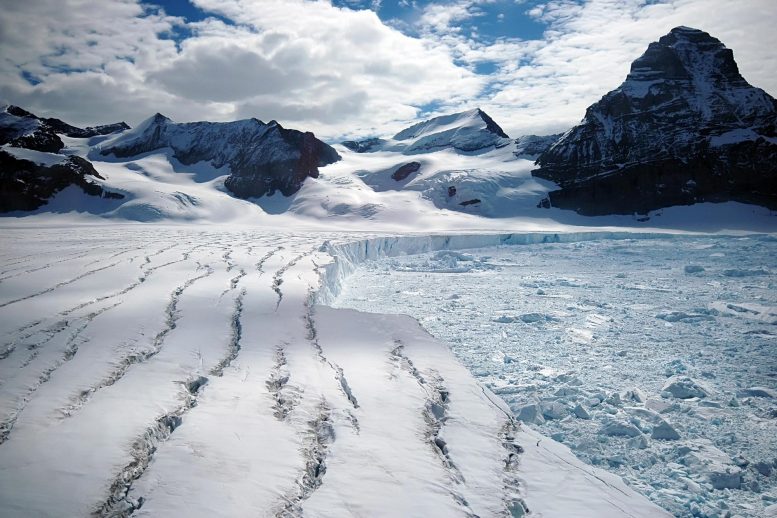
Antarctica’s ancient ice growth reveals how past CO2 drops reshaped climate and life, offering lessons for today’s warming world.
A new study from researchers at The Australian National University (ANU) on how the world’s largest ice sheet developed also provides vital clues about climate change tipping points.
Forty million years ago, Antarctica grew massive ice sheets for the first time. The ANU study shows how these ice sheets stayed low, wet, and relatively warm for millions of years.
The current Antarctic ice sheet is the largest block of ice on Earth, covering more than 14 million square kilometers. If it melted, sea levels would rise by about 60 meters.
But it hasn’t always been that way.
The spectacular ice sheet we’re familiar with today didn’t develop until around 12 million years ago, according to study co-author Dr. Bradley Opdyke.
“This had a huge impact on the stability of global sea levels,” Dr. Opdyke said. “Sea-level is a key indicator of global climate changes, so having more complete sea-level records will give us clues about climate tipping points, and what we might expect in the future.”
Once the ice sheets become so high, dry, and dynamic, determining past sea level and temperature changes becomes less certain.
Oxygen Isotopes Reveal Past Conditions
Scientists study the ratio of isotopes of oxygen in different materials from the deep sea to look for clues.
“This study could help us tease out some of the causes of the dramatic changes we saw in the middle Miocene period — around 12 million years ago,” Dr. Opdyke.
“Around this time in the Miocene we also started seeing pulses to lower CO2 levels that had interesting evolutionary consequences, like the appearance of grasses that are better adapted to a lower CO2 world.”
“The middle Pliocene period — about three million years ago — is important as well, because it’s the last time CO2 levels were similar to those of today.”
Reference: “Sea level and deep-sea temperature reconstructions suggest quasi-stable states and critical transitions over the past 40 million years” by Eelco J. Rohling, Jimin Yu, David Heslop, Gavin L. Foster, Bradley Opdyke and Andrew P. Roberts, 25 June 2021, Science Advances.
DOI: 10.1126/sciadv.abf5326
The paper has been published in the journal Science Advances. The research was led by Professor Eelco Rohling from ANU.
Never miss a breakthrough: Join the SciTechDaily newsletter.
Follow us on Google and Google News.
1 Comment
Let me see if I can summarize the above. Forty-million years ago, when CO2 levels were much higher than today, the Antarctic ice sheets formed for the first time. About 12-million years ago, when CO2 was still higher than today, the ice sheets reached the approximate size they are today. There were pulses of lower CO2. Then, 3-million years ago, when CO2 had lowered to about the same as it is today, the ice sheet was apparently about the same as today. Although, not stated explicitly in the article, presumably the ice sheets expanded 2-million years ago, during the last major glaciation, as CO2 reached lower concentrations.
This does not demonstrate a high correlation between CO2 and Antarctic temperatures. Apparently, the correlation is better when CO2 levels are lower. However, it doesn’t establish causation.
During the time of the major expansion of Northern Hemisphere continental glaciers, and alpine glaciers worldwide, there was reduced vegetation levels (Because plants can’t grow in ice!), reducing the ability of plants to sequester CO2, yet CO2 levels apparently continued to decrease! Why was that?
For the last 40-million years, it appears that an anti-correlation best describes the relationship between global temperatures and CO2, rather than CO2 being some kind of ‘Control Knob.’