
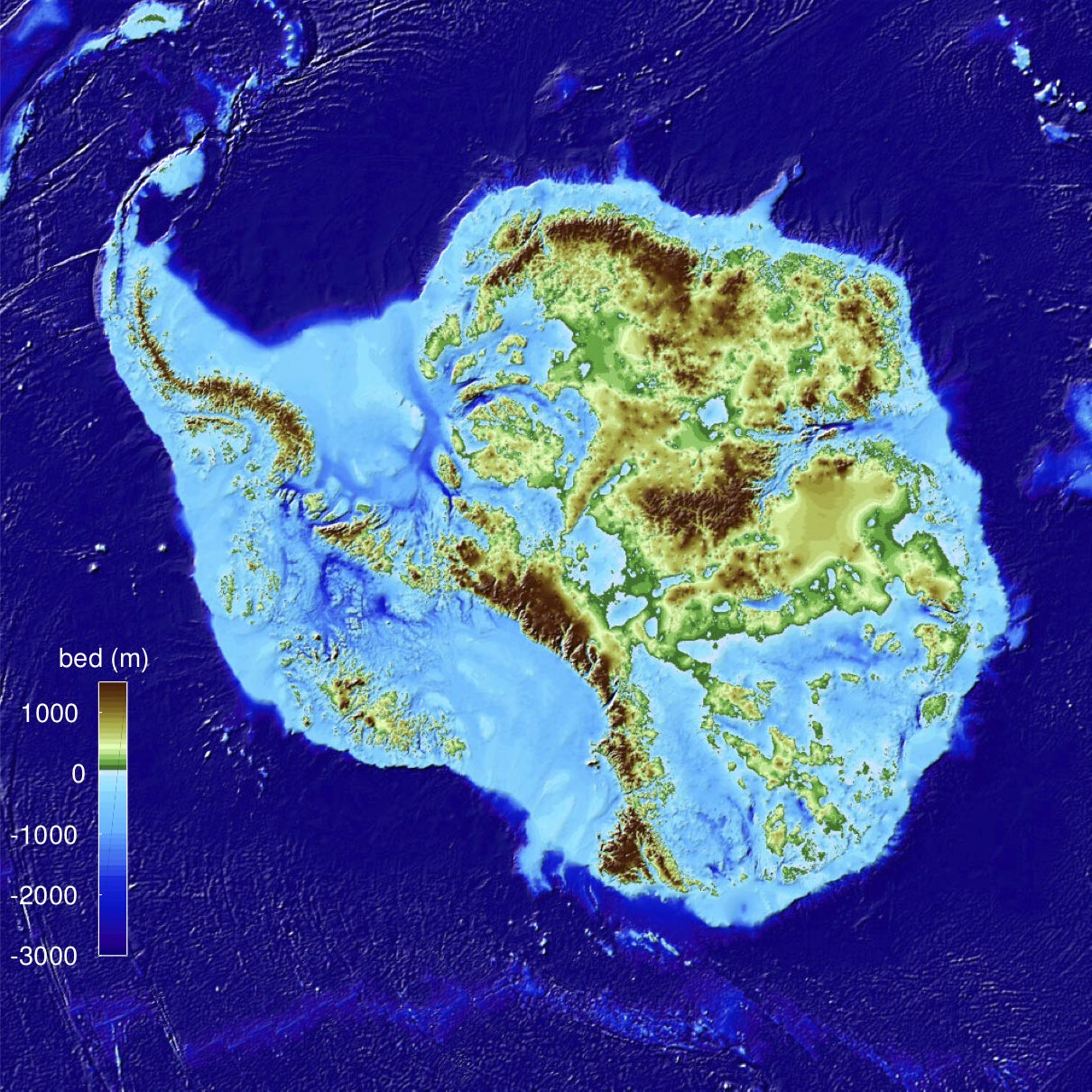
University of California, Irvine-led team releases high-precision map of Antarctic ice sheet bed topography. New findings will help scientists predict climate change impact on frozen continent.
A University of California, Irvine-led team of glaciologists has unveiled the most accurate portrait yet of the contours of the land beneath Antarctica’s ice sheet – and, by doing so, has helped identify which regions of the continent are going to be more, or less, vulnerable to future climate warming.
Highly anticipated by the global cryosphere and environmental science communities, the newly released Antarctica topography map, BedMachine, and related findings were published on December 12 in the journal Nature Geoscience.
Among the most striking results of the BedMachine project are the discovery of stabilizing ridges that protect the ice flowing across the Transantarctic Mountains; a bed geometry that increases the risk of rapid ice retreat in the Thwaites and Pine Island glaciers sector of West Antarctica; a bed under the Recovery and Support Force glaciers that is hundreds of meters deeper than previously thought, making those ice sheets more susceptible to retreat; and the world’s deepest land canyon below Denman Glacier in East Antarctica.
“There were lots of surprises around the continent, especially in regions that had not been previously mapped in great detail with radar,” said lead author Mathieu Morlighem, UCI associate professor of Earth system science. “Ultimately, BedMachine Antarctica presents a mixed picture: Ice streams in some areas are relatively well-protected by their underlying ground features, while others on retrograde beds are shown to be more at risk from potential marine ice sheet instability.”
The new Antarctic bed topography product was constructed using ice thickness data from 19 different research institutes dating back to 1967, encompassing nearly a million line-miles of radar soundings. In addition, BedMachine’s creators utilized ice shelf bathymetry measurements from NASA’s Operation IceBridge campaigns, as well as seismic information, where available.
“Using BedMachine to zoom into particular sectors of Antarctica, you find essential details such as bumps and hollows beneath the ice that may accelerate, slow down or even temporarily stop the retreat of glaciers,” Morlighem said.
Previous Antarctica mapping methods relying on radar soundings have been generally effective, with some limitations. As aircraft fly in a straight line over a region, wing-mounted radar systems emit a signal that penetrates the ice and bounces back from the point at which the ice meets solid ground. Glaciologists then use interpolation techniques to fill in the areas between the flight tracks, but this has proven to be an incomplete approach, especially with fast-flowing glaciers.
Alternatively, BedMachine relies on the fundamental physics-based method of mass conservation to estimate what lies between the radar sounding lines, utilizing highly detailed information on ice flow motion from satellite data that dictates how ice moves around the varied contours of the bed. This technique was instrumental in the research team’s conclusion regarding the true depth of the Denman trough.
“Older maps suggested a shallower canyon, but that wasn’t possible; something was missing,” Morlighem said. “With conservation of mass, by combining existing radar survey and ice motion data, we know how much ice flows through the canyon – which, by our calculations, reaches 3,500 meters (11,500 feet) below sea level, the deepest point on land. Since it’s relatively narrow, it has to be deep to allow that much ice mass to reach the coast.”
By basing its results on ice surface velocity in addition to ice thickness data from radar soundings, BedMachine is able to present a more accurate, high-resolution depiction of the bed topography. This methodology has been successfully employed in Greenland in recent years, transforming cryosphere researchers’ understanding of ice dynamics, ocean circulation, and the mechanisms of glacier retreat.
Applying the same technique to Antarctica is especially challenging due to the continent’s size and remoteness, but, Morlighem noted, BedMachine will help reduce the uncertainty in sea level rise projections from numerical models.
He said that future bed topography mapping on land could be greatly enhanced by charting sea floor depth offshore and beneath floating ice, which is an area of active study right now. In the paper published today, Morlighem also suggests that the study of fast-flowing Antarctic ice sheets would benefit from soundings along flight tracks perpendicular to the flow direction, “especially upstream of the Academy and Support Force glaciers, along the Gould Coast near the Ross Ice Shelf, and along the Wilhelm II Coast between the Denman and Lambert glaciers.”
Reference: “Deep glacial troughs and stabilizing ridges unveiled beneath the margins of the Antarctic ice sheet” by Mathieu Morlighem, Eric Rignot, Tobias Binder, Donald Blankenship, Reinhard Drews, Graeme Eagles, Olaf Eisen, Fausto Ferraccioli, René Forsberg, Peter Fretwell, Vikram Goel, Jamin S. Greenbaum, Hilmar Gudmundsson, Jingxue Guo, Veit Helm, Coen Hofstede, Ian Howat, Angelika Humbert, Wilfried Jokat, Nanna B. Karlsson, Won Sang Lee, Kenichi Matsuoka, Romain Millan, Jeremie Mouginot, John Paden, Frank Pattyn, Jason Roberts, Sebastian Rosier, Antonia Ruppel, Helene Seroussi, Emma C. Smith, Daniel Steinhage, Bo Sun, Michiel R. van den Broeke, Tas D. van Ommen, Melchior van Wessem and Duncan A. Young, 12 December 2019, Nature Geoscience.
DOI: 10.1038/s41561-019-0510-8
The BedMachine Antarctica project was supported by NASA’s Cryospheric Sciences Program, the U.S. National Science Foundation, the Australian government’s Cooperative Research Centres Programme and the National Natural Science Foundation of China, with participation from NASA’s Jet Propulsion Laboratory, the Alfred Wegener Institute, the University of Texas Institute for Geophysics, the British Antarctic Survey, the Technical University of Denmark, Northumbria University, the Polar Research Institute of China, The Ohio State University, the Geological Survey of Denmark and Greenland, the Korea Polar Research Institute, the Institute for Marine and Atmospheric Research at Utrecht University, the Norwegian Polar Institute, Grenoble Alps University, the NSF’s Center for Remote Sensing of Ice Sheets, the Université Libre de Bruxelles and the Australian Antarctic Division.
BedMachine Antarctica is publicly available through the National Snow and Ice Data Center in Boulder, Colorado.
Never miss a breakthrough: Join the SciTechDaily newsletter.
Follow us on Google and Google News.