
Close Menu
    Facebook X (Twitter) Instagram
    SciTechDaily
    • Biology
    • Chemistry
    • Earth
    • Health
    • Physics
    • Science
    • Space
    • Technology
    Facebook X (Twitter) Pinterest YouTube RSS
    SciTechDaily
    Home»Space»Could Low-Altitude Magnetic Reconnection Power Jupiter’s Polar Aurorae?
    Space

    Could Low-Altitude Magnetic Reconnection Power Jupiter’s Polar Aurorae?

    By Morgan Rehnberg, American Geophysical UnionSeptember 25, 2021No Comments3 Mins Read
    Facebook Twitter Pinterest Telegram LinkedIn WhatsApp Email Reddit
    Share
    Facebook Twitter LinkedIn Pinterest Telegram Email Reddit
    Hubble Jupiter Aurora
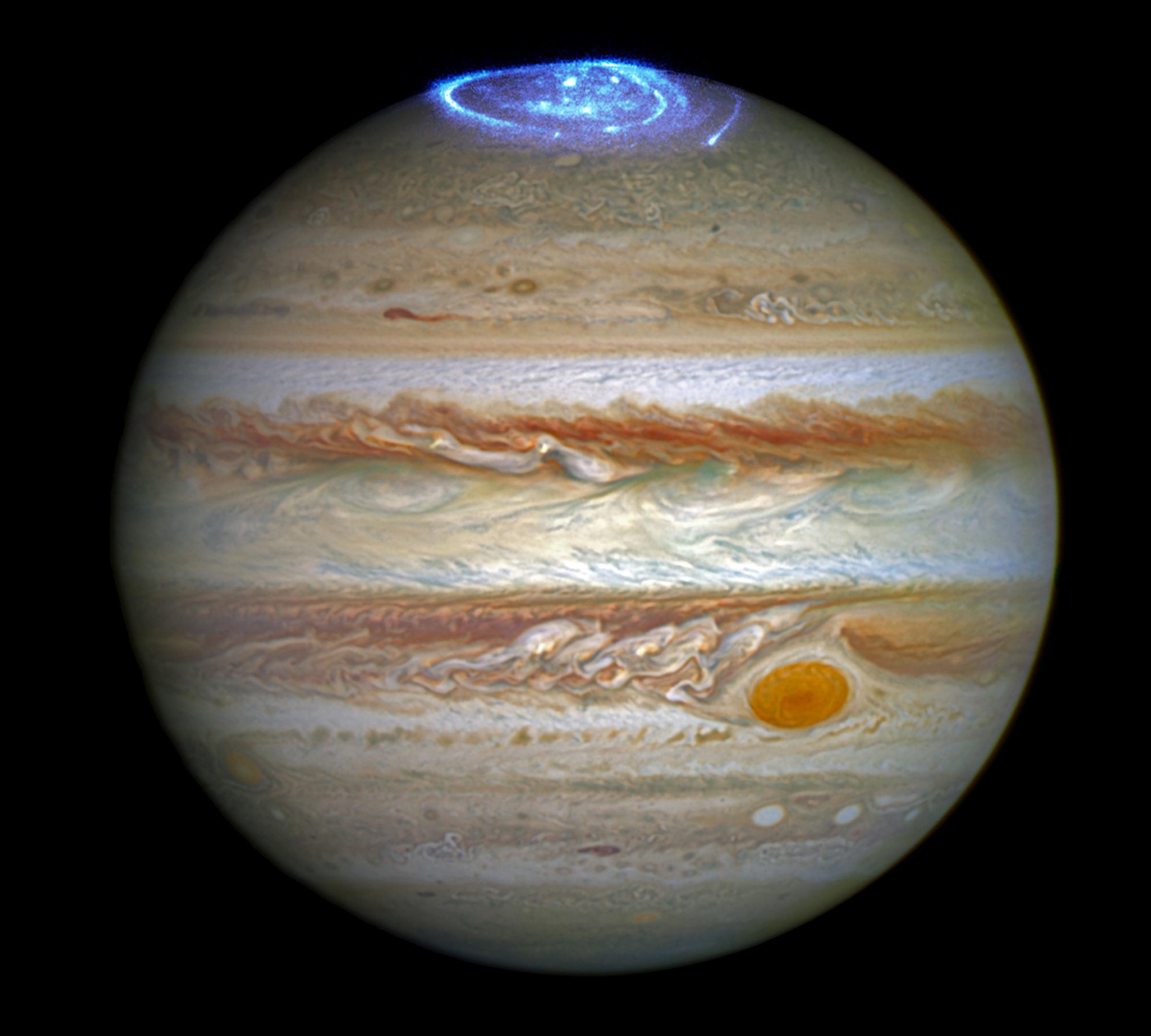
    This composite image shows the location of Jupiter’s northern aurorae, as seen by the Hubble Space Telescope. Strong auroral activity occurs very near the pole, a feature unique in the solar system to Jupiter. Credit: NASA, ESA, and J. Nichols, University of Leicester

    Magnetic reconnection events less than 2 Jovian radii above the planet’s cloud tops could explain why Juno has yet to observe a source for Jupiter’s polar aurore.

    Like Earth, Jupiter’s magnetic field channels electrically charged particles into its atmosphere, resulting in the formation of brilliant aurorae near its poles. However, the brightness and variety of Jupiter’s auroral emissions exceed those generated on our planet. Of particular interest are patches of emission that originate from even closer to the poles than the main aurorae, a feature that appears far stronger at Jupiter than at Earth or Saturn.

    Emission in the polar region can be fleeting, lasting minutes or sometimes only seconds. The polar auroral area can be further divided into three morphologies: “dark” regions of minimal emission, “active” regions of vigorous emission, and, at the highest latitudes, “swirl” regions of turbulent emission.

    Low-Altitude Magnetic Reconnection

    NASA’s Juno spacecraft has detected downward particle fluxes that can account for the main emission. However, no such flux has been found that could account for the bulk of the polar emissions, especially those from the swirl regions. Masters et al. propose a mechanism that would not yet have been observed by Juno: magnetic reconnection occurring not far above the Jovian cloud tops.

    The authors perform one-dimensional magnetohydrodynamic modeling to track the evolution of individual magnetic field lines in the vicinity of Jupiter’s pole. They model the region starting at the top of the planet’s atmosphere and extending 2 Jovian radii from that point. This region lies entirely below any extant spacecraft observations.

    Waves moving through the plasma enter the model domain from above, generated by interactions farther out in the planet’s magnetosphere. The propagation of these waves has the effect of deflecting the idealized magnetic field lines from a perfectly vertical position. This is a small effect, on the order of 0.01°, but it may be sufficient to kick-start magnetic reconnection events between neighboring field lines.

    Reconnection and Electron Acceleration

    During reconnection, adjacent field lines break and reform in a more energetically favorable configuration. This process releases energy stored within the field, which is carried away by the acceleration of nearby charged particles. The authors suggest downward traveling energetic electrons may be the source of the swirl regions in Jupiter’s polar aurorae.

    Finally, the authors suggest that this effect isn’t important at Earth or Saturn because of their weaker magnetic fields. Jupiter’s field is more than an order of magnitude stronger, and the reconnection rate increases by roughly the square of that value. Thus, Jupiter has strong polar aurorae, whereas Earth and Saturn do not.

    Reference: “Magnetic Reconnection Near the Planet as a Possible Driver of Jupiter’s Mysterious Polar Auroras” by A. Masters, W. R. Dunn, T. S. Stallard, H. Manners and J. Stawarz, 14 July 2021, Journal of Geophysical Research: Space Physics.
    DOI: 10.1029/2021JA029544

    Never miss a breakthrough: Join the SciTechDaily newsletter.
    Follow us on Google and Google News.

    American Geophysical Union Aurora Geophysics Jupiter
    Share. Facebook Twitter Pinterest LinkedIn Email Reddit

    Related Articles

    Electromagnetic “Tug-of-War” Lights Up Jupiter’s Upper Atmosphere

    Devourer of Storms: Jupiter’s Great Red Spot Feeds on Smaller Storms

    STEVE – An Entirely New Celestial Phenomenon

    New Hydrothermal Model Evaluates the Possibility of Life on Jupiter’s Moon Europa

    Astronomers Reveal How a Jupiter Jet Stream Shifts into Reverse

    Astronomers View Jupiter’s Independently Pulsating X-ray Auroras

    Jupiter’s Powerful Auroras Present a Challenging Mystery

    Geophysicists Resolve the Mystery About Wind Flows on Jupiter

    MESSENGER Spacecraft Reveals New Details about Mercury

    Leave A Reply Cancel Reply

    • Facebook
    • Twitter
    • Pinterest
    • YouTube

    Don't Miss a Discovery

    Subscribe for the Latest in Science & Tech!

    Trending News

    Mezcal “Worm” in a Bottle Mystery: DNA Testing Reveals a Surprise

    New Research Reveals That Your Morning Coffee Activates an Ancient Longevity Switch

    This Is What Makes You Irresistible to Mosquitoes

    Shockingly Powerful Giant Octopuses Ruled the Seas 100 Million Years Ago

    Scientists Stunned by New Organic Molecules Found on Mars

    Rewriting Dinosaur Evolution: Scientists Unearth Remarkable 150-Million-Year-Old Stegosaur Skull

    Omega-3 Supplements Linked to Cognitive Decline in Surprising New Study

    First-of-Its-Kind Discovery: Homer’s Iliad Found Embedded in a 1,600-Year-Old Egyptian Mummy

    Follow SciTechDaily
    • Facebook
    • Twitter
    • YouTube
    • Pinterest
    • Newsletter
    • RSS
    SciTech News
    • Biology News
    • Chemistry News
    • Earth News
    • Health News
    • Physics News
    • Science News
    • Space News
    • Technology News
    Recent Posts
    • Scientists Just Discovered the Hidden Trick That Keeps Your Cells Alive
    • This Simple Movement Could Be Secretly Cleaning Your Brain
    • Male Birth Control Breakthrough: Scientists Find Way To Turn Sperm Production Off and Back On
    • A Common Vitamin Could Hold the Key to Treating Fatty Liver Disease
    • New Research Shows Vitamin B12 May Hold the Key to Healthy Aging
    Copyright © 1998 - 2026 SciTechDaily. All Rights Reserved.
    • Science News
    • About
    • Contact
    • Editorial Board
    • Privacy Policy
    • Terms of Use

    Type above and press Enter to search. Press Esc to cancel.