

Close Menu
    Facebook X (Twitter) Instagram
    SciTechDaily
    • Biology
    • Chemistry
    • Earth
    • Health
    • Physics
    • Science
    • Space
    • Technology
    Facebook X (Twitter) Pinterest YouTube RSS
    SciTechDaily
    Home»Science»Contrary to Theory, Binge-Eating Is Not Caused by Stress-Induced Impulsivity
    Science

    Contrary to Theory, Binge-Eating Is Not Caused by Stress-Induced Impulsivity

    By Society for NeuroscienceSeptember 26, 2021No Comments2 Mins Read
    Facebook Twitter Pinterest Telegram LinkedIn WhatsApp Email Reddit
    Share
    Facebook Twitter LinkedIn Pinterest Telegram Email Reddit
    Obesity Binge Eating Disorder
    Stress changes brain activity in regions related to self-inhibition but does not induce binge-eating.

    Stress alters brain activity in inhibition network but doesn’t prompt binge-eating, contrary to theory.

    Stress alters brain activity in self-inhibition areas yet doesn’t trigger binge-eating, according to new research published in JNeurosci.

    People who binge-eat, a hallmark symptom of several eating disorders, can feel out of control and unable to stop, and often binge after stressful events. This led scientists to theorize stress impairs the brain regions responsible for inhibitory control — the ability to stop what you are about to do or currently doing — and triggers binge-eating.
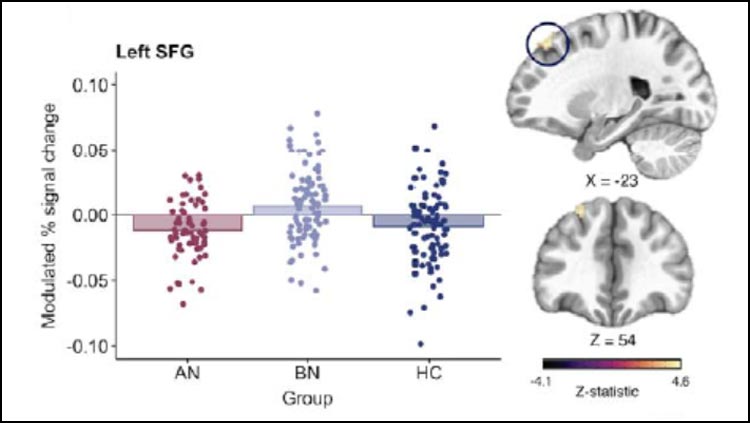
    Binge-Eating Is Not Caused by Stress-Induced Impulsivity
    Impaired proactive inhibition in bulimia nervosa is associated with increased superior frontal gyrus activity. Credit: Westwater et al., JNeurosci 2021

    Westwater et al. tested this theory by using fMRI to measure the brain activity of women with anorexia, bulimia, or without an eating disorder as they completed an inhibitory control task, either while stressed or relaxed. The task entailed pushing a button to stop a moving bar when it reached a specific point on the screen. On some trials the bar stopped early, and the participants had to prevent themselves from pushing the button. Stress altered the brain activity associated with inhibitory control in both groups of women with eating disorders but had no effect on task performance — meaning they still had the ability to stop their actions. These results indicate self-inhibition is preserved in the face of stress, so the actual mechanism behind binge-eating is more complex than previously thought.

    For more on this research, read Contrary to Theory, Stress Does Not Lead to Loss of Self-Control in Eating Disorders.

    Reference: “Prefrontal responses during proactive and reactive inhibition are differentially impacted by stress in anorexia and bulimia nervosa” by Margaret L. Westwater [MPhil], Flavia Mancini [PhD], Adam X. Gorka [PhD], Jane Shapleske [MD], Jaco Serfontein [MD], Christian Grillon [PhD], Monique Ernst [MD, PhD], Hisham Ziauddeen [MRCPsych, PhD] and Paul C. Fletcher [MRCPsych, PhD], 12 April 2021, Journal of Neuroscience.
    DOI: 10.1523/JNEUROSCI.2853-20.2021

    Never miss a breakthrough: Join the SciTechDaily newsletter.
    Follow us on Google and Google News.

    Eating Disorders Neuroscience Society for Neuroscience
    Share. Facebook Twitter Pinterest LinkedIn Email Reddit

    Related Articles

    Infant Brain Circuitry Shaped by Language Exposure

    “Area 32” – How the Brain Balances Emotion and Reason

    Contradicting Previous Theories, Neuroscientists Find Overlap Between Fear and Anxiety Brain Circuits

    Why Time Sometimes Flies or Drags: How the Brain Creates the Experience of Time

    Motherhood Overrides the Brain’s Decision-Making – Prioritizes Offspring Over Cocaine

    Monkeys Experience the Uncanny Valley Effect, Just Like Humans

    Scientists Can See the Bias in Your Brain – Even Before You Make Your Decision

    Listening to Binaural Beats Synchronizes Brain Activity, but What Is the Effect on Mood, Focus and Anxiety?

    Watching Music Move Through the Brain

    Leave A Reply Cancel Reply

    • Facebook
    • Twitter
    • Pinterest
    • YouTube

    Don't Miss a Discovery

    Subscribe for the Latest in Science & Tech!

    Trending News

    A Hidden Sugar in Red Meat Linked to a 63% Higher Risk of Diabetes

    Something Strange Is Happening Beneath Nicaragua’s Masaya Volcano

    Scientists Discover Aspirin May Slash Dementia Risk by 70% – but Only for Certain People

    The World’s Oldest Land Animal Has a Remarkable Anti-Aging Secret Hidden in Its DNA

    Scientists Discover a Surprising Link Between Obesity and Dementia Survival

    The Fossil Record May Be Missing 200 Million Years of Animal History

    Scientists Predicted Humanity Would End on November 13, 2026. Should We Be Worried?

    Experimental Heart Drug Helps Patients Exercise More and Feel Better

    Follow SciTechDaily
    • Facebook
    • Twitter
    • YouTube
    • Pinterest
    • Newsletter
    • RSS
    SciTech News
    • Biology News
    • Chemistry News
    • Earth News
    • Health News
    • Physics News
    • Science News
    • Space News
    • Technology News
    Recent Posts
    • Scientists Uncover a 500-Year-Old Secret Hidden in a Book Henry VIII Wanted Destroyed
    • Zimbabwe’s Ancient Dinosaurs Were Nothing Like Scientists Expected
    • MIT Astronomers Catch a Star Slowly Eating Its Companion 300 Light-Years Away
    • Eating Blueberries Linked to Subtle Gut Changes and Signs of Mood Improvement
    • Scientists Discover Why Eating Fat Before Carbs Reduces Blood Sugar Spikes
    Copyright © 1998 - 2026 SciTechDaily. All Rights Reserved.
    • Science News
    • About
    • Contact
    • Editorial Board
    • Privacy Policy
    • Terms of Use

    Type above and press Enter to search. Press Esc to cancel.