
A small trial in older adults uncovered subtle gut changes and hints of mood improvement with daily blueberry powder, but no clear benefit over placebo.
Inside the gut, the fiber and dark pigments in blueberries encounter a crowded community of microbes. Those ingredients could change the microbes and the substances they produce, raising the possibility that eating the fruit might influence mood. Establishing whether those microscopic changes actually ease depressive symptoms requires evidence that reaches beyond the gut.
Courtney L. Millar, PhD, and her colleagues explored that possibility in a three-month pilot study of sedentary adults 65 and older with mild depressive symptoms. Participants who consumed blueberry powder daily showed a greater, more consistent reduction in symptoms than those given a placebo. The difference between the groups was not statistically significant, however, leaving the apparent benefit uncertain.
Two cups of blueberries versus placebo
“Fiber and anthocyanins in blueberries have potential to modify the gut microbiome and metabolites that are relevant to depression in older adults,” said Millar, the study’s lead author and an assistant scientist II at Hebrew SeniorLife’s Hinda and Arthur Marcus Institute for Aging Research. Anthocyanins are the pigments that give blueberries their rich color, while metabolites are substances produced through chemical processes, including those carried out by microbes.
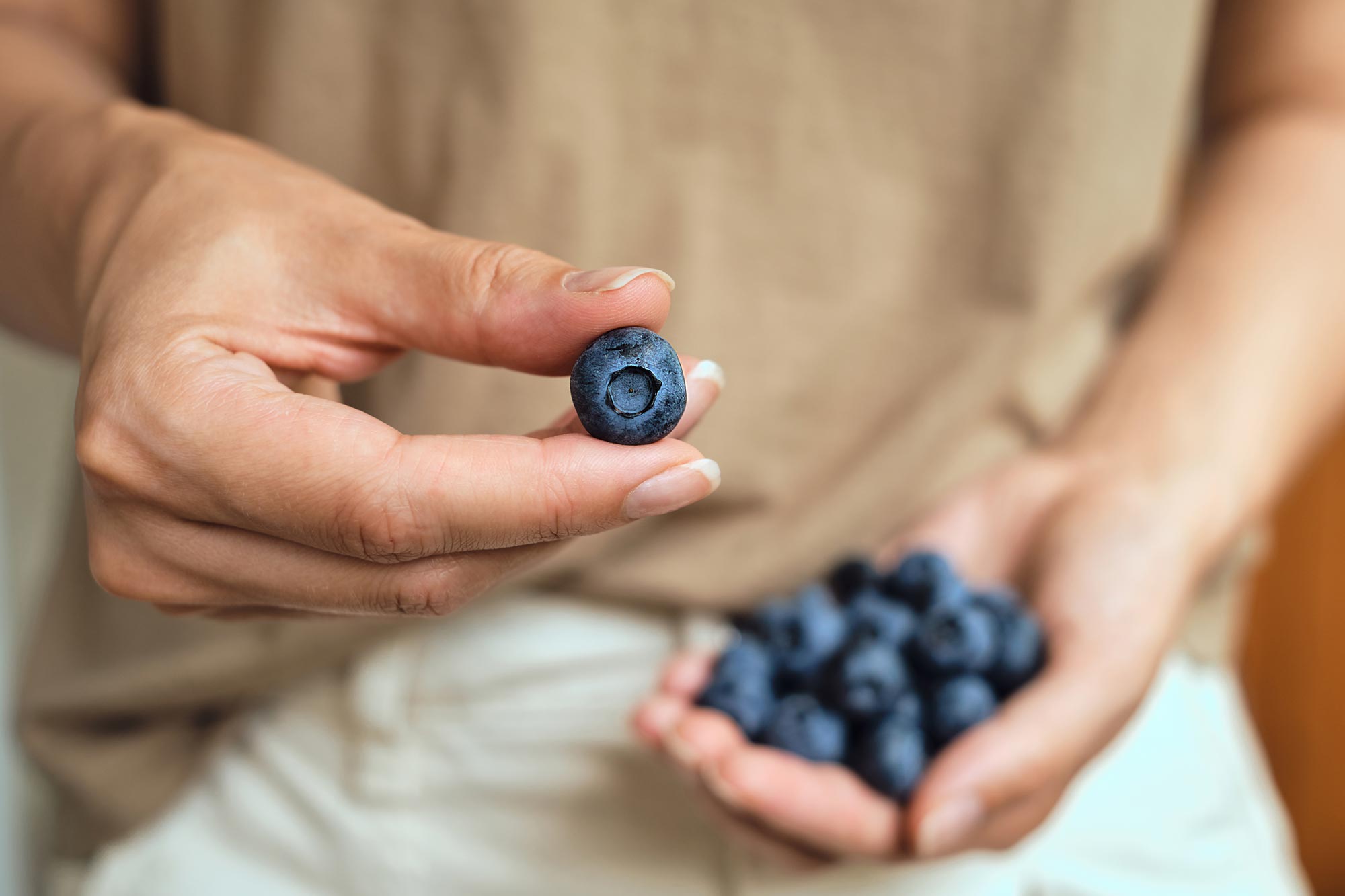
Participants were randomly assigned to consume either 48 grams, about 1.7 ounces, of blueberry powder each day or a matched placebo powder. The blueberry portion represented approximately two cups of fresh berries. The trial was double-blind, meaning neither the participants nor the researchers assessing them knew who was receiving which powder.
Millar’s team paired questionnaires measuring depressive symptoms with laboratory analyses of stool samples collected before and after the intervention.
“Our objective was to preliminarily determine the effect of blueberry consumption on the gut microbiome, metabolites, and depressive symptoms,” said Millar, who is also an assistant professor of medicine at Beth Israel Deaconess Medical Center and Harvard Medical School.
Reading microbial DNA allowed the researchers to measure which species and genes were present and how abundant they were. Separate chemical analyses measured short-chain fatty acids, substances produced by gut microbes. Together, these measurements let the team examine both the microbial community and some of its chemical products.
Small gut changes, uncertain mood benefits
Several categories of genes associated with microbial enzymes changed significantly within the blueberry group. One involved polyamine-transporting ATPase, which the researchers describe as participating in the production of the neurotransmitter gamma-aminobutyric acid, or GABA. Changes in the abundance of those genes do not, by themselves, demonstrate that the microbes produced more GABA or that it affected participants’ mood.
Other measurements remained unchanged, including the abundance of microbial species, the metabolic pathways assessed, and the short-chain fatty acids measured in stool. The genetic findings therefore represented a narrow change within the gut microbiome, without a corresponding change in those measured chemical products.
Eighteen older adults completed the study, including 10 who consumed blueberry powder daily and eight who received a placebo. Researchers observed subtle shifts in microbial genes in the blueberry group, alongside greater reductions in depressive symptoms, pointing to a possible connection between blueberry compounds, the gut microbiome, and mood.
Reference: “A pilot study of daily blueberry intake modulates the gut microbiota enzyme commissions in older, sedentary adults with mild depressive symptoms” by Courtney L. Millar, Mohit P. Chopra, Xochitl Morgan, Emily A. Green, Alex Wolfe, Kerry A. Pierce, Lidan Gao, Christopher N. Blesso, Alyssa B. Dufour, Douglas P. Kiel and Lewis A. Lipsitz, 21 August 2026, The Journal of nutrition, health and aging.
DOI: 10.1016/j.jnha.2026.100958
The Berries, Bugs, and the Blues was funded by the USDAAFRINIFA grant (2023-67017-39055). The parent trial was funded by The Boston Roybal Center for Active Lifestyle Interventions and the NIA (P30 AG048785-09).
Never miss a breakthrough: Join the SciTechDaily newsletter.
Follow us on Google and Google News.