

Close Menu
    Facebook X (Twitter) Instagram
    SciTechDaily
    • Biology
    • Chemistry
    • Earth
    • Health
    • Physics
    • Science
    • Space
    • Technology
    Facebook X (Twitter) Pinterest YouTube RSS
    SciTechDaily
    Home»Science»Motherhood Overrides the Brain’s Decision-Making – Prioritizes Offspring Over Cocaine
    Science

    Motherhood Overrides the Brain’s Decision-Making – Prioritizes Offspring Over Cocaine

    By Society for NeuroscienceJuly 6, 2020No Comments2 Mins Read
    Facebook Twitter Pinterest Telegram LinkedIn WhatsApp Email Reddit
    Share
    Facebook Twitter LinkedIn Pinterest Telegram Email Reddit

    Brain Heart Connected

    Infralimbic cortex prioritizes offspring over drugs, promotes maternal behavior in rats.

    Motherhood takes over the brain’s decision-making regions to prioritize caring for offspring, according to new research in rats published today (July 6, 2020) in eNeuro.

    Making decisions requires the medial prefrontal cortex filtering and repressing multiple streams of information. This often involves picking between powerful, conflicting stimuli, such as when drug-using mothers must choose between their new child or drug-seeking. Since the most effective addiction therapies in this situation work by emphasizing the mother/infant relationship, Pereira and Morrell hypothesized that a brain region must direct a mother to prioritize offspring over drugs.
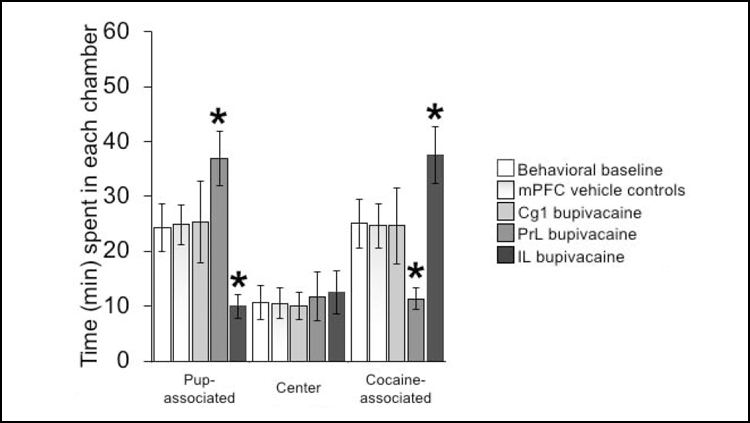
    Motherhood Overrides the Brain's Decision-Making
    Deactivating the prelimbic cortex (dark grey) increased preference for pups and decreased preference for cocaine. Deactivating the infralimbic cortex (black) increased preference for cocaine and decreased preference for pups. Credit: Pereira and Morrell, eNeuro 2020

    To pinpoint this brain region, the team temporarily inactivated different regions of rats’ prefrontal cortices with a local anesthetic and tested the rats’ preference for their pups or cocaine. Before inactivation, 40% of rats preferred to spend time in a room associated with cocaine, 40% preferred a pup-associated room, and 20% preferred a neutral room.

    But when the scientists inactivated the rats’ infralimbic cortex, 78% of rats preferred the cocaine room and none chose the pup room. The opposite was true when the prelimbic cortex was inactivated: 71% of rats preferred the pup room, and none chose the cocaine room. Inactivating the infralimbic cortex also decreased the mother’s maternal behaviors towards her pups. The researchers found that during motherhood, the brain recruits the discriminating powers of the infralimbic cortex to prioritize offspring over competing desires.

    Reference: “Infralimbic Cortex Biases Preference Decision Making for Offspring Over Competing Cocaine Associated Stimuli in New Mother Rats” by Mariana Pereira and Joan I. Morrell, 6 July 2020, eNeuro.
    DOI: 10.1523/ENEURO.0460-19.2020

    Never miss a breakthrough: Join the SciTechDaily newsletter.
    Follow us on Google and Google News.

    Addiction Behavioral Science Neuroscience Society for Neuroscience
    Share. Facebook Twitter Pinterest LinkedIn Email Reddit

    Related Articles

    Neuroscientists Track How Bad Moods Develop and Persist in the Brain

    Musicians Have Brains With Stronger Connections Than Non-musicians

    Infant Brain Circuitry Shaped by Language Exposure

    Too-Little Sleep Can Increase the Rewarding Properties of Cocaine, Paving Way to Addiction

    “Area 32” – How the Brain Balances Emotion and Reason

    Why Time Sometimes Flies or Drags: How the Brain Creates the Experience of Time

    Monkeys Experience the Uncanny Valley Effect, Just Like Humans

    Scientists Can See the Bias in Your Brain – Even Before You Make Your Decision

    Listening to Binaural Beats Synchronizes Brain Activity, but What Is the Effect on Mood, Focus and Anxiety?

    Leave A Reply Cancel Reply

    • Facebook
    • Twitter
    • Pinterest
    • YouTube

    Don't Miss a Discovery

    Subscribe for the Latest in Science & Tech!

    Trending News

    Doctors May Need To Rethink Calcium and Vitamin D Recommendations After Major Review

    Scientists Discover a Hidden Cause of Cellular Aging That Can Be Reversed

    Archaeologists Have Found Something Unexpected Inside a 1,600-Year-Old Egyptian Mummy

    Scientists May Have Found a Completely New Way To Treat Depression

    New 7-Dimensional Theory May Finally Solve the Black Hole Information Paradox

    Scientists Made Older Mice Biologically Younger Using Gut Microbes

    Scientists Finally Uncover Why Ozempic Stops Working for Some People

    Wasp Colonies Explode Into Violence After Losing Their Queen

    Follow SciTechDaily
    • Facebook
    • Twitter
    • YouTube
    • Pinterest
    • Newsletter
    • RSS
    SciTech News
    • Biology News
    • Chemistry News
    • Earth News
    • Health News
    • Physics News
    • Science News
    • Space News
    • Technology News
    Recent Posts
    • Researchers Solve the Mystery Behind a Billion-Dollar Dental Implant Disease
    • Scientists Finally Uncover How a “Forever Chemical” Causes Birth Defects
    • Scientists Uncover the Earliest Brain Changes That May Predict Alzheimer’s Decades Before Symptoms
    • Mystery Solved: The Decades-Old Secret Lurking Beneath North Carolina’s Blueberry Farms
    • Surprising New Study Challenges a Century-Old Theory of Habit Formation
    Copyright © 1998 - 2026 SciTechDaily. All Rights Reserved.
    • Science News
    • About
    • Contact
    • Editorial Board
    • Privacy Policy
    • Terms of Use

    Type above and press Enter to search. Press Esc to cancel.