
Close Menu
    Facebook X (Twitter) Instagram
    SciTechDaily
    • Biology
    • Chemistry
    • Earth
    • Health
    • Physics
    • Science
    • Space
    • Technology
    Facebook X (Twitter) Pinterest YouTube RSS
    SciTechDaily
    Home»Science»A Concrete Solution: Recycled Concrete and CO2 From the Air Are Made Into a New Building Material
    Science

    A Concrete Solution: Recycled Concrete and CO2 From the Air Are Made Into a New Building Material

    By University of TokyoOctober 11, 2021No Comments3 Mins Read
    Facebook Twitter Pinterest Telegram LinkedIn WhatsApp Email Reddit
    Share
    Facebook Twitter LinkedIn Pinterest Telegram Email Reddit
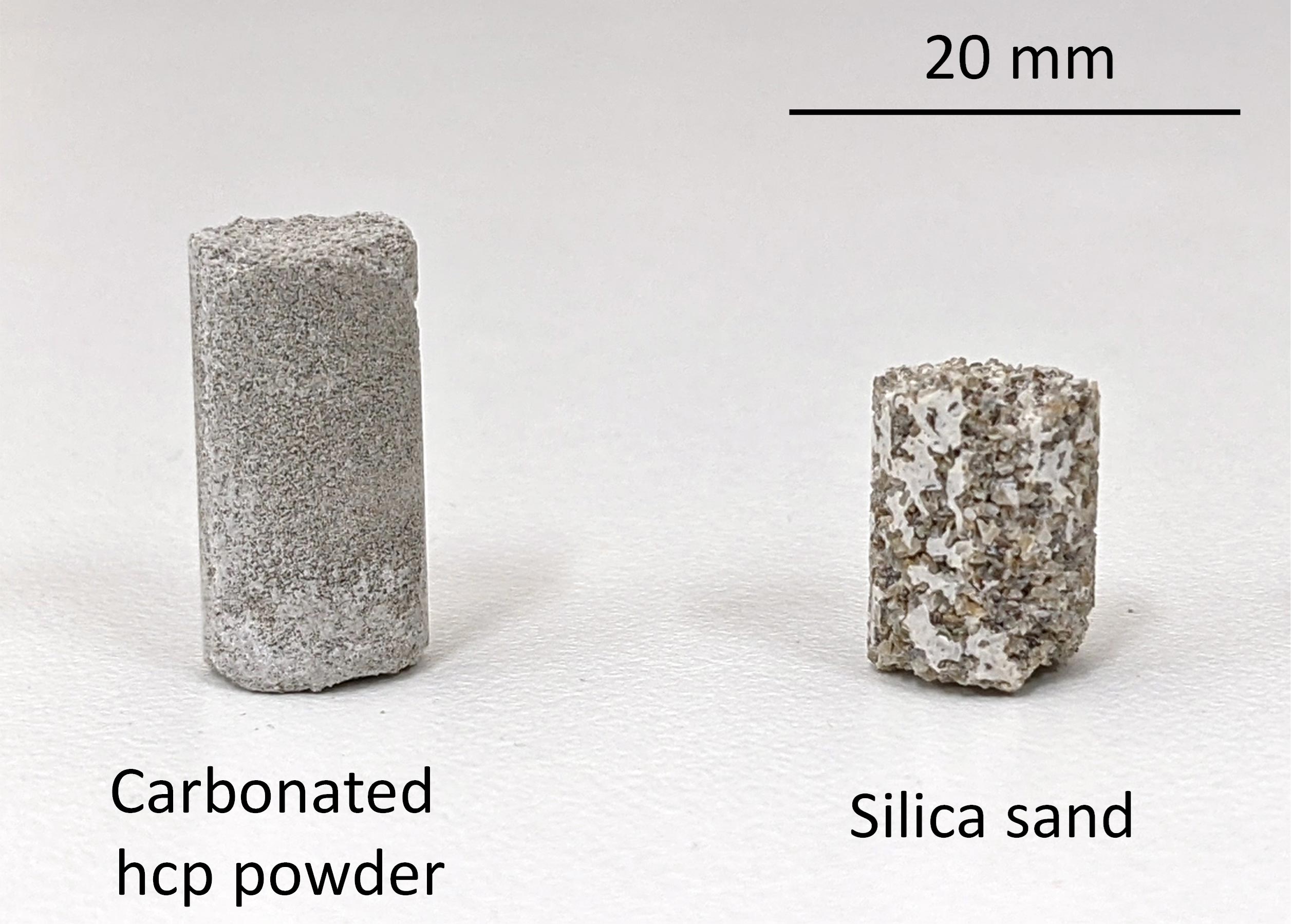
    Calcium Carbonate Concrete Samples
    Two samples of calcium carbonate concrete, one using hardened cement paste (left) and the other using silica sand. Both raw materials are common construction and demolition waste products. Credit: © 2021 Maruyama et al.

    A new concrete made from waste and captured CO₂ offers a greener path for future construction.

    A new kind of concrete could reduce emissions from the construction industry. Calcium carbonate concrete is made from waste concrete and carbon dioxide from the air or industrial exhaust gases. It shows promise as a future construction material, especially in places where natural resources are limited.

    The modern world is built from concrete. Every tall building in every city on Earth uses the durable and versatile material to give it shape and strength. The concrete industry therefore is enormous, and this comes at a cost: It is estimated that around 7% of the world’s carbon dioxide emissions come from the manufacture and use of cement, the main component of concrete. And a large proportion of this 7% is due to the necessary use of calcium, which is usually obtained by burning limestone.

    A new way to reduce emissions levels caused by concrete use has been proposed and proven to work by Professor Ippei Maruyama and C4S (Calcium Carbonate Circulation System for Construction) project manager Professor Takafumi Noguchi, both from the Department of Architecture at the University of Tokyo. They have found a way to take waste concrete and captured carbon dioxide, and combine them in a novel process into a usable form of concrete called calcium carbonate concrete.

    Inspired by Nature’s Fossilization Process

    Inspired by the way some aquatic organisms harden into fossils over time, Maruyama wondered if the same process that forms hard calcium carbonate deposits from dead organic matter could be applied to concrete. Calcium is essential for the reaction between cement and water to form concrete, and Maruyama saw this as an opportunity to investigate a less carbon-intensive way of performing the same function.

    “Our concept is to acquire calcium from discarded concrete, which is otherwise going to waste,” said Maruyama. “We combine this with carbon dioxide from industrial exhaust or even from the air. And we do this at much lower temperatures than those used to extract calcium from limestone at present.”

    Calcium carbonate is a very stable material, so makes for a durable construction material. And the ability to recycle large quantities of material and waste is a great benefit. However, calcium carbonate concrete cannot replace typical concrete at present. It is not quite as strong as typical concrete, though for some construction projects, such as small houses, this would not be a problem. Also at present, only small blocks a few centimeters in length have been made.

    “It is exciting to make progress in this area, but there are still many challenges to overcome,” said Noguchi. “As well as increasing the strength and size limits of calcium carbonate concrete, it would be even better if we could further reduce the energy use of the production process. However, we hope that in the coming decades, carbon-neutral calcium carbonate concrete will become the mainstream type of concrete and will be one of the solutions to climate change.”

    Reference: “A New Concept of Calcium Carbonate Concrete using Demolished Concrete and CO2” by Ippei Maruyama, Wataru Kotaka, Bui Ngoc Kien, Ryo Kurihara, Manabu Kanematsu, Hikotsugu Hyodo, Hiroshi Hirao, Ryoma Kitagaki, Masaki Tamura, Masato Tsujino, Satoshi Fujimoto, Takafumi Noguchi, 8 October 2021, Journal of Advanced Concrete Technology.
    DOI: 10.3151/jact.19.1052

    Never miss a breakthrough: Join the SciTechDaily newsletter.
    Follow us on Google and Google News.

    Climate Change Concrete Construction Popular University of Tokyo
    Share. Facebook Twitter Pinterest LinkedIn Email Reddit

    Related Articles

    A “Silent Hazard” Is Lurking Underneath Our Major Global Cities – Subterranean Climate Change Threatens Urban Stability

    Baking Soda Saves the World: New Additive in Concrete Mix Could Slash Carbon Emissions

    Green Cement – New Approach to Emissions-Free Production

    Initial Pulse of Siberian Traps Sills Triggered End-Permian Extinction

    Antarctic Ozone Layer Shows Signs of Healing

    New Study Traces the Impact of Volcanic Activity on Climate Change

    Scientists Teleport Photonic Qubits with Extreme Reliability

    Prolonged Drought Contributed to Maya Civilization’s Collapse

    Intercontinental Crop Losses Caused by Ozone

    Leave A Reply Cancel Reply

    • Facebook
    • Twitter
    • Pinterest
    • YouTube

    Don't Miss a Discovery

    Subscribe for the Latest in Science & Tech!

    Trending News

    Common Laxative May Help Reverse Depression-Related Brain Fog

    Younger Generations Are Aging Faster – and It May Be Fueling a Surge in Cancer

    New Discovery Could Unlock Quantum Computers the Size of a Coin

    Shingles Vaccine Linked to 24% Lower Dementia Risk in Older Adults

    Scientists Found a Wordle Trick That Solves 99% of Puzzles

    A Hidden Galaxy Called Shadow Blaster May Explain One of Astronomy’s Biggest Mysteries

    These 3 Common Sleep Habits May Be Aging Your Brain Faster

    Rare Goblin Shark Spotted Alive in Its Natural Habitat for the First Time

    Follow SciTechDaily
    • Facebook
    • Twitter
    • YouTube
    • Pinterest
    • Newsletter
    • RSS
    SciTech News
    • Biology News
    • Chemistry News
    • Earth News
    • Health News
    • Physics News
    • Science News
    • Space News
    • Technology News
    Recent Posts
    • Scientists Create Tiny “Mini Livers” That Could One Day Replace Liver Transplants
    • This Surprising Factor May Predict Heart Disease Decades Before It Strikes
    • New Nonsurgical Knee Treatment Delivers Lasting Pain Relief
    • Scientists Discover Hidden Rule That Could Make Fuel Cells Cheaper and More Powerful
    • New Water-Harvesting Jacket Pulls up to 30 Ounces of Drinking Water From the Air Daily
    Copyright © 1998 - 2026 SciTechDaily. All Rights Reserved.
    • Science News
    • About
    • Contact
    • Editorial Board
    • Privacy Policy
    • Terms of Use

    Type above and press Enter to search. Press Esc to cancel.