
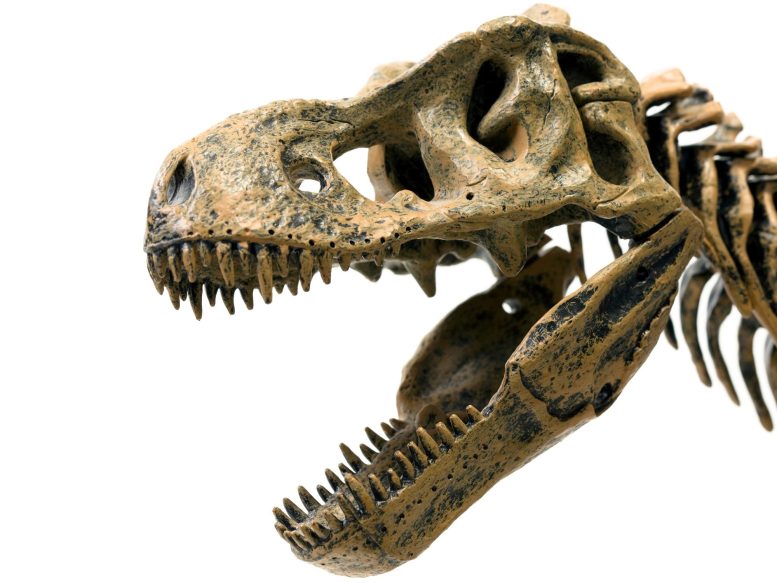
Theropod dinosaurs evolved more robust jaws through time allowing them to consume tougher food, a new study reveals.
Researchers used digital modeling and computer simulation to uncover a common trend of jaw strengthening in theropods — expanding the rear jaw portion in all groups, as well as evolving an upturned jaw in carnivores and a downturned jaw in herbivores.
Publishing their findings today (December 16, 2021) in the journal Current Biology, scientists revealed that biomechanical analysis showed these form changes made jaws mechanically more stable when biting — minimizing the chance of bone fracture.
The international team, led by scientists at the University of Birmingham, created digital models of more than 40 lower jaws from five different theropod dinosaur groups, including typical carnivores like Tyrannosaurus and Velociraptor, and lesser-known herbivores like ornithomimosaurs, therizinosaurs, and oviraptorosaurs.
A Feeding Spectrum
Fion Waisum Ma, PhD researcher at the University of Birmingham, who led the study, said: “Although theropod dinosaurs are always depicted as fearsome predators in popular culture, they are in fact very diverse in terms of diets. It is interesting to observe the jaws becoming structurally stronger over time, in both carnivores and herbivores. This gives them the capacity to exploit a wider range of food items.

“Theropod dinosaurs underwent extreme dietary changes during their evolutionary history of 165 million years. They started off as carnivores, later on evolved into more specialized carnivores, omnivores, and herbivores. Studying how their feeding mechanics changed is key to understanding the dietary transitions in other vertebrate animals, too.”
For example, in carnivores like tyrannosauroids, an early form like Guanlong had a relatively slender and straight jaw. But later forms such as Tarbosaurus and Tyrannosaurus evolved deeper jaws with the front portion bending upward, which increased jaw strength.
Having a strengthened jaw is especially important to herbivorous theropods, as their jaws experience considerable stress from repetitive plant cropping. Herbivores like Erlikosaurus and Caudipteryx have extremely downward-bending jaws that could help dissipate such stress.
Bone Remodeling as Nature’s Reinforcement Strategy
Dr. Stephan Lautenschlager, Senior Lecturer at the University of Birmingham and senior author of the study, said: “It is fascinating to see how theropod dinosaurs had evolved different strategies to increase jaw stability depending on their diet. This was achieved through bone remodeling — a mechanism where bone is deposited in regions of the jaw that experience high stresses during feeding.”
The researchers studied the feeding mechanics of tyrannosaurids through growth and observed that the deeper and more upturned jaws of adult theropods, such as Tyrannosaurus and Tarbosaurus, are structurally stronger compared to those of their juvenile forms.
Dr. Lautenschlager further explained: “The similarity between jaw strengthening through growth and through time suggests that developmental patterns in juvenile dinosaurs ultimately affected the evolution of the whole group. This likely facilitated the jaw evolution of theropod dinosaurs and their overall success for over 150 million years.”
Reference: “Macroevolutionary trends in theropod dinosaur feeding mechanics” by Waisum Ma, Michael Pittman, Richard J. Butler and Stephan Lautenschlager, 16 December 2021, Current Biology.
DOI: 10.1016/j.cub.2021.11.060
Never miss a breakthrough: Join the SciTechDaily newsletter.
Follow us on Google and Google News.
2 Comments
The point is right this show dinosaur is a gator no dinosaur have a powerful bite as the gator they have fully secondary bony palate fuse to braincase 6 bone fuse to the braincase and it show dinosaur as primitive .advance dinosaur is a joke.they know dinosaur bite force is a step by step evolution the first dinosaur did not have a palate some have small palate some scientist not even call that palate because it’s so small. full palate is found in tyrannosaur t.rex spinosauridae gator mesoeucrocodylia the top dinosaur allso mammal . mammal type reptile did not have full palate that why mammal and gator won the war .no tetanuran 3 finger dinosaur eat plant only mesoeucrocodylia eat plant because they have full palate they replace plant eating dinosaur they have stronger bite force thy can threw like mammal mesoeucrocodylia is superior to dinosaur that why they are alive the gator.dinosaur serrated teeth have back up maniraptoran lack back up because they are birds not thecodont.ornithomimus ancestor did not have thecodont teeth it’s a bird.thecodont mean crocodilian teeth. Birds are not tetanuran that why they have slender skull not like tetanuran early dinosaur had bird like skull .protosuchus has tetanuran skull not bird like ,like tetanuran dinosaur that why protosuchus is a dinosaur .t.rex modern crocodilian have wider tetanuran skull because of powerful bite force and more hole in the skull like mammal.velociraptor slender skull because it’s a bird it’s ancestor was a flying bird strong wide skull ad weight it’s not good for flying .velociraptor is a flightless bird not a dinosaur.the ancestor oviraptor sapaornis had hypocleidum furcula a true bird .oviraptor was a flightless bird.the m.levator pterygoideus muscle is not found maniraptoran like modern birds it is found in dinosaur.gator can not have it because it’s eusuchian mesoeucrocodylia the palate is fuse to the braincase in lizard muscle is attach to parietal prootic in thecodont laterosphenoid in birds like velociraptor epipterygoid is reduce in modern bird they is no epipterygoid .some dinosaur like sauropod there is no epipterygoid that why attach to laterosphenoid bird hip dinosaur allso lack epipterygoid .m.protractor pterygoideus is reduce in velociraptor and maniraptoran ala basisphenoid is not found archaeopteryx troodon or modern birds in these advance birds.in lizard and dinosaur it’s big triangular on the basisphenoid in eusuchian mesoeucrocodylia because palate is fuse to braincase it is move to laterosphenoid it’s move in modern birds maniraptoran bird too to parabasispheniod and reduce .there is no match with birds and dinosaur any part of the body but gator it is a match with dinosaur. m.levator pterygoideus move in dinosaur poor kinetic skull poor kinesis it’s gone in velociraptor modern bird because good kinesis upper jaw muscle.gator skull is full akinetic future of eusuchian .teleosaurus thalattosuchus the whale mesoeucrocodylia or protowhale they do not have 6 bone fuse to braincase like spinosauridae mesoeucrocodylia allso have prearticular bone a primitive feature rest of mesoeucrocodylia lack this bone .modern crocodilian lack epipterygoid prearticular this show they were allways was advance the most advance dinosaur ever.full palate gator mammal lead to a diverse animal change to the skull t.rex Chinese long snout tyrannosaur was like the gator .teleosaurus lack of 6 bones fuse to braincase hard to kill prey it’s not a problem long snout have bigger palate so spinosauridae skull is more powerful than gator Nile crocodile these crocodilian snout have scientific name the problem is if teleosaurus try to have short skull it become weak than the gator that why modern crocodilian are so successful.
Future eusuchian feature eusuchian.small crocodilian are pess probaly help reduce dinosaur numbers and gator Nile crocodile numbers.