

Astronomers confirmed Proxima d, a Mars-sized exoplanet, around Proxima Centauri. It’s one of the lightest exoplanets found, orbiting in just five days.
In August of 2016, astronomers with the European Southern Observatory (ESO) announced that they had discovered an exoplanet orbiting in neighboring Proxima Centauri. Based on Radial Velocity measurements (aka. Doppler Photometry), the discovery team estimated that the planet was roughly the same size and mass as Earth and orbited with Proxima Centauri’s Circumsolar Habitable Zone (HZ). In 2020, this planet was confirmed by follow-up observations.
In that same year, a second exoplanet (Proxima c) roughly seven times the mass of Earth (a Super-Earth or mini-Neptune) was confirmed. As if that wasn’t enough, an international team of astronomers with the ESO recently announced that they detected a third exoplanet around Proxima Centauri – Proxima d! This Mars-sized planet orbits about halfway between its host star and Proxima b and is one of the lightest exoplanets ever discovered.
The research team responsible for this discovery includes astrophysicists from the National Institute for Astrophysics (INAF), the Instituto de Astrofísica de Canarias (IAC), the Consejo Superior de Investigaciones Científicas (CSIC), the Institute of Astrophysics and Space Sciences (IACE), and multiple universities and research institutes in Spain, Portugal, Switzerland, Italy, Canada, and Chile. The paper that describes their findings was published in the February 10th issue of the journal Astronomy & Astrophysics.
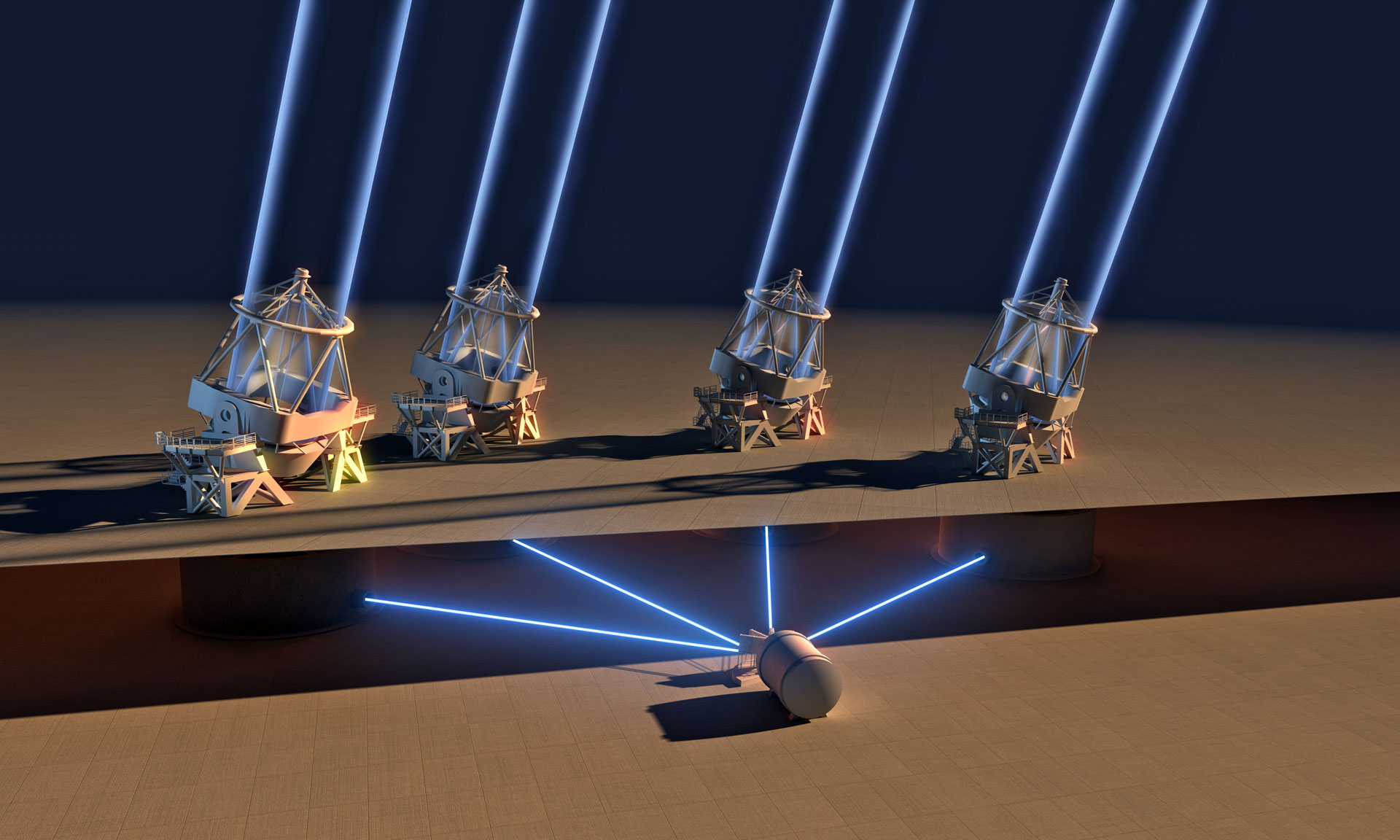
According to the discovery team, Proxima d’s existence was first hinted at in 2020 when astronomers conducted follow-up observations of Proxima Centauri using a new instrument on the ESO’s Very Large Telescope (VLT) – the SPectrograph for Rocky Exoplanets and Stable Spectroscopic Observations (ESPRESSO). In addition to confirming the existence of Proxima b, astronomers spotted the first hints of a signal corresponding to an object with a five-day orbit.
Confirming the Presence of Proxima d
Since the signal was so weak, the team had to conduct follow-up observations with ESPRESSO to confirm that it was due to a planet. Similar to Proxima b and c, the planet was confirmed using the Radial Velocity Method, where slight changes in a star’s position indicate the possible presence of planets. As João Faria, a researcher at the Instituto de Astrofísica e Ciências do Espaço and the lead author on the paper, explained in a recent ESO press release:
“After obtaining new observations, we were able to confirm this signal as a new planet candidate. I was excited by the challenge of detecting such a small signal and, by doing so, discovering an exoplanet so close to Earth. This result clearly shows what ESPRESSO is capable of and makes me wonder about what it will be able to find in the future.”
According to their results, Proxima d has a minimum mass of 0.26 Earth masses (twice the mass of Mars), making it the lightest exoplanet ever measured using the Radial Velocity Method. Because Proxima b is so light, its gravitational influence is so small that it only causes Proxima Centauri to move back and forth at around 40 cm per second (1.44 km/h; 0.89 mph). They also confirmed that it orbits its star at a distance of about 0.029 AU – 4 million km; 2,485,485 mi – or less than a tenth of Mercury’s distance from the Sun.
The Proxima Centauri star system consists of three confirmed exoplanets, with orbital periods of five days (Proxima d), eleven days (Proxima b), and five years (Proxima c). As Pedro Figueira, an ESPRESSO instrument scientist at ESO in Chile, indicated:
“This achievement is extremely important. It shows that the radial velocity technique has the potential to unveil a population of light planets, like our own, that are expected to be the most abundant in our galaxy and that can potentially host life as we know it.“
Impact on Exoplanet Studies and Future Research
This discovery not only demonstrates the way exoplanet studies have grown by leaps and bounds in recent years. It has also made Proxima Centauri even more appealing to astronomers. With three exoplanets (in six years) discovered around this closest stellar neighbor, the research potential is immeasurable. These activities will benefit tremendously from the James Webb Space Telescope (JWST), which will start gathering light.
In addition, exoplanet surveys using the ESPRESSO instrument will benefit from the Extremely Large Telescope (ELT), which is scheduled to become operational by 2027. Between its 39.3 m (130 ft) primary mirror, 4.2 m (14 ft) secondary mirror, and an advanced suite of instruments – which includes a spectrograph, coronograph, and adaptative optics (AOs) – the ELT will play a vital role in expanding the exoplanet census.
Adapted from an article originally published on Universe Today.
For more on this discovery, see New Planet Detected Nearby – Orbiting Around Star Closest to the Sun.
Never miss a breakthrough: Join the SciTechDaily newsletter.
Follow us on Google and Google News.