
Researchers found Atlantic cod and squid far north in the Arctic Ocean, expanding the region’s known food web. Despite this discovery, the Central Arctic lacks harvestable fish stocks, and an international agreement bans commercial fishing for at least 16 years.
Single Atlantic cod and squid can be found far further north than previously thought. In the midst of the Arctic Ocean, in deep water, scientists taking part in the multinational MOSAiC mission aboard the research icebreaker Polarstern have discovered fish and squid. The findings from Stockholm University, the Alfred Wegener Institute, and other members of the European Fisheries Inventory in the Central Arctic Ocean (EFICA) Consortium were published in the scientific journal Science Advances today (February 18, 2022).
Small fish occur at very low abundances in the 200-600 m (660-2,000 ft) deep Atlantic water layer of the Amundsen Basin as shown by the unique hydroacoustic dataset collected by the EFICA Consortium that showed a “deep scattering layer” (DSL) consisting of zooplanktion and fish along a 3,170 km (1,970 mi) long track of the MOSAiC expedition.
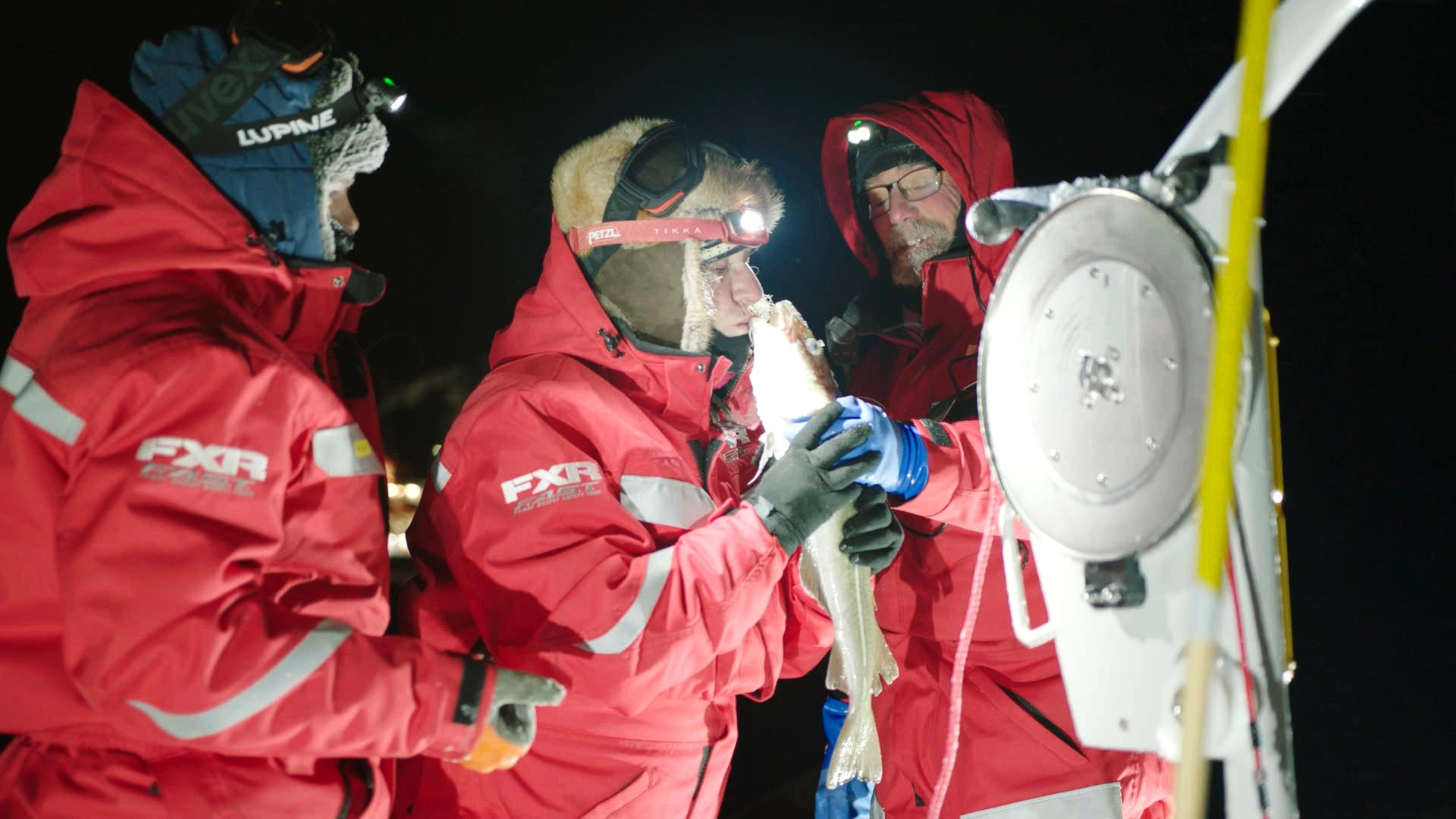
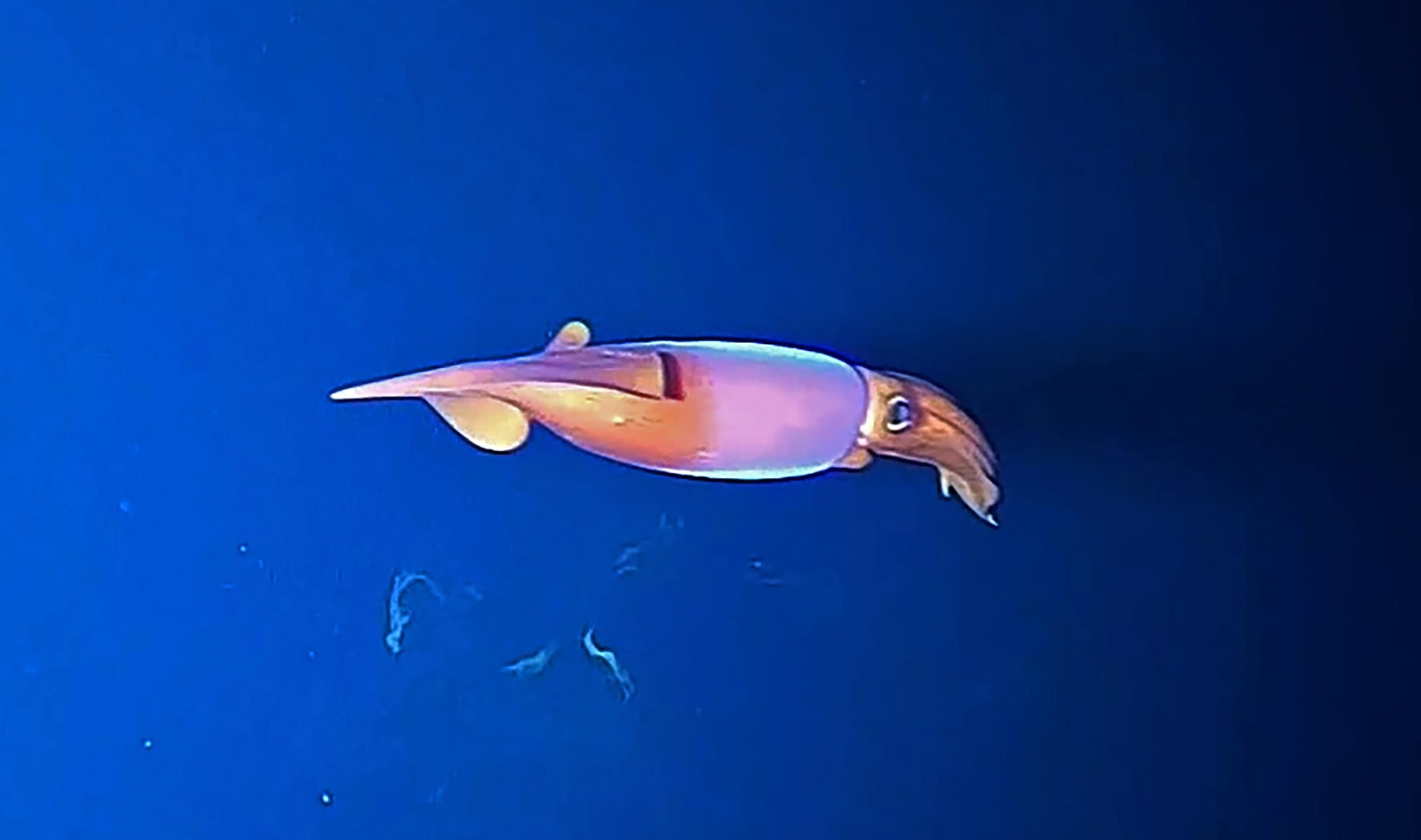
It was a surprise when four large fish were captured at 350–400 meters (1,150-1,300 feet). Three of the fish were Atlantic cod, a predatory, coastal species that shouldn’t exist this far north or in a four-kilometer-deep (2.5-mile-deep) ocean basin 500 kilometers (310 miles) from the shore. Scientists also used a deep-sea camera to find Atlantic armhook squid and Atlantic lanternfish far further north than previously believed.
The Atlantic cod originated from Norwegian spawning grounds, and had lived in Arctic water temperatures (-1 to 2 oC or 30 to 36 oF) for up to six years laboratory analyses showed. The fish preferred the Atlantic water layer, a slightly warmer water mass (0-2 oC or 32-36 oF) that reaches far into the Arctic basin in between the surface and deeper water layers which are below 0 oC.
“So, even if the Atlantic cod does not have its own central Arctic stock, this research shows that it can survive. A small number of individuals seem to find enough food to stay healthy for a longer time,” says Pauline Snoeijs Leijonmalm, coordinator of the EFICA Consortium and professor in marine ecology at Stockholm University.
New Insights in the Functioning of the Pelagic Food Web
The study thus adds a new trophic level to the pelagic food web of the central Arctic ecosystem – that of large predatory fish and squid. Together with the smaller fishes in the DSL, continuous immigration of larger Atlantic fish contributes to potential food for mammals since seals and walrus can dive down to the Atlantic water layer.
“The availability of small and even some larger fish in the Atlantic water layer could explain why seals, walrus, and polar bear can be found even at the North Pole. Both fish and mammals are very few, but they are there,” says biologist Dr. Hauke Flores, Alfred Wegener Institute.
The new study also found that diel vertical migration of the DSL is absent during the polar night, half a year of continuous darkness (DSL at 100-250 m or 330-820 ft), and the polar day, half a year of continuous light (DSL at 300-500 m or 980-1,640 ft). This implies that the carbon flux from shallower to deeper water through daily vertical migration of the DSL is hampered in the Central Arctic Ocean compared to all other oceans.
“During the short productive season of the polar day the DSL will remain in the deeper part of the Atlantic water layer 24 hours per day, even when the sea ice disappears, because this process is regulated by the availability of light,” says Pauline Snoeijs Leijonmalm.
No Harvestable Fish Stocks
Based on their scientific results, the authors of the new paper in Science Advances conclude that – at least in the Eurasian Basin – there are no harvestable fish stocks today or in the near future.
“This was expected because the Central Arctic Ocean has very low nutrient concentrations and very low biological productivity. Even if more Atlantic fish and their prey would be advected with the water inflow from the Atlantic Ocean, the capacity of the Central Arctic Ocean ecosystem to support larger fish stocks is without doubt rather limited,” says Pauline Snoeijs Leijonmalm.
Pauline Snoeijs Leijonmalm stresses that it is of great importance that this fragile but fully functional ecosystem will receive robust international protection similar to Antarctica.
International Agreement Prevents Commercial Fishing
The Arctic suffers more from global warming than the rest of the world, and according to climate predictions, it won’t be long until non-ice-breaking ships can access the Central Arctic Ocean. Political debates on national and international levels surround potential future human activity in this region since the majority of it is high seas, which are international waters outside of national authorities.
“Usually, exploitation of newly accessible natural resources tends to precede scientific research and management measures, and internationally shared fish stocks in high seas are especially prone to overexploitation”, says Pauline Snoeijs Leijonmalm.
Taking a precautionary approach, Canada, China, Greenland (Kingdom of Denmark), Iceland, Japan, Norway, Russia, South-Korea, the USA and the European Union negotiated the Agreement to Prevent Unregulated High Seas Fisheries in the Central Arctic Ocean (CAO) that entered into force on 25 June 2021. The ten partners of the Agreement will soon be launching a large Joint Scientific Research and Monitoring Program to collect new fish and ecosystem data in the Central Arctic Ocean. The EU has already started this work by financing the EFICA Consortium’s ecosystem research on the MOSAiC expedition (2019-2020), and the Synoptic Arctic Survey expedition with the Swedish icebreaker Oden (2021). The new paper in Science Advances is the first scientific paper presenting new field data in the context of the agreement.
“This agreement prevents any commercial fishing for at least 16 years to come, and puts “science first”, warranting scientific assessments of the status and distribution of possible fish stocks in the Central Arctic Ocean and the ecosystem supporting them – a wise political decision and a good start towards full protection”, says Pauline Snoeijs Leijonmalm.
Reference: “Unexpected fish and squid in the central Arctic deep scattering layer” by Pauline Snoeijs-Leijonmalm, Hauke Flores, Serdar Sakinan, Nicole Hildebrandt, Anders Svenson, Giulia Castellani, Kim Vane, Felix C. Mark, Céline Heuzé, Sandra Tippenhauer, Barbara Niehoff, Joakim Hjelm, Jonas Hentati Sundberg, Fokje L. Schaafsma, Ronny Engelmann and The EFICA-MOSAiC Team, 18 February 2022, Science Advances.
DOI: 10.1126/sciadv.abj7536
Never miss a breakthrough: Join the SciTechDaily newsletter.
Follow us on Google and Google News.
1 Comment
My nightmare is that every bird will be banded, and every land and sea creature will have a radio transmitter collar, and every endangered fish will be captured for study, then kept in glass jars fixed with formaldehyde in museum basements.
Maybe the rare fish you caught were the last ones?