
Close Menu
    Facebook X (Twitter) Instagram
    SciTechDaily
    • Biology
    • Chemistry
    • Earth
    • Health
    • Physics
    • Science
    • Space
    • Technology
    Facebook X (Twitter) Pinterest YouTube RSS
    SciTechDaily
    Home»Earth»Plans to Protect Antarctic Sea Faces Difficult Challenges
    Earth

    Plans to Protect Antarctic Sea Faces Difficult Challenges

    By SciTechDailyOctober 17, 20121 Comment2 Mins Read
    Facebook Twitter Pinterest Telegram LinkedIn WhatsApp Email Reddit
    Share
    Facebook Twitter LinkedIn Pinterest Telegram Email Reddit
    weddell-seal-antarctic-toothfish
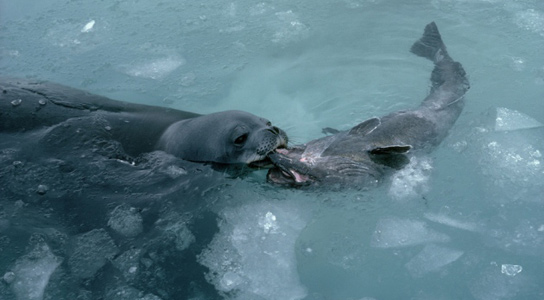
    A Weddell seal holds an Antarctic toothfish, one of the lucrative fish found in the Antarctic’s waters. Credit: K. Westerskov / Alamy

    The seas surrounding Antarctica are among the world’s most pristine, but fishing vessels are set to move in. Next week, there is a meeting of the Commission for the Conservation of Antarctic Marine Living Resources (CCAMLR) that may try to contain the rush to access the region’s natural resources.

    There are currently four proposals to create vast marine protected areas (MPAs) that would tightly regulate fishing activities in the region. However, protection will require a unanimous agreement by CCAMLR’s members, which includes 24 countries and the EU. Some, like Japan and China, have recorded skepticism about any kind of Antarctic MPA. If the proposals are blocked, it would set back the conservation effort by more than a decade, states Alex Rogers, a conservation biologist at the University of Oxford, UK.
    proposals-of-antarctic-seas-regions
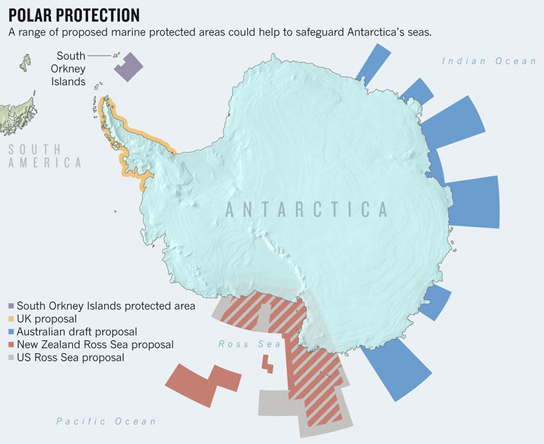
    Proposed protection zones of Antarctic waters.

    There is only one large section of Antarctic waters that is currently designated as an MPA. It’s a zone of 94,000 square kilometers near the South Orkney Islands. The USA and New Zealand are advancing two rival proposals to turn Antarctica’s Ross Sea, which is home to seals, whales, fish, penguins, and other wildlife, into one of the world’s largest reserves.

    Commercial fishing in the Ross Sea is lucrative, especially for the Antarctic toothfish (Dissostichus mawsoni). The US proposal would ensure the protection of 1.8 million square kilometers (700,000 square miles), with 800,000 (301,000 square miles) of those completely off-limits to any kind of fishing. The New Zealand proposal would cover some 2.5 million square kilometers (965,000 square miles), with fishing allowed in some areas. They tried to bring forth a joint proposal but couldn’t reach an agreement.

    A UK-led effort is seeking protection for areas exposed by collapsing ice shelves around the Antarctic Peninsula, which can quickly become populated by animals, making them attractive to fishing fleets. If these areas are protected, it would allow scientists to study how the marine ecosystem changes after the collapse of the ice. The fourth proposal is by Australia, which would create a network of reserves around eastern Antarctica. All of these proposals are scientifically sound, but success is far from assured.

    Never miss a breakthrough: Join the SciTechDaily newsletter.
    Follow us on Google and Google News.

    Antarctica Conservation Environment Fish Oceanography Wildlife
    Share. Facebook Twitter Pinterest LinkedIn Email Reddit

    Related Articles

    “Important and Unexpected Finding” – Formation of the West Antarctic Ice Sheet Was Very Different Than Previously Believed

    “Nuclear Niño” – Nuclear War Could Trigger Big El Niño and Decrease Seafood

    Intense Atmospheric Rivers Help Create Massive Holes in Antarctic Sea Ice

    Ocean Health Index, a Comprehensive Assessment of the Ocean and Its Ecosystems

    Many Nature Reserves Struggling to Sustain Their Original Biodiversity

    Tropical Oceans Role in Climate Change

    Southern Ocean Research Shows Decrease in Dense Antarctic Bottom Water

    Antarctic Ecosystems Threatened by Invasive Alien Species and Climate Change

    New Research Shows Southern Ocean as a Powerful Influence on Climate Change

    1 Comment

    1. raymond.jolliffe. on July 10, 2022 4:02 pm

      i.am.not.a.spammer.why.donot.un.place.a.total.ban.on.any.fishing.around.the.whole.of.the
      antartic.if.anyone.is.caught.take.their.whole.catch.and.sink.their.vessel.also.fine.the.
      company.1.million.dollars.with.no.court.cases.end.of.story.maybe.then.these.greedy.companies
      would.think.about.our.offspring.to.come.not.like.the.super.yatchs.group.that.only.want.to.
      feel.there.back.pockets.with.gold.

      Reply
    Leave A Reply Cancel Reply

    • Facebook
    • Twitter
    • Pinterest
    • YouTube

    Don't Miss a Discovery

    Subscribe for the Latest in Science & Tech!

    Trending News

    Scientists Say This Hellish “Day-Night” Planet May Support Life

    Historians Got It Wrong: New Findings Rewrite the Story of the Battle of Hastings

    Scientists Just Broke the Solar Power Limit Everyone Thought Was Absolute

    Scientists Discover Protein That Turns Brown Fat Into a Calorie-Burning Machine

    Scientists Call for a Complete Rethink of Alzheimer’s Treatment

    Scientists Identify Molecular Switch That Lets Exercise Reverse Muscle Aging

    Why Your Most Vivid Dreams Might Be the Key to Deep, Restful Sleep

    A Bright Star Hid a Massive Secret for 50 Years: Mystery of Gamma Cassiopeiae Finally Solved

    Follow SciTechDaily
    • Facebook
    • Twitter
    • YouTube
    • Pinterest
    • Newsletter
    • RSS
    SciTech News
    • Biology News
    • Chemistry News
    • Earth News
    • Health News
    • Physics News
    • Science News
    • Space News
    • Technology News
    Recent Posts
    • New Carbon Nanotube Coating Could Supercharge 6G Technology
    • Scientists Smash Superconductivity Record at Normal Pressure
    • 100x Less Power: The Breakthrough That Could Solve AI’s Massive Energy Crisis
    • Simple Brain Training Cuts Dementia Risk Decades Later, Study Finds
    • A Simple Injection Could Help the Heart Heal Itself After a Heart Attack
    Copyright © 1998 - 2026 SciTechDaily. All Rights Reserved.
    • Science News
    • About
    • Contact
    • Editorial Board
    • Privacy Policy
    • Terms of Use

    Type above and press Enter to search. Press Esc to cancel.