
Close Menu
    Facebook X (Twitter) Instagram
    SciTechDaily
    • Biology
    • Chemistry
    • Earth
    • Health
    • Physics
    • Science
    • Space
    • Technology
    Facebook X (Twitter) Pinterest YouTube RSS
    SciTechDaily
    Home»Space»NASA’s Ambitious Odyssey: Europa Clipper Mission Advances With Solar Array Deployment
    Space

    NASA’s Ambitious Odyssey: Europa Clipper Mission Advances With Solar Array Deployment

    By NASAMarch 13, 2024No Comments3 Mins Read
    Facebook Twitter Pinterest Telegram LinkedIn WhatsApp Email Reddit
    Share
    Facebook Twitter LinkedIn Pinterest Telegram Email Reddit
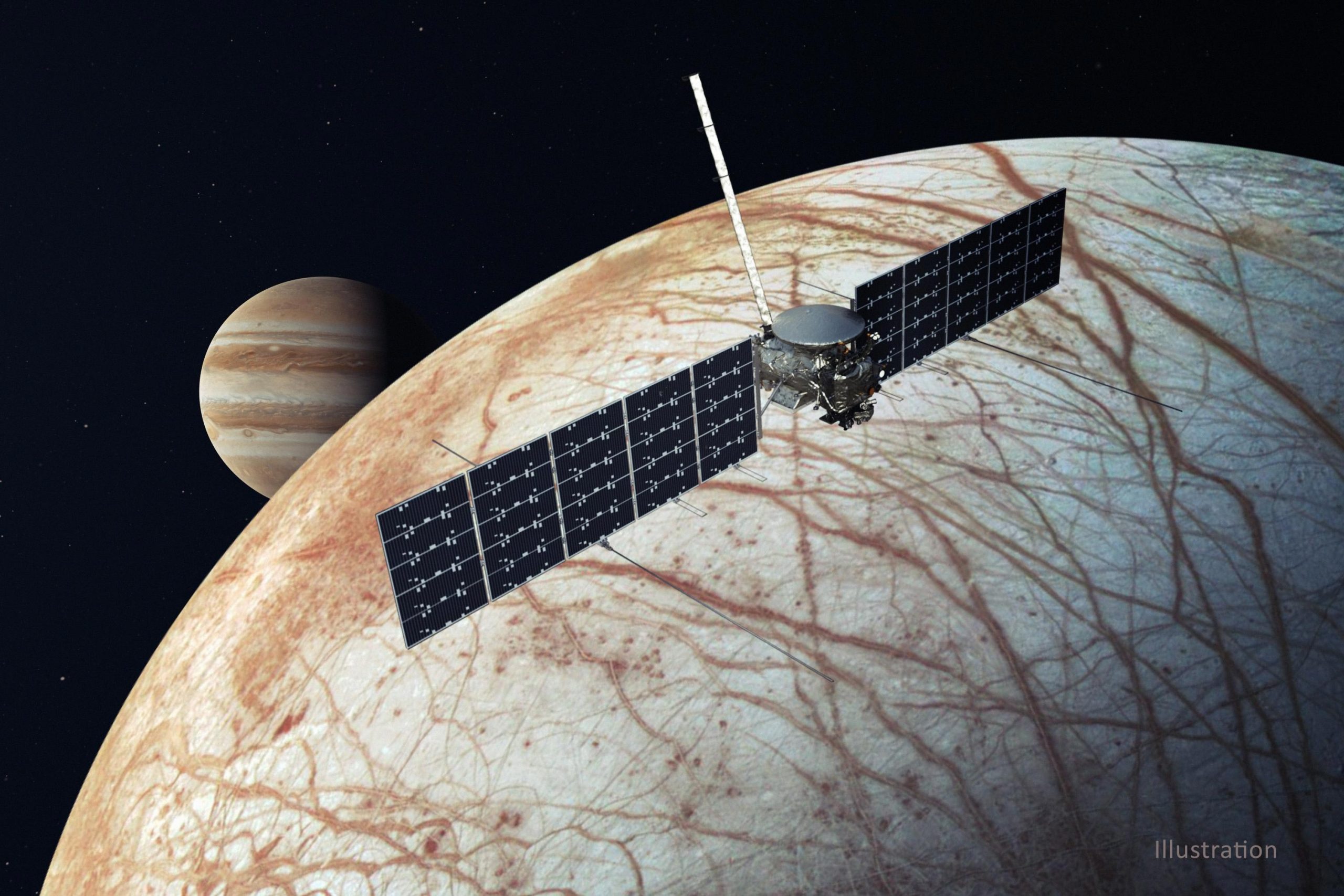
    Europa Clipper Spacecraft Illustration
    NASA’s Europa Clipper, depicted in this illustration that was updated in December 2020, will swoop around Jupiter on an elliptical path, dipping close to its moon Europa on each flyby to collect data. Credit: NASA/JPL-Caltech

    NASA’s Europa Clipper mission is advancing with the processing of large solar arrays at Kennedy Space Center, essential for powering the spacecraft to study Europa, one of the most promising habitable moons in our solar system. The spacecraft, being the largest ever for a planetary mission, will launch aboard a SpaceX Falcon Heavy rocket.

    Processing of the large solar arrays built for NASA’s Europa Clipper is now underway inside the Payload Hazardous Servicing Facility at the agency’s Kennedy Space Center in Florida.

    Planned to arrive at Jupiter in April 2030, the spacecraft will study Jupiter’s moon Europa, which shows strong evidence beneath its icy crust of a global ocean over twice the volume of all Earth’s oceans. Europa is currently considered one of the most promising habitable environments in our solar system.
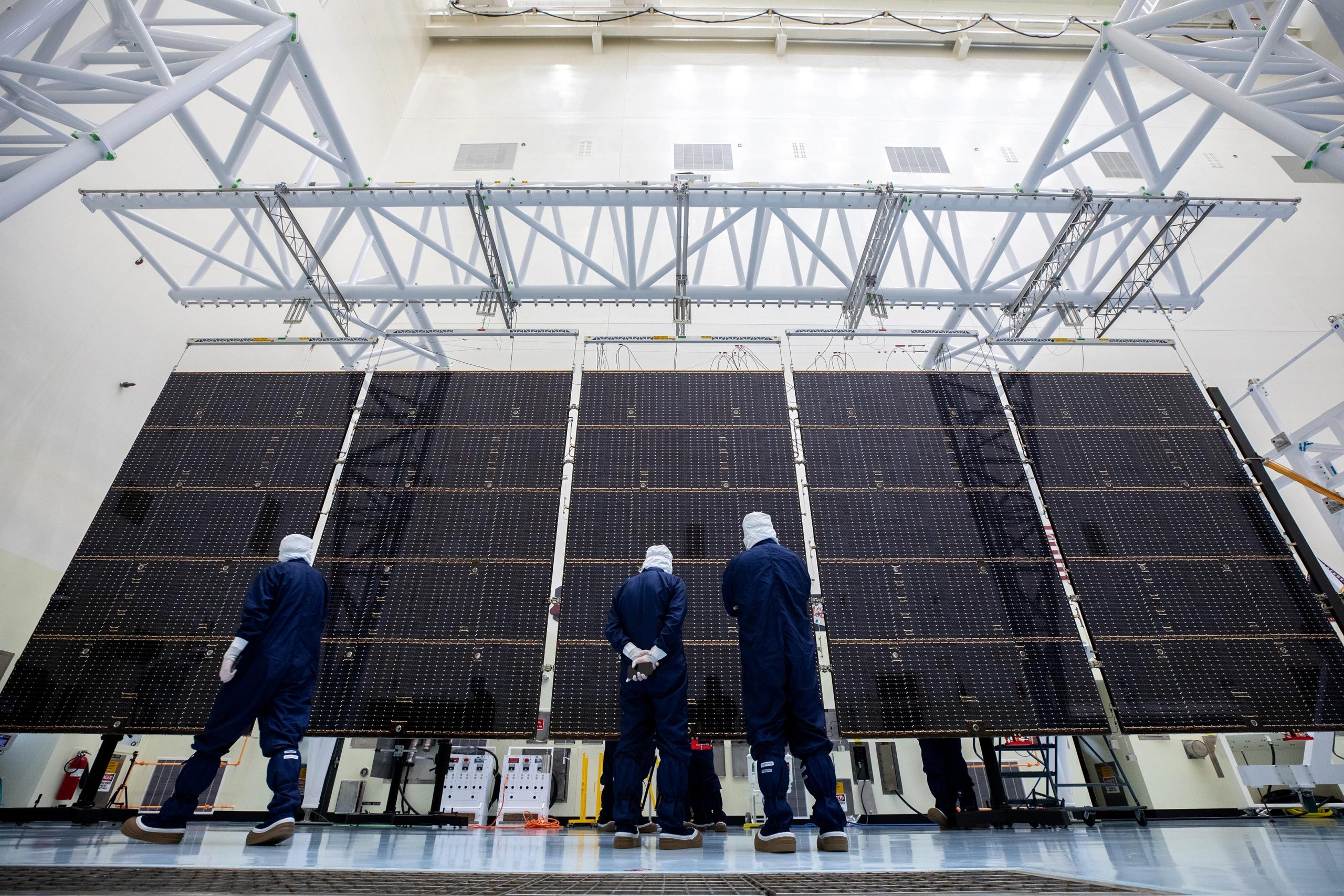
    Technicians Examine Solar Arrays Built for NASA’s Europa Clipper
    Technicians examine the first of two fully extended five-panel solar arrays built for NASA’s Europa Clipper suspended on a support system called a gravity offload fixture during inspection and cleaning as part of assembly, test, and launch operations inside the Payload Hazardous Servicing Facility at the agency’s Kennedy Space Center in Florida on Wednesday, March 6, 2024. Credit: NASA/Ben Smegelsky

    Assembly and Preparation

    Once processing of the first five-panel solar array is complete, technicians will remove it from the gravity offload fixture, which helps support the weight of the array. The same steps will then be repeated with the second solar array. Built by Airbus in Leiden, Netherlands, the arrays arrived at Kennedy late last month by truck, after traveling to the U.S. by air.

    When both solar arrays are installed and deployed on Europa Clipper – the agency’s largest spacecraft ever developed for a planetary mission – the spacecraft will span a total length of more than 100 feet and weigh 7,145 pounds without the inclusion of propellants. The spacecraft needs the large solar arrays to collect enough light to power it as it operates in the Jupiter system, which is more than five times as far from the Sun as Earth.
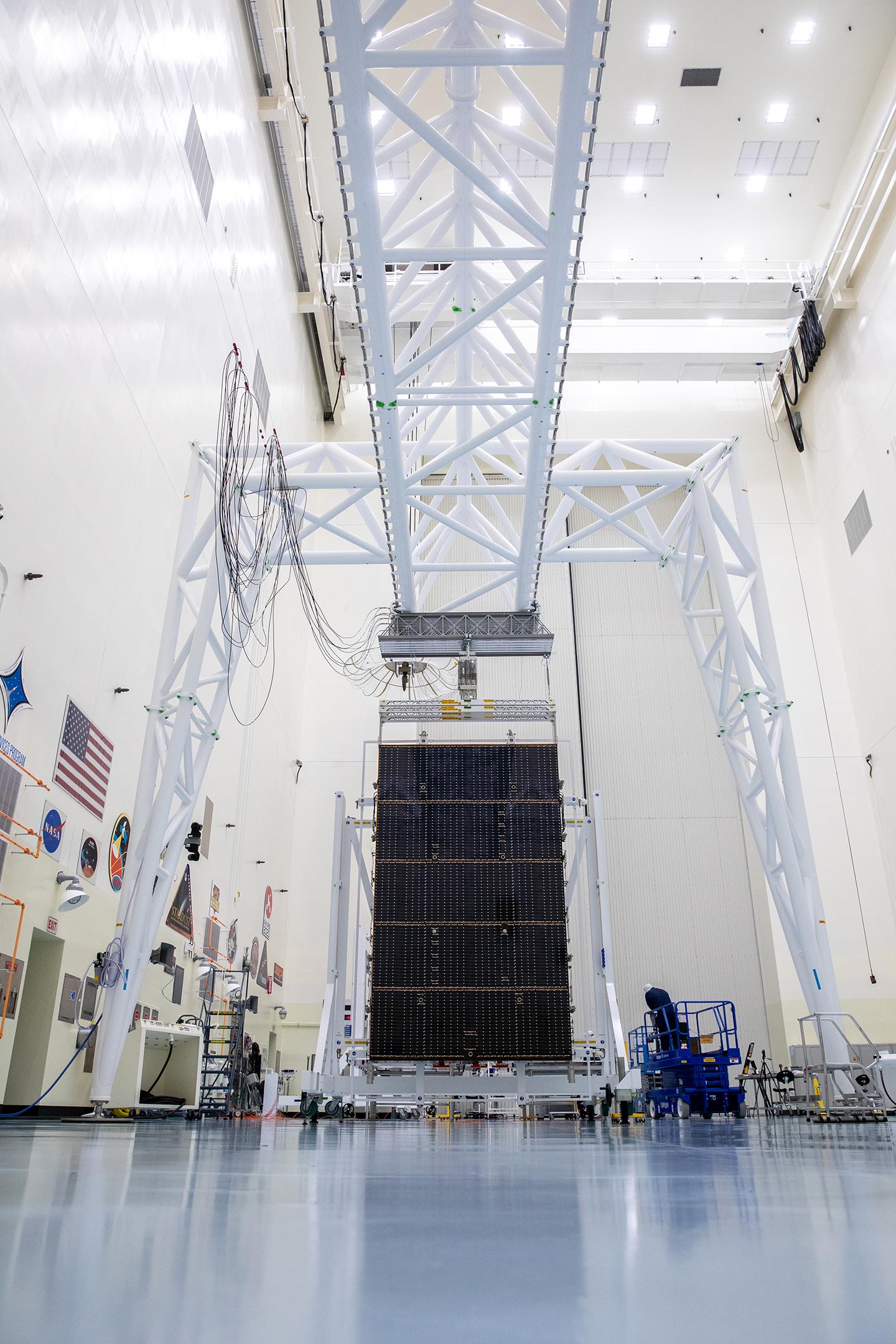
    NASA Europa Clipper Solar Arrays Stand Inside the Payload Hazardous Servicing Facility
    The first of two five-panel solar arrays built for NASA’s Europa Clipper stands inside the Payload Hazardous Servicing Facility at the agency’s Kennedy Space Center in Florida in preparation for inspection and cleaning as part of assembly, test, and launch operations on Wednesday, March 6, 2024. Credit: NASA/Ben Smegelsky

    Europa Clipper’s Journey Ahead

    Europa Clipper is being assembled at NASA’s Jet Propulsion Laboratory in Southern California and is managed in partnership with Johns Hopkins University Applied Physics Laboratory in Laurel, Maryland. The spacecraft will ship to Florida later this year for launch aboard a SpaceX Falcon Heavy rocket from Kennedy’s Launch Complex 39A. NASA’s Launch Services Program, based at Kennedy, is managing the launch service.

    Never miss a breakthrough: Join the SciTechDaily newsletter.
    Follow us on Google and Google News.

    Europa Clipper Kennedy Space Center NASA
    Share. Facebook Twitter Pinterest LinkedIn Email Reddit

    Related Articles

    NASA’s Largest Planetary Spacecraft Ever: Europa Clipper Blasts Off on a Historic Journey

    Hurricane Milton Grounds NASA’s Historic Europa Clipper Mission to Jupiter’s Moon

    NASA’s Europa Clipper Spacecraft Transported to SpaceX Hangar at Kennedy Space Center

    Watch Live: NASA’s Europa Clipper Launching to Jupiter’s Icy Moon on SpaceX Falcon Heavy

    Exploring Jupiter’s Icy Moon: NASA’s Europa Clipper Prepares for Launch

    Orion Spacecraft Returns to Kennedy Space Center for Final Preparations Before Artemis I Launch

    NASA Mission to Jupiter’s Icy Moon Confirmed

    Microgravity Mimics Aging in Immune Cells

    Construction Begins on Space Shuttle Atlantis Exhibit at Kennedy Space Center Visitor Complex

    Leave A Reply Cancel Reply

    • Facebook
    • Twitter
    • Pinterest
    • YouTube

    Don't Miss a Discovery

    Subscribe for the Latest in Science & Tech!

    Trending News

    Popular Sugar-Free Sweetener Linked to Liver Disease, Study Warns

    What Is Hantavirus? The Deadly Disease Raising Alarm Worldwide

    Scientists Just Discovered How the Universe Builds Monster Black Holes

    Scientists Unveil New Treatment Strategy That Could Outsmart Cancer

    A Simple Vitamin May Hold the Key to Treating Rare Genetic Diseases

    Scientists Think the Real Fountain of Youth May Be Hiding in Your Gut

    Ravens Don’t Follow Wolves, They Predict Them

    This Common Knee Surgery May Be Doing More Harm Than Good

    Follow SciTechDaily
    • Facebook
    • Twitter
    • YouTube
    • Pinterest
    • Newsletter
    • RSS
    SciTech News
    • Biology News
    • Chemistry News
    • Earth News
    • Health News
    • Physics News
    • Science News
    • Space News
    • Technology News
    Recent Posts
    • Why Are So Many New Fathers Dying? Scientists Say the U.S. Has a Dangerous Blind Spot
    • Scientists Identify Simple Supplement That Greatly Reduces Alzheimer’s Damage
    • You May Have a Dangerous Type of Cholesterol Even if Your Tests Look Normal
    • Study Reveals Dangerous Flaw in AI Symptom Checkers
    • New MRI Breakthrough Captures Stunningly Clear Images of the Eye and Brain
    Copyright © 1998 - 2026 SciTechDaily. All Rights Reserved.
    • Science News
    • About
    • Contact
    • Editorial Board
    • Privacy Policy
    • Terms of Use

    Type above and press Enter to search. Press Esc to cancel.