
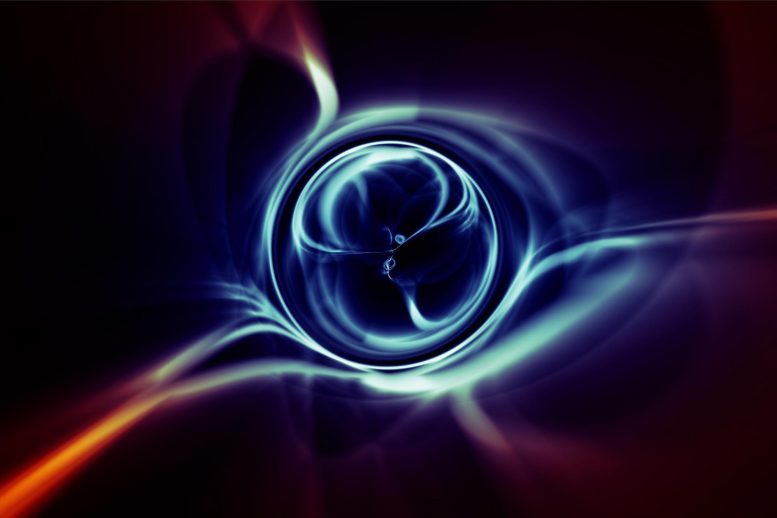
Brookhaven scientists suggest that ultralight dark matter may explain the rapid formation of supermassive black holes in the early universe. Their model predicts that this unique dark matter could have collapsed under gravitational forces shortly after the Big Bang, leaving detectable gravitational waves.
There are a lot of amazing things in our Universe and a black hole is one of the most unknown. We don’t know for certain what happens inside a black hole and even the formation of supermassive black holes in the early universe is still being worked out. A group of physicists at Brookhaven National Laboratory have tackled this question and have come up with a possible solution to the mystery. The nature of dark matter may be resolved by their theory as well.
“The yet unanswered question of the nature of Dark Matter, and how primordial supermassive Black Holes could grow so fast in such a short amount of time are two pressing open questions in physics and astrophysics. Finding a common explanation for these observations is desirable and could provide us with insights into the inner workings of the Universe.”
Julia Gehrlein, Physicist at Brookhaven National Laboratory
Observations have shown that supermassive black holes may have formed in the early universe. According to our current understanding of how black holes form, there would not have been enough time for that to happen. Neither accretion (when matter falls into a black hole) nor galactic collisions can account for primordial supermassive black holes.
Ultralight Dark Matter and Its Galactic Evidence
Theoretical physicists Hooman Davoudiasl, Peter Denton, and Julia Gehrlein developed a model that describes one possible solution using the idea of dark matter as being ultralight, with a mass that is 28 orders of magnitude lighter than the proton but possibly spanning light years per particle. “In our case we noticed that [ultrafaint dwarf galaxies] are showing some preliminary hints that dark matter may be ultralight” says Peter Denton. There is some evidence that the dark matter distribution of these galaxies is not sharp towards the center, as might be expected. Ultralight dark matter would be an explanation for this. “If the breadth of the dark matter distribution is comparable in all galaxies, then that could indicate that dark matter has a characteristic size and is ultralight.”
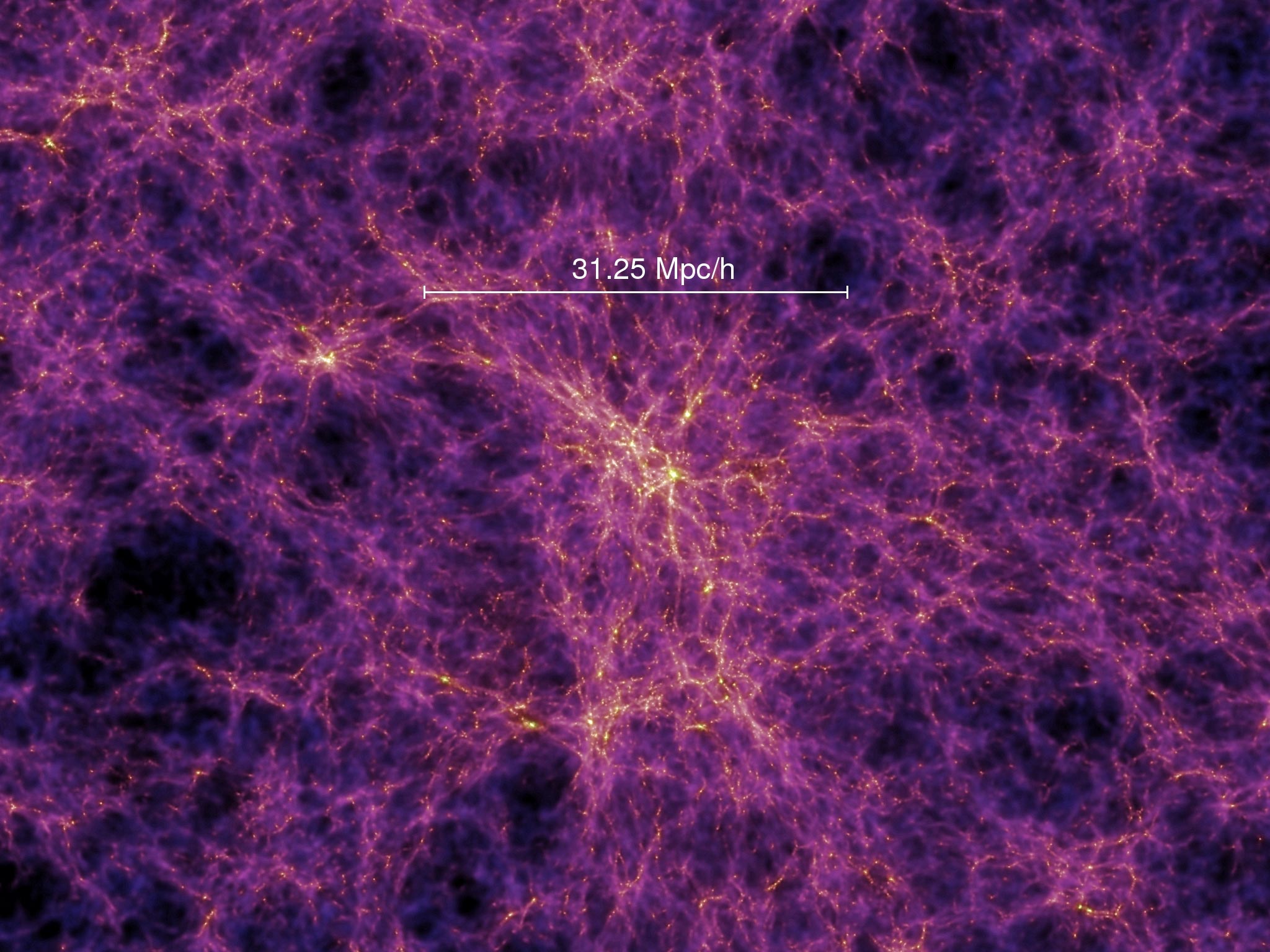
If dark matter is ultralight, then that could be the key to explain the formation of primordial supermassive black holes. The conditions needed for matter to collapse and form a black hole of supermassive size were just right “a few days after the Big Bang when the Universe had a temperature close to that of the Sun’s core,” according to Hooman Davoudiasl. This would be 15 million Kelvins, or 27 million degrees Fahrenheit. These temperatures would be needed for this particular type of matter to exist. Once the temperature of the Universe reached the right level, the pressure could have dropped to a very low level, allowing matter to collapse due to gravity. This would not happen with known particles, thus the idea of ultralight dark matter.
This collapsing of matter would cause gravitational waves. “Those waves have a characteristic shape, so we make a prediction for that signal and its expected frequency range,” says Peter Denton. When next-generation pulsar timing arrays that are more sensitive come online they may be able to detect those waves and provide validation for the theory that dark matter is or may have been ultralight. Scientists could then put together more pieces of the puzzle to get a clearer understanding of dark matter, black holes, and our awesome universe.
Adapted from an article originally published on Universe Today.
Never miss a breakthrough: Join the SciTechDaily newsletter.
Follow us on Google and Google News.
4 Comments
Another possibility, from a view of String Theory, is that Dark Matter appears to us as an effect of string/anti-string annihilations. As you may know, quantum mechanics requires that strings must be formed as pairs in the quantum foam – a string and an anti-string – that immediately annihilate each other. Quantum mechanics also requires both the string and anti-string to be surrounded by “jitters” that reduce their monstrous vibrating energies. What if this jitter remains for a fraction of an instant after their string/anti-string annihilations? This temporary jitter would be seen by us as matter, via E=mc2, for that instant before it too returns to the foam. That’s why we never see it – the “mass” lasts only for that instant but is repeated over and over and over, all over. Specifics on this can be found by searching YouTube for “Dark Matter – A String Theory Way”
The earliest super massive black holes has increased mass upto 1o folds.Dark matter has significant role in this increase.But comparing to milkyway,there is no significant change to be seen except of
a fraction; when SMBH mass is compared with the mass of galaxy.
The earliest super massive black holes has increased mass upto 1o folds.Dark matter has significant role in this increase.But comparing to milkyway,there is no significant change to be seen except of
a fraction; when SMBH mass is compared with the mass of galaxy.
But as galaxies are expanded,so the super massive black have increase to net 1000 times in a ratio with present time total mass of milky way standard galxy.Here we have deleted 10 fold from both SMBH host galaxy masses.Now,net feature of comparision comes as in early galaxy of milky way galaxy the super massive black hole is 1000 times small,that is,this has 4000 solar mass.
…