
Unprecedented Warming in Equatorial Pacific Ocean Could Last up to Seven Years
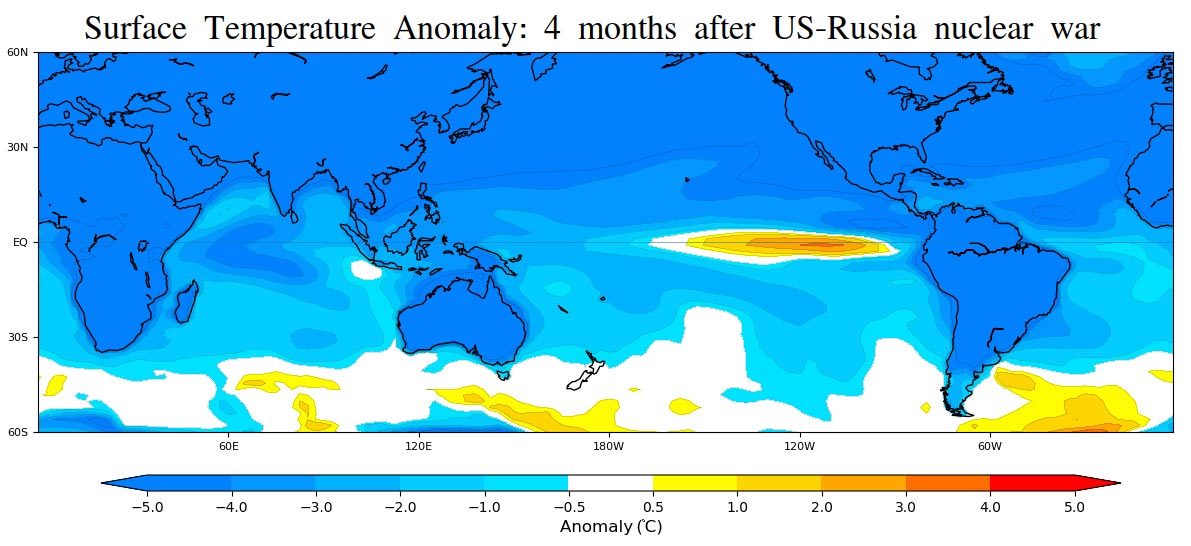
A nuclear war could trigger an unprecedented El Niño-like warming episode in the equatorial Pacific Ocean, slashing algal populations by 40 percent and likely lowering the fish catch, according to a Rutgers-led study.
The research, published in the journal Communications Earth & Environment, shows that turning to the oceans for food if land-based farming fails after a nuclear war is unlikely to be a successful strategy – at least in the equatorial Pacific.
“In our computer simulations, we see a 40 percent reduction in phytoplankton (algae) biomass in the equatorial Pacific, which would likely have downstream effects on larger marine organisms that people eat,” said lead author Joshua Coupe, a post-doctoral research associate in the Department of Environmental Sciences in the School of Environmental and Biological Sciences at Rutgers University–New Brunswick. “Previous research has shown that global cooling following a nuclear war could lead to crop failure on land, and our study shows we probably can’t rely on seafood to help feed people, at least in that area of the world.”
Scientists studied climate change in six nuclear war scenarios, focusing on the equatorial Pacific Ocean. The scenarios include a major conflict between the United States and Russia and five smaller wars between India and Pakistan. Such wars could ignite enormous fires that inject millions of tons of soot (black carbon) into the upper atmosphere, blocking sunlight and disrupting Earth’s climate.
Nuclear War Could Alter Global Weather Cycles
With an Earth system model to simulate the six scenarios, the scientists showed that a large-scale nuclear war could trigger an unprecedented El Niño-like event lasting up to seven years. The El Niño-Southern Oscillation is the largest naturally occurring phenomenon that affects Pacific Ocean circulation, alternating between warm El Niño and cold La Niña events and profoundly influencing marine productivity and fisheries.
During a “nuclear Niño,” scientists found that precipitation over the Maritime Continent (the area between the Indian and Pacific oceans and surrounding seas) and equatorial Africa would be shut down, largely because of a cooler climate.
Collapse of Marine Food Web
More importantly, a nuclear Niño would shut down upwelling of deeper, colder waters along the equator in the Pacific Ocean, reducing the upward movement of nutrients that phytoplankton – the base of the marine food web – need to survive. Moreover, the diminished sunlight after a nuclear war would drastically reduce photosynthesis, stressing and potentially killing many phytoplankton.
“Turning to the sea for food after a nuclear war that dramatically reduces crop production on land seems like it would be a good idea,” said co-author Alan Robock, a Distinguished Professor in the Department of Environmental Sciences at Rutgers–New Brunswick. “But that would not be a reliable source of the protein we need, and we must prevent nuclear conflict if we want to safeguard our food and Earth’s environment.”
Reference: “Nuclear Niño response observed in simulations of nuclear war scenarios” by Joshua Coupe, Samantha Stevenson, Nicole S. Lovenduski, Tyler Rohr, Cheryl S. Harrison, Alan Robock, Holly Olivarez, Charles G. Bardeen and Owen B. Toon, 22 January 2021, Communications Earth & Environment.
DOI: 10.1038/s43247-020-00088-1
Scientists at the University of California, Santa Barbara; University of Colorado, Boulder; Australian Antarctic Partnership Program; University of Texas, Rio Grande Valley; and National Center for Atmospheric Research contributed to the study.
Funding: Open Philanthropy Project, National Science Foundation, University of Colorado Boulder, Colorado State University
Never miss a breakthrough: Join the SciTechDaily newsletter.
Follow us on Google and Google News.
1 Comment
I think I would have bigger worries than fish if there was a nuclear war of any magnitude. I probably wouldn’t eat anything, especially fish, after a nuclear war, without scanning it for radiation first.